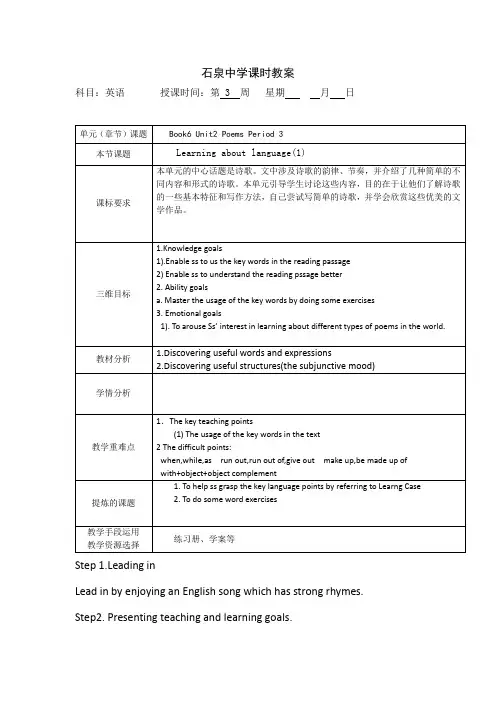
Unit Two PoemsIntroduction: This unit introduces the students to several simple forms of poems. It takes a look at some poetic devices like rhythm, rhyme, repetition, sound patterns and imagery. It includes poem forms that English speakers have adopted from other countries. The poem forms in this unit include ones that students can use as models to create their own poems.The styles of English poems:1. Narrative poems: Epic史诗, Dramatic poems戏剧诗, Metrical tale故事诗, Ballad 民谣;2. Didactic poems说理诗;3. Clerihews打油诗;4. Parody模仿诗;5. Lyric抒情诗英语打油诗歌的规则: 1. 一首诗包含四句2. 第一句和第二句押韵, 第三局和第四句押韵3. 第一句如以人名结尾, 第二句以和人名押韵的词结尾.Nursery rhymes (摇篮诗): They are the first poems that children will hear. They are often sung. Children love to move and dance to nursery rhymes and songs because they have strong regular rhythms. They enjoy the rhymes and the way the nursery rhyme plays with sounds.List poems: A list poem is a list of things. It can have as many lines as the writer likes. Sometimes they have repetition in them and sometimes they have words that rhyme. When a list poem has rhyming words, it also has a regular rhythm.Cinquain poems: A Cinquain is made up of five lines and has the following structure. Line one: a noun that names the subject of the poem. Line two: two adjectives that describe the subject. Line three: three verbs ending with –ing that describe the subject’s actions. Line four: four words that give the writer’s opinion or feelings about the subject. Line five: a word that gives another name for the subject.Haiku poems: The haiku is a centuries-old form of Japanese poetry. It is made up 17 syllables and has the following structure: line one: 5 syllables; line two: 7 syllables; line three: 5 syllables. A haiku poem is almost like a photo or painting as it creates a strong imagine in very few words. It is often an observation of nature or of the changing season. It is a good idea to collect observations of nature for haiku. For example, leaves blowing in the wind, bees buzzing around flowers, ducks swimming in a pond, snow piling up against a door.Tang poems: when translated into English, Tang poems have a free form (that is, without a regular rhythm) and do not rhyme. They have strong imagery and are often about the bringing together of opposites, for example, the small is contrasted with the large, and the temporary with the eternal.Songs: Poems are often put into music or are written to be sung. When a poem is to be sung, it is written with a strong rhythm, use rhyme, in simple language, and the theme is often an emotion, such as, love, anger or despair.Adverb poem: in this form of poem the students pick an adverb to start each line. The lines are in rhyming pairs, such as:Slowly the dog crosses the road.Slowly the old man carries his load.Important new words and expressions in this unit: transform, exchange, sponsor, concrete, flexible, appropriate, eventually, tick, convey, tease, rhyme(押韵), nursery,diamond, pattern, cottage, sparrow, minimum, translation, branch, sorrow, librarians, section, diploma, blank, compass, bride, bridegroom, championship, darkness, warmth, scholarship, pianist, violinist, load, contradictory, endless, salty, forever, take it easy, run out of, be made up of, try out, let out, in particular, be popular with, translate…..into…., stay up, be likely to do sth. look forward to, by chance, by accidentSentence patterns:List poems have a flexible line length and repeated phrases which give both a pattern and a rhythm to the poem. (the attributive clause)We would have won if Jack had scored that goal. (the subjunctive mood)Another simple form of poem that students can easily write is the Cinquain, a poem made up of five lines. (past participle as the attributive)When I was a baby, my mother used to read me nursery rhymes. (used to do sth.)With so many difficult forms of poetry to choose from, students may eventually want to write poems of their own. (with + object + objective complement)Function: intention and plansI’m (not) going to…….How are you going to…..?I plan to…..I’ll…..I’m looking forward to ……Grammar: the Subjunctive mood (2)If Rob hadn’t injured himself, we would have won.If she had studied harder, she would have got the diploma.Teaching important and difficult points of this unit:1. Get students t know about different types of poems, some poetic devices like rhythm, rhyme, repetition, sound patterns and imagery.2. Have students learn some useful new words and expressions about poetry and let them learn effective ways to master them.3. To enable students to grasp and use the expressions of intention and plans.4. To let students learn the new grammar item: the Subjunctive Mood (2).5. To develop students’ listening, speaking, reading and writing ability.6. To develop students’ integrative skills.The first period: Warming up, Pre-reading, Reading and Comprehending Knowledge and skills:1. To know the meanings of the following new words and expressions: tick(给….标记号), rhyme(韵, 押韵), convey(传送, 运送), nursery(托儿所), concrete(具体的), contradictory(引起矛盾的, 好反驳的), diamond(钻石, 菱形), flexible(灵活的, 易弯曲的),pattern(模式, 式样, 图案), cottage, sparrow, take it easy, run out of, be made up of, tease(取笑, 戏弄), salty, endless, minimum(最低限度,最少量), translation, branch, in particular(尤其, 特别).2. To learn about some simple form of English poems.3. To develop the students’ reading ability by skimming and scanning the passage.4. To develop the students’speaking ability by talking about some features of some simple poems.Teaching important and difficult points:1. To enable the students’to learn about some simple forms of English poetry and develop their reading ability.2. To enable the students’ to write their own poems.Step 1 Warming up2. Warming up by asking students to complete Exercise 1 and 2 in groups. Get them to recite the little poems and songs they can remember.3. Tell students that there are many reasons why people write poetry. Give the examples in Exercise 3. ask students the reasons they think the poets wrote poems they have just recited.Step 2 Pre-reading1. Match the following information.Du Fu Tang DynastyFan Zhongyan Song DynastyMeng Haorang ModernGuo Moruo ModernXu Zhimo Tang DynastyByron AmericaShelly EnglandWhitman EnglandTagore India2. Ask students to do Exercise 1 and 2, making them talk about what they feel about the poems.Step 3 Reading and comprehending1. Fast-reading: Read the reading passage quickly to answer the questions.1) What is the main idea of the reading passage?_____________________________________________________________________.2) How many kinds of poems does the reading passage talk about and what are they?_____________________________________________________________________.3) The reading passage discusses five kinds of poems. What are they?_____________________________________________________________________.2. Detailed-reading:音.Step 4 Language studyDeal with language problems if any (words and sentences might not understand) to help the students to have a better understanding of the text.Step 5 Listening, reading aloud and underliningAsk students to read the passage aloud to the tape and let them pay attention to the pronunciation of each word and the pause within each sentence. Tell them to pick out all the useful expressions from the passage while reading and copy them in the notebooks after class.Step 6 Structure analyzingThe text structure: This passage is an introduction of some of the simple forms English poems. The first paragraph introduces the topic and the theme of the text, explaining the purpose of the poetry writing, that is, to give readers a strong impression or to convey certain emotions. From the second paragraph, the text analyses the different kinds of poems and gives examples for reference. The last paragraph encourages students to have a try and write poems of their own.Step 7 RetellingAsk students to talk about the different kinds of poems in their own words. Give themsome key words and expressions to help.Step 8 Homework1. Learn the useful new words and expressions by heart.2. Try to find some selections of poems and appreciate their beauty and eventually try to write some poems of their own.Reflection after teaching:The second period: Language pointsKnowledge and skills:1. To get the students to learn to use the following important new words and expressions: transform, exchange, sponsor, concrete, flexible, appropriate, eventually, tick, convey, tease, rhyme, nursery, diamond, pattern, cottage, sparrow, minimum, translation, branch, sorrow, librarians, section, diploma, blank, compass, bride, bridegroom, championship, darkness, warmth, scholarship, pianist, violinist, load, contradictory, endless, salty, forever, take it easy, run out of, be made up of, try out, let out, in particular, be popular with, translate…..into…., stay up, be likely to do sth. look forward to, by chance, by accident2. To get the students to understand and use the following important and useful sentence patterns:Some poems tell a story or describe something in a way that will give the reader a strong impression.Some rhyme (like B) while others do not (like C).Another simple form of poem that students can easily write is the Cinquain, a poem made up of five lines.Teaching important and difficult points:1. Important new words and expressions above.2. Important and useful sentence patterns:The attributive clause with the antecedent “way”Compound sentences with “while”Past participles as the postpositive attributive.3. Some difficult and long sentences in the text.Step 1 RevisionCheck the homework exercises.Ask some students to tell about some simple forms of English poems.Step 2 Reading and findingRead the text thoroughly to pick out all the useful new words and expressions and copy them down in the notebooks.Step 3 Practice for useful words and expressionsDo the exercises on Page 12.Step 4 V ocabulary study1. poet 诗人/ poetry(总称) 诗歌, 韵文/ poem s诗歌As a piece of _____, it seems to be a selection of the renaissance.He is both a soldier and a _______.I decided to write a _____ about what I felt.2. concrete: 具体的, 混凝土Shoes and trees are concrete objects.Have you got any concrete proposal?3. pattern: 方式, 模式, 图案She wore a dress with a pattern of roses on it.The illness is not following its usualHe patterned himself upon a man he admired.4. tease: 取笑,招惹,戏弄,爱开玩笑的人At school the other children always teased me because I was fat.They teased her about her laziness.Stop teasing the poor cat!He is a terrible tease. 他特别爱戏弄人.5. rhyme: 韵, 押韵, 韵文The nursery rhyme is very familiar to me.The last two lines of this poem doesn’t rhyme properly.6. endless: 无止境的, 无休止的The endless lea will purify your thought. 一望无际的草原会净化你的思想.I am tired of your endless interruption.Visitors to the exhibition came in an endless stream. 参观展览会的人络绎不绝.7. take it easy: 不着急, 放松警惕We would have won if we hadn’t taken it easy.Just take it easy and tell me exactly what happened.There is no hurry, take your time.8. in particular: 尤其, 特别He studied in particular the fishes of the India Ocean.I noticed his eyes in particular, because they were such an unusual colour.The engineer in particular must be able to communicate his ideas to others rapidly and accurately.9. convey: 表达, 传达; convey sth. to sb.; convey sth. from…to..He was sent to convey a message to the UN Secretary General.I want to convey to children that reading is important.Wires convey electricity from power to the users.Please convey my best wishes to your parents.10. flexible: 灵活的, 易弯曲的, 柔韧的, 可变通的We need a foreign policy that is more flexible.A piece of rubber hose (管道) is flexible.Flexible tubing can assist in installation in tight space. 柔性管道便于在紧凑的空间安装.11. eventually: at last, finallyShe eventually married the most persistent one of her admirers.她终于嫁给了最执着追求她的人.He struggled with his assailants (攻击者) and eventually drove them off.He worked so hard that eventually he made himself ill.12. transform: 改变transform…into…; transformation变革, 改变Never looking back, transformed into stone. 化为石, 不回头.A fresh coat of paint can transform a room. 房间重新粉刷一遍可大为改观.The way in which we work has undergone a complete transformation in the past decade.在过去的十年里, 我们的工作方式经历了彻底的改变.A steam-engine transforms heat into energy.13. forever:Many Pharaohs in ancient Egypt believe they can live forever. 古埃及的许多法老相信他们可以永生.May the friendship between the people of our two countries last forever.祝两国人民友谊万古长青.The national heroes will live forever in our hearts.14 run out of: 用光, 耗尽What if / say you were to run out of money? What would you do?His money soon ran out.15. be made up of; make up; make up for;16. so ….that…17. convey: 传达,传送convey one’s feeling; convey news / information to sb.Words cannot convey how delighted I was.Body language conveys much more information than language spoken.Please convey to her my best regards.18. certain: 某个, 某种For certain reason I will be unable to attend the meeting.On thing is certain; I am not coming here again.It is certain that…..It’s sure that….This letter made me certain of his innocence.He is confident of victory.19. however: 然而, 不过We thought the figures were correct. However, we have now discovered some errors.However I approached the problem, I couldn’t find a solution.He likes pop music, while his sister likes classical music.He’s hard-working but not very intelligent.She’s a funny girl, (and / but) yet you can’t help liking her.He can be very rude but at the same time you can’t help liking him.20. common: 普通的, 常见的, 共同的, 共有的; usual: 通常的, 一贯的, 习惯性的;regular: 通常的, 常例的, 强调遵循实物既定规律或自然规律;ordinary: 普通的, 平凡的, 指没有什么特殊的地方;Rabbits and foxes are very common in Britain.He was asked the usual questions by the police.Sunday is a regular holiday.The book describes the way of life of the ordinary people of Mexico.21. delight: be delighted with对….感到高兴be delighted to do sth.乐于做某事; delight in doing sth. 以…取乐; take delight in 嗜好, 乐于, 喜欢to one’s delight 令某人高兴的是with delight 高兴地, 欣然22. say a word说话; have words with sb与某人吵架; in a word总之; word by word 逐字地; in other words换句话说; have a word with sb.与某人说话; keep / break one’s word遵守诺言;This is secret information so don’t say a word.Could we have a word before you go to the meeting?In a word, we’ll provide you with all good service.Tom doesn’t like work--- in other words, he’s lazy.Step 5 Sentence focus1. Some poems tell a story or describe something in a way that will give the reader a strong impression.I feel surprised at the way in which / that / 不填he talks to his mother.In 1700, the room was completed the way in which / that /不填she wanted it.2. Some rhyme while others do not.While I understand what you say, I can’t agree with you. (虽然; 尽管)My wife kept silent while I was writing. (当…..时候)Strike while the iron is hot. (当…..时候)While there is life there is hope. (只要)Their country has plenty of oil, while ours has done. (然而)3. Another simple form of poem that students can easily write is the Cinquain, a poem made up of five lines.Step 6 HomeworkFinish off the workbook exercises in Using Words and Expressions.Learn the useful new words and expressions by heart.Step 7 Reflection after teaching.The third period: Grammar: the Subjunctive Mood 虚拟语气在其他结构中的用法:1. 语法基础: 虚拟语气在主句中的用法: 在it is / was + adj. + that clause中, 常见的形容词有: advisable可取的, anxious焦急的, compulsory强制的, 义务的, crucial决定的, desirable令人满意的, eager渴望的, essential必要的, fitting恰当的, imperative绝对必要, impossible, improper不恰当的, important, natural, necessary, obligatory义务的, preferable更好地, probable很可能的, recommended建议, urgent紧急的, vital.It is strange that he (should) say so.It is a great pity that you (should) think so.It is natural that a bird (should) rest in trees.2. 虚拟语气在宾语从句中的用法: 在表示建议,要求,命令,想法等动词后的从句里, 用should + 动词原形, should可以省略.此用法的词有: advise, agree, command, decide, demand, determine, grant, indicate, insist, order, prefer, propose, request, require, suggest, urge. 常考到的是: suggest, advise, demand, require, propose, insist, request等.His doctor suggests that he (should) take short leave of absence.The author proposed that TV (should) be turned off at least one hour every day.She insists that she is right.She insisted that I should finish the work at once.3. 虚拟语气在表语从句和同位语从句中的用法是: 在表示建议, 要求,命令,想法等名词后的从句中, 用should + 动词原形, should可以省略. 如: advice, suggestion, agreement, command, decision, demand, insistence, order, preference, proposal, request, requirement.My idea is that we (should) get more people to attend the conference.I make a proposal that we (should) hold a meeting next week.It was Bill’s suggestion that everyone (should) have a map.His suggestion was that everyone (should) have a map.He gave us a suggestion that everyone (should) have a map.4. 虚拟语气在定语从句中的用法: 在It is high time / first (second, third etc) time that ….句型中表示“是做某事的时候了”, 其后的从句谓语动词要用过去式或用should + 动词原形, should可以省略。