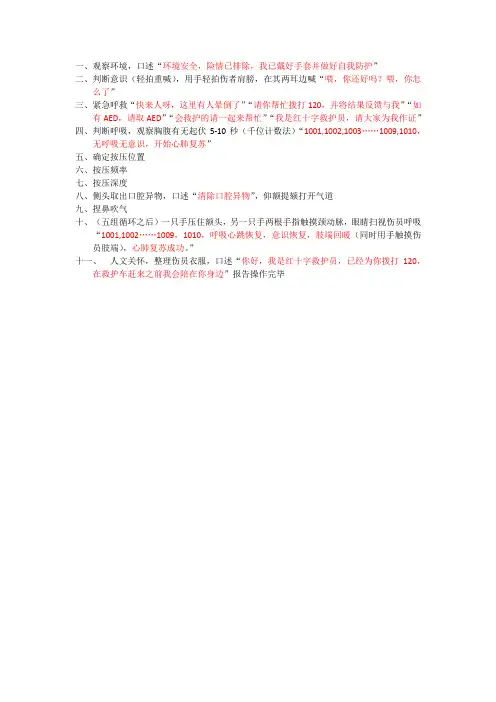
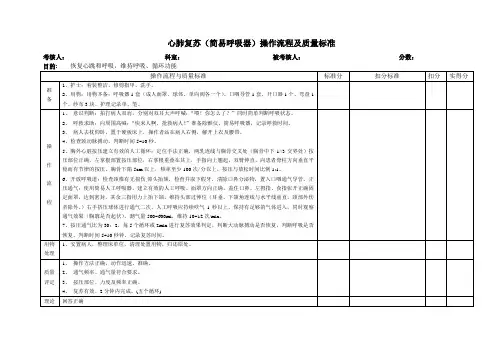
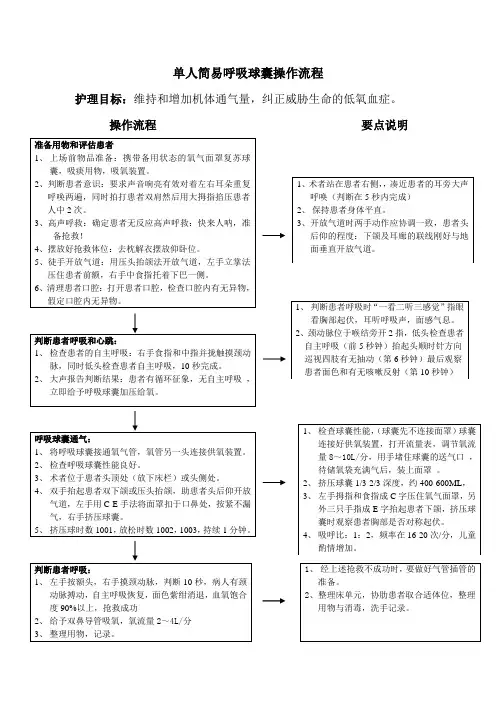
简易呼吸气囊心肺复苏操作流程
- 格式:doc
- 大小:16.54 KB
- 文档页数:5
简易呼吸气囊心肺复苏操作流程
英文回答:
Cardiopulmonary resuscitation (CPR) is an emergency
procedure performed to manually restore blood circulation
and breathing in a person who is in cardiac arrest. One of
the techniques used in CPR is the use of a simple bag valve
mask, also known as a resuscitator or an Ambu bag.
The basic steps for using a bag valve mask for CPR are
as follows:
1. Position the patient: Ensure that the patient is
lying on their back on a firm surface. Tilt their head back
slightly to open the airway.
2. Open the airway: Use the head-tilt, chin-lift
technique to open the patient's airway. This involves
gently tilting the head back with one hand while lifting
the chin with the other hand.
3. Seal the mask: Place the mask over the patient's
nose and mouth, ensuring a good seal. Use one hand to hold
the mask in place.
4. Give breaths: Squeeze the bag to deliver a breath
into the patient's lungs. Watch for chest rise and fall as
you provide the breaths. Give two breaths, each lasting
about one second.
5. Check for chest rise: After giving breaths, watch
for the chest to rise and fall. If the chest does not rise,
reposition the mask and try again.
6. Perform chest compressions: After giving breaths,
perform chest compressions. Place the heel of one hand on
the center of the patient's chest, slightly below the
nipple line. Place the other hand on top of the first hand
and interlock the fingers. Push hard and fast, aiming for a
depth of about 2 inches. Perform compressions at a rate of
100-120 compressions per minute.
7. Alternate breaths and compressions: Continue to
alternate between giving breaths and performing chest
compressions in a ratio of 30 compressions to 2 breaths.
This is known as the "30:2" ratio.
8. Monitor the patient: While performing CPR, continue
to monitor the patient's response and adjust your technique
as needed.
9. Call for help: If you are alone, call for emergency
medical assistance as soon as possible. If there are others
present, instruct someone to call for help while you
continue to perform CPR.
10. Continue until help arrives: Continue performing
CPR until emergency medical personnel arrive and take over
or until the patient shows signs of life.
Remember, it is important to receive proper training in
CPR techniques and to regularly refresh your skills to
ensure you are prepared to respond in an emergency
situation.
中文回答:
心肺复苏(Cardiopulmonary Resuscitation,CPR)是一种紧急操作,用于手动恢复心脏停跳患者的血液循环和呼吸。在CPR中使用的一种技术是使用简易呼吸气囊,也称为人工呼吸器或Ambu袋。
使用呼吸气囊进行CPR的基本步骤如下:
1. 位置患者,确保患者仰卧在坚硬的平面上。稍微向后倾斜头部以打开气道。
2. 打开气道,使用头后仰、下颌抬起的技术打开患者的气道。这涉及到用一只手轻轻向后倾斜头部,用另一只手抬起下颌。
3. 密封面罩,将面罩放在患者的鼻子和口腔上,确保密封良好。用一只手固定面罩的位置。
4. 给予呼吸,挤压气囊向患者的肺部输送呼吸。观察胸部的起伏,确保呼吸顺畅。每次给予两次呼吸,每次持续约一秒钟。
5. 观察胸部起伏,给予呼吸后,观察胸部的起伏。如果胸部未起伏,重新调整面罩的位置并再次尝试。
6. 进行胸外按压,给予呼吸后,进行胸外按压。将一只手的后跟放在患者胸部中央,略低于乳头线。将另一只手放在第一只手的上方,并交叉握住手指。用力快速地按压,力度约为2英寸。按照每分钟100-120次的速度进行按压。
7. 交替呼吸和按压,继续交替给予呼吸和进行胸外按压,按照30次按压和2次呼吸的比例进行。这被称为“30:2”的比例。
8. 监测患者,在进行CPR时,继续监测患者的反应,并根据需要调整操作。
9. 寻求帮助,如果你是一个人,尽快呼叫紧急医疗救援。如果有其他人在场,指示某人呼叫帮助,同时你继续进行CPR。
10. 继续操作直到救援到达,继续进行CPR直到紧急医疗人员到达并接管,或者患者出现生命体征。
请记住,接受正确的CPR技术培训,并定期更新你的技能,以确保你在紧急情况下能够做出正确的反应。