中考英语复习反意疑问句详细讲义及练习
- 格式:docx
- 大小:41.79 KB
- 文档页数:4
反意疑问句专项讲义及练习
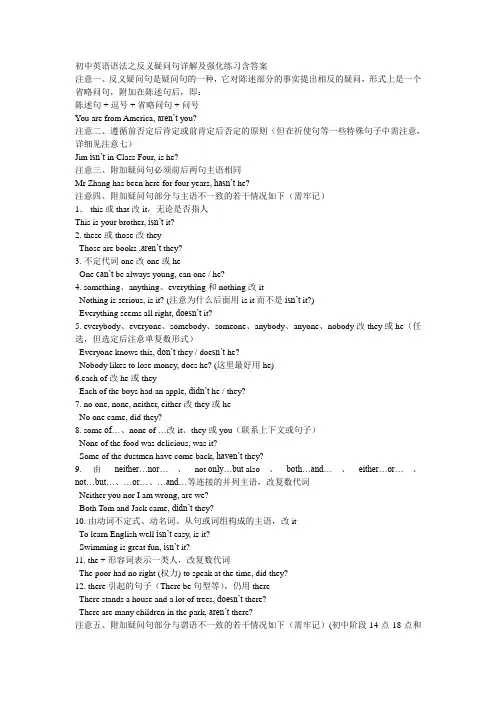
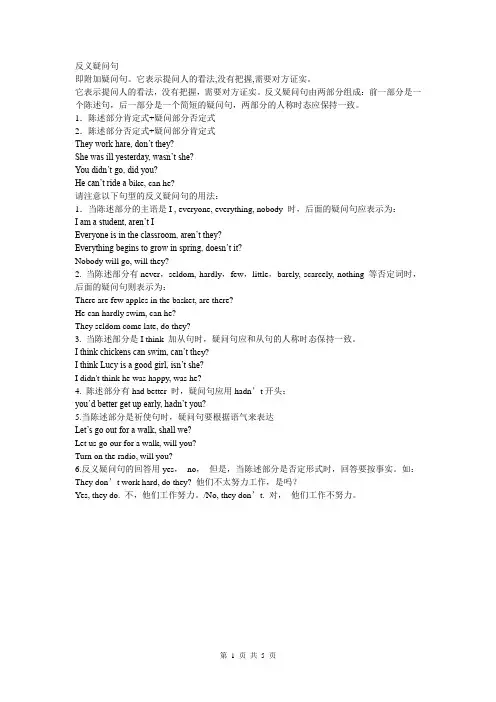
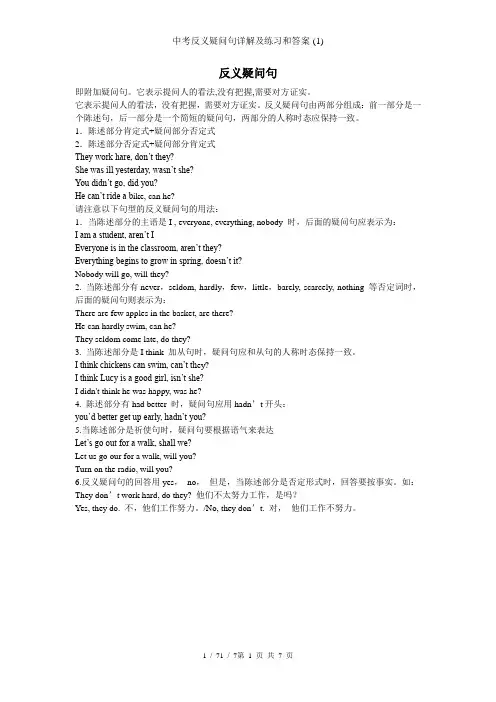
一、基本用法:
(一)定义:表示对陈述句所说的事实提出相反的疑问,要求对方用“yes”或“no”来进行回答。
(二)构成:陈述部分+附加疑问句,前一部分是陈述部分,后一部分是附加疑问句(用be动词/助动词/情态动词+人称代词主格构成,否定式必须是be动词/情态动词/助动词)与not的缩写形式)。
(三)原则:整个句子遵循前肯定,后否定;前否定,后肯定的原则。
例:
He is very old, isn’t he? 他非常老了,不是吗?
Tom isn’t working here, is he? Tom不在这里工作,是吗?
You like English very much, don’t you? 你非常喜欢英语,对吧?
Lucy doesn’t like to stay here, does she? Lucy不喜欢待在这里,是吗?
(四)回答:和一般疑问句的回答规则一样(遵循事实即可)
例:--Lucy doesn’t like English, does she? Lucy不喜欢英语,是吗?
--Yes, she does. 不,她喜欢。(事实上她是喜欢英语)
--No, she doesn’t. 是的,她不喜欢。(事实上她不喜欢英语)
基础练习:
1. You are in Grade Two now,______________?
2. Your father is a worker, ______________?
3. Mary is going to study French, ______________?
4. Kate swims very well in her class, ______________?
5. They like reading books,______________?
6. She isn’t going to buy a book,______________?
7. They won’t have a good time,______________?
8. We can’t go there together, ______________?
9. Tom watches TV every day,______________?
10. You don’t like to go there, ______________?
二、更多用法
(一)当陈述部分是祈使句时,附加疑问句要根据语气来表达,分三种情况:
1)一般情况下用will you(或won’t you),其中will you
多表示请求,won’t you则表示提醒对方注意。如果前面的陈述部分为祈使句的否定句,附加疑问句则用will you. 例:Give me a hand, will you/won’t you? 帮我一把,好吗?
Don't spoil your child, will you? 别宠孩子,好吗?
2)以Let's(听者包括在内)开头的祈使句,附加疑问句通常用shall we(或shan’t we)
例:Let's have a look at your book, shall we/shan’t we?
3)以Let us(听话人不被包括在"us"里面)或Let me开头的祈使句,附加疑问句多用will you(或won’t you)。
例:Let us know the time of your arrival, will you/won’t you?
让我们知道你的到达时间,好吗?
Let me help you, will you/won’t you? 让我帮助你,好吗?
专项练习:
1) Don't make much noise,
_______________?
2) Let’s go swimming together,
_______________?
3)
Leave all the things as they are, _______________?
4)
Let us go there on foot, _______________?
5)Let me have a try, _______________?
(二)如果陈述部分是there be句型,附加疑问句则是“be 动词(not) + there?”的结构,当be动词前有助动词时,则用助动词+there结构,都要遵循前肯定后否定,前否定后肯定的原则。
例:There are some apples in the basket, aren't there? 篮子里有一些苹果,是吗?
There isn't any milk left, is there?
没有牛奶剩下,是吗?
There will be a meeting tomorrow, won’t there? 明天将有一个会议,对吗?
(三)如果陈述部分是感叹句时,附加疑问句多用isn’t/aren’t + 人称代词主格表示,如果是带有动词或副词(副词修饰动词)的感叹句,附加疑问句则用助动词形式。
例:What beautiful flowers they are, aren’t they? 多么漂亮的花啊,不是吗?
How clever the girl is, isn’t she?
那个女孩真聪明啊,不是吗?
How time flies, doesn’t it? 时光飞逝,不是吗?
(四)陈述部分时I am时,附加疑问句要用aren’t I,不能用am not I.
例:I am much older than you, aren’t I?
我比你老得多,对吗?
专项练习:
1) There was a girl singing here at this time yesterday, _______________?
2) There are many interesting books in the library, _______________?
3) There won’t be too many things to do tomorrow, _______________?
4) What an interesting book, _______________?
5) How super that shopping centre is,_______________?
6) I am talking with my friend now, _______________? (五)陈述部分的主语是everything, something, anything, nothing, this, that时,附加疑问句的主语要用it;陈述部分的主语是everyone, everybody, someone, somebody, anyone, anybody, no
one, nobody, none, neither, these, those时,其附加疑问句的主语需用人称代词复数they。
例:Everything starts to grow in spring, doesn’t it? 春天里万物开始生长,对吧?
Nothing is impossible, is it? 没有什么是不可能的,对吧?
Those are Tom’s favourite balls, aren’t they? 那些都是Tom最喜欢的球,对吧?
专项练习:
1)Someone looked for me yesterday, ________________?
2)No one knows about it, ________________?
3)Nothing is important if you put you heart in it, ________________?
4)Everything will be OK if you work hard,________________?
5)Someone will come to see us tomorrow,________________?
(六)陈述部分含有否定意思的词,如few, little, not, no, nothing, nobody, hardly, none, never,
seldom, neither等词时,附加疑问句要用肯定结构;但一些表示否定意思的前缀词除外,如unhappy, impossible, unlike等,附加疑问句仍要用否定形式。
例:There is little water in your cup, is there? 你的杯子里没有多少水了,是吗?
Tom seldom goes to see his grandparents on Sundays, does he?
Tom在周日很少去看他的祖父母,是吗?
Lucy feels quite unhappy today, doesn’t she? Lucy今天感觉不开心,是吗?
(七)陈述部分是主从复合句时,附加疑问句要以主句为准,但如果主语是第一人称且谓语动词是think, believe, suppose, guess时,附加疑问句则以从句为准,并注意否定前移。
例:He said there was a girl singing in that room, didn’t he?
他说那间房间里有个女孩在唱歌,是吗?
I don’t think he will come here, will he? 我不认识他会来这,对吧?
(八)陈述部分有must, need等词时,要判断must的意思以及need是情态动词还是实义动词。如mustn’t表示“禁止,一定不要”的意思是,附加问句常用must; must表示“必须”的意思是,附加问句要用needn’t;当must表示对现在的情况进行推测时,附加问句则要根据must后面的动词采用相应的形式。need则需判断词性,规则同含有实义动词或情态动词的句子的变法。
例:He must be good at English, isn’t he? 他的英语一定很好,对吧?(表示推测)
They must finish the work today, needn’t they? 他们今天必须完成工作,是吗?(表必须)
You mustn’t cross the street when the light is red, must you? (表禁止)
你一定不要在红灯时过马路,知道吗?
We need to help them as possible as wen can, don’t we?
我们需要尽可能地帮他们,对吧?(实义动词)