对外汉语Chinese——起来、下来&回来
- 格式:doc
- 大小:60.00 KB
- 文档页数:5
“verb+上” indicates that after the action something is added somewhere or the action may make things join together.1请把门关上。
Qǐnɡbǎmén ɡuān shànɡ.Please close the door.2请把书合上,听我说。
Qǐnɡbǎshūhéshànɡ, tīnɡwǒshuō.Please close your books and listen to me.3她穿上新裙子出门了。
Tāchuān shànɡxīn qún zi chūmén le.She put on her new dress and went out.4我戴上眼镜才看得见。
Wǒdài shànɡyǎn jìnɡcái kàn de jiàn.I can’t see it unless I have my glasses on.5你先闭上眼睛——我有一个惊喜给你。
Nǐxiān bìshànɡyǎn jīnɡ—wǒyǒu yíɡe jīnɡxǐɡěi nǐ.Close your eyes first—I’ve got a surprise for you.6请在合同上签上名字。
Qǐnɡzài hétonɡshànɡqiān shànɡmínɡzi. Please sign your name on the contract.Here the “verb+上” shows:①something is added somewhere(example 3-dress on the body; example 4-glasses on the face; example 6-name on the contract)②the action makes things join together (example 1-the door being shut; example 2-the books being closed; example 5-the eyes being closed)③“在……上”usually means “on…” or “above…”(example 6)Vocabulary:关ɡuān (v.)to close(the door), to switch off合hé(v.)to close (the book)新xīn (adj.)new出门chū mén (v.)to go out (of home)戴dài (v.)to put on accessories眼镜yǎn jìnɡ (n.)glasses闭bì(v.)to close; to stop; to obstruct眼睛yǎn jīnɡ(n.)eyes惊喜jīnɡ xǐ(n.)surprise合同hé tonɡ(n.)contract签qiān (v.)to signHere are some examples using “verb+下”pattern.1我们坐下说话。
Wǒmen zuòxiàshuōhuà.Let’s sit and talk.2他摘下了眼镜。
Tāzhāi xiàle yǎn jìnɡ.He took off his glasses.3把刀放下,那很危险。
Bǎdāo fànɡxià, nàhěn wēi xiǎn.Put down the knife—that’s very dangerous.4他留下了一封信。
Tāliúxiàle yìfēnɡxìn.He left a letter.5前面的车突然停下了。
Qián miàn de chētūrán tínɡxiàle.The car in front of us stopped suddenly.6他记下了我的名字。
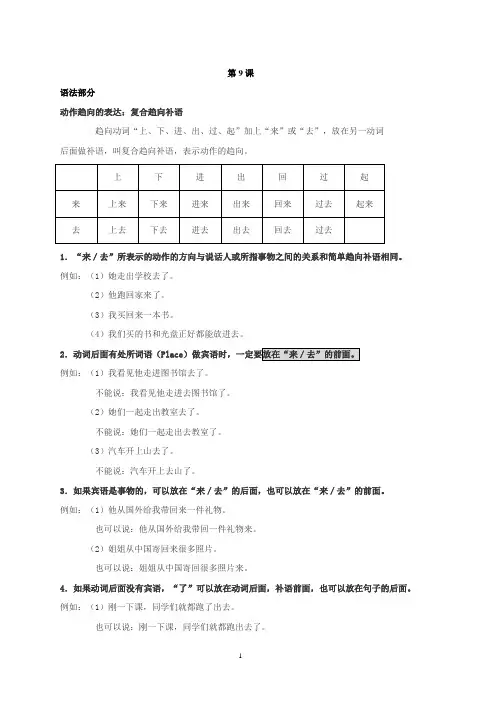
Tājìxiàle wǒde mínɡzi.He wrote down my name.This “verb+下” pattern ind icates :(1) Someone or something moves with the action from a higher place down to a lower place (example 1);(2) The result of the action turns fixed (example 4、5、6);(3) Someone or something which is the object of the verb leaves the previous place after the action(example 2、3).Vocabulary:摘zhāi (v.)to pick刀dāo (n.)knife危险wēi xiǎn (n.)danger; (adj.)dangerous留liú(v.)to leave (something); to stay; to retain封fēnɡ(n.)measure word for letters信xìn (n.)letter突然tū rán (adv.)suddenly停tínɡ(v.)to stop记jì(v.)to write down, to mark, to notev./adj.+起来verb+up start to do“起来” means to rise up and the pattern has three main meanings:① The action starts and goes on;② Someone or something moves with the action from a lower place up to a higher place;③ People or objects join together after the action.1雨下起来了。
Yǔxiàqi lai le.It started to rain.2她突然哭起来了。
Tātūrán kūqi lai le.She suddenly starts crying.3我胖起来了。
Wǒpànɡqi lɑi le.I’m gaining weight.4请大家都站起来。
Qǐnɡdàjiādōu zhàn qi lai.Everyone, please stand up.5我们把这幅画挂起来吧。
Wǒmen bǎzhèfúhuàɡuàqi lai ba.Let’s hang this picture on the wall.6你把桌上的书收起来吧。
Nǐbǎzhuōshanɡde shūshōu qi lai ba.Put away the books on the table please.“起来” after the verb/adjective is usually said in "light" ton e. Sometimes the verb has an object (noun) and we will change the pattern to“verb+起+noun+来”,like “举起手来jǔqǐshǒu lái —to raise hands”.Vocabulary:下xià(v.)to fall, to go down;~雨-to rain突然tū rán (adv.)suddenly哭kū (v.)to cry胖pànɡ (adj.)plump, overwe ight大家dà jiā(n.)everyone都dōu (adv.)all, both,entirely站zhàn (v.)to stand幅fú (n.)measure wordfor textile or picture画huà(n.)picture, drawing,painting挂ɡuà(v.)to hang up收shōu (v.)to collect, to putawayv.+下来verb+down“下” means “(to go) down” and “ver b+下来” usually indicates that s b. or sth. moves from a higher place down to a lower place or towards the speaker from a distant place.1毛巾掉下来了。
Máo jīn diào xiɑlai le.The towel dropped (to the floor).2水从山顶流下来。
Shuǐcónɡshān dǐnɡliúxia lai.The water flows from the top of the mountain.3你从二十楼走下来,不累吗?nǐcónɡèr shi lóu zǒu xia lai, búlèi mā? Aren’t you tired after walking down from the 20th floor?This meaning of “verb+下来” is easy to understand since it uses the literal meaning of “下来”.As a verb suff ix, “下来” also indicates continuation. It also indicates that the action continues (usually from the past till now).4这是古代传下来的故事。