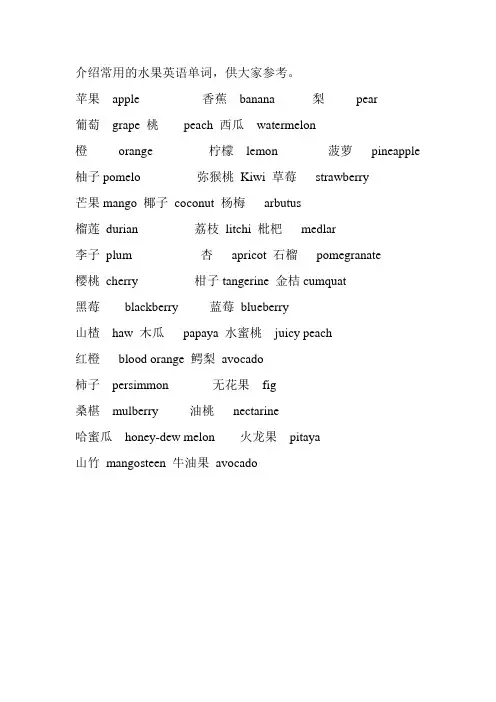
水果英文介绍大全[修订]
- 格式:pdf
- 大小:509.29 KB
- 文档页数:19
水果英文介绍大全 苹果:
The apple is a tree and its pomaceous fruit, of the species Malus
domestica in the rose family Rosaceae. It is one of the most
widely cultivated tree fruits. It is a small deciduous tree
reaching 5-12 m tall, with a broad, often densely twiggy crown.
The leaves are alternately arranged, simple oval with an acute
tip and serrated margin, slightly downy below, 5-12 cm long and
3-6 cm broad on a 2-5 cm petiole. The flowers are produced in
spring with the leaves, white, usually tinged pink at first,
2.5-3.5 cm diameter, with five petals. The fruit matures in
Autumn, and is typically 5-8 cm diameter (rarely up to 15 cm).
__TOC__
Apple tree in flower
Botanical origins
Wild Malus sieversii apple in KazakhstanThe wild ancestor of
Malus domestica is Malus sieversii. It has no common name in
English, but is known where it is native as "alma"; in fact,
one major city in the region where it is thought to originate
is called Alma-Ata, or "father of the apples". This tree is
still found wild in the mountains of Central Asia in southern
Kazakhstan, Kyrgyzstan, Tajikistan, and Xinjiang, China.
For many years, there was a debate about whether M. domestica evolved from chance hybridization among various wild species.
Recent DNA analysis by Barrie Juniper, Emeritus Fellow in the
Department of Plant Sciences at Oxford University and others,
has indicated, however, that the hybridisation theory is
probably false. Instead, it appears that a single species still
growing in the Ili Valley on the northern slopes of the Tien
Shan mountains at the border of northwest China and the former
Soviet Republic of Kazakhstan is the progenitor of the apples
we eat today. Leaves taken from trees in this area were analyzed
for DNA composition, which showed them all to belong to the
species M. sieversii, with some genetic sequences common to M.
domestica.
Some individual M. sieversii, recently planted by the US
government at a research facility, resist many diseases and
pests that affect domestic apples, and are the subject of
continuing research to develop new disease-resistant apples.
Other species that were previously thought to have made
contributions to the genome of the domestic apples are Malus
baccata and Malus sylvestris, but there is no hard evidence for
this in older apple cultivars. These and other Malus species
have been used in some recent breeding programmes to develop
apples suitable for growing in climates unsuitable for M.
domestica, mainly for increased cold tolerance.
Apple cut horizontally, showing seedsThe apple tree was
probably the earliest tree to be cultivated, and apples have
remained an important food in all cooler climates. To a greater degree than other tree fruit, except possibly citrus, apples
store for months while still retaining much of their nutritive
value. Winter apples, picked in late autumn and stored just
above freezing, have been an important food in Asia and Europe
for millennia, as well as in Argentina and in the United States
since the arrival of Europeans.
The word apple comes from the Old English word aeppel, which
in turn has recognisable cognates in a number of the northern
branches of the Indo-European language family. The prevailing
theory is that "apple" may be one of the most ancient
Indo-European words (*abl-) to come down to English in a
recognisable form. The scientific name malus, on the other hand,
comes from the Latin word for apple, and ultimately from the
archaic Greek mālon (mēlon in later dialects). The legendary
placename Avalon is thought to come from a Celtic evolution of
the same root as the English "apple"; the name of the town of
Avellino, near Naples in Italy is likewise thought to come from
the same root via the Italic languages.
橘子:
Orange—specifically, sweet orange—refers to the citrus tree
Citrus sinensis and its fruit. The orange is a hybrid of ancient
cultivated origin, possibly between pomelo (Citrus maxima) and
tangerine (Citrus reticulata). It is a small tree, growing to
about 10 m tall, with thorny shoots and evergreen leaves 4-10
cm long. Oranges originated in southeast Asia, in either India
or modern day Pakistan, Vietnam or southern China. The fruit
of Citrus sinensis is called sweet orange to distinguish it from
Citrus aurantium, the bitter orange.
Oranges are widely grown in warm climates worldwide, and the