锆簇金属有机骨架材料(Zr-MOFs)的合成总结
- 格式:docx
- 大小:2.18 MB
- 文档页数:24
序号
配体
条件
结构 来源
1
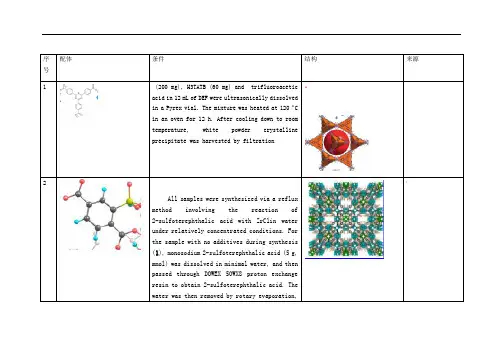
(200 mg), H3TATB (60 mg) and trifluoroacetic
acid in 12 mL of DEF were ultrasonically dissolved
in a Pyrex vial. The mixture was heated at 120 ºC
in an oven for 12 h. After cooling down to room
temperature, white powder crystalline
precipitate was harvested by filtration ·
2
All samples were synthesized via a reflux
method involving the reaction of
2-sulfoterephthalic acid with ZrClin water
under relatively concentrated conditions. For
the sample with no additives during synthesis
(1), monosodium 2-sulfoterephthalic acid (5 g,
mmol) was dissolved in minimal water, and then
passed through DOWEX 50WX8 proton exchange
resin to obtain 2-sulfoterephthalic acid. The
water was then removed by rotary evaporation, (
then 40 mL of fresh ultrapure water was added
to
dissolve the solid. Separately, ZrCl g,
mmol) was dissolved in 15 mL of ultrapure water
(caution, highly exothermic), then the two
solutions were mixed to make a clear, slightly
pink solution with pH < 1. The solution was then
heated to reflux, and after ~3 minutes a white
precipitate formed. Reflux was continued for 16
hours, then the solution was cooled and the
solid was recovered by centrifugation. The
solid was then washed 2x with ultrapure water,
then refluxed for another 16 hours in ultrapure
water to purify.
3
Synthesis of 14 nm UiO-66-N3
(Zr6O4OH4(C8H3O4-N3)6
2-Azido-1,4-benzenedicarboxylic acid (50 mg,
mmol) was dissolved in 1 mL
of N,N Dimethylformamide (DMF). In a separate
vial, zirconyl chloride octahydrate (21 纳米 级别
'
mg, mmol) was dissolved in 3 mL of DMF. The two
solutions were mixed together
in a 10 mL scintillation vial, and acetic acid (300
µl) was added to the reaction mixture.
The solution was heated at 90 ˚C for 18 h to yield
UiO-66-N3 (Zr6O4OH4(C8H3O4-N3)6.
MOF nanoparticles were purified by centrifugation
(15000 rpm, 90 min) followed by
solvent exchange (3 x DMF and 3 x NANOpure H2O)
over a 48 h period. MOF
nanoparticles were suspended in H2O for
characterization and functionalization with
~
4
DUT-67. ZrCl/HfCl(230 mg/320 mg, 1 mmol)
was dissolved in the mixture of DMF mL) and NMP mL) by
sonication for 10 min. 2,5-Thiophenedicarboxylic acid
(Htdc) (110 mg, mmol) was added to resulting solution and
sonicated additional 5 min. After that acetic acid (7 mL, *
117 mmol) was added to the solution and sonicated for 10 min. The resulting mixture was distributed to 10 Pyrex
tubes, which were subsequently tempered at 120 °C for 48
h. The resulted powder was separated by centrifugation and
washed several times with DMF until supernatant solution
became colorless. The powder was filtered and dried under
argon atmosphere
for half an hour. Yield: 224 mg %) for DUT-67(Zr) and 259
mg
%) for DUT-67(Hf).
The single crystals of DUT-67 were obtained using the same
procedure, but 10 mL of acetic acid instead of 7 mL were
added.
5 ZrCl/HfCl(230 mg/320 mg, 1 mmol)
was dissolved in DMF (25 mL) by sonication for 10 min. Htdc
(258 mg, mmol) was added to resulting solution, and the
mixture was sonicated additional 5 min. After that acetic
acid (11 mL, 183 mmol) was added and the mixture was
sonicated for further 10 min. The reaction mixture was .
distributed to 12 Pyrex tubes, which were subsequently
tempered at 120 °C for 72 h. The washing and drying
procedure was the same as applied to DUT-67. Yield: 384
mg %) for DUT-67(Zr) and 453 mg %) for DUT-67(Hf). The
single
crystals of DUT-68(Zr) were obtained using the same
synthetic
protocol, but utilizing larger amount of modulator.
}
A solutionofHeddb (65mg,,ZrCl(60 mg, ,(HOAc)in16mLof
N,N-dimethyl-
formamide(DMF)wassealedina20mLglassvialandheatedat 120 1C
washedwithDMFandacetone,andthendriedinair(yield72mg).
ZrCl(24 mg) was dissolved in 8 mL of
N,N-dimethylformamide (DMF) in a 25 mL pyrex vial,
to which benzoic acid was added. The mixture was
heated in 85 ºC oven for 1 hours and cooled
to the room temperature. Then, HTBPP (20 mg) was
added to the above solution, which was
{
sonicated for a while. The resulting mixture was
heated in 120 ºC oven for 96 hours to yield about
14 mg of dark red crystals (yield: % based on
HTBPP). The crystals obtained were filtered
and washed with DMF. Elemental analyses calcd (%) Chem. Sci., 2015, 6,
3466–3470 | 3467