
24节气(英文版)
- 格式:ppt
- 大小:2.63 MB
- 文档页数:25


在你的托福口语里加上点儿“春分”、“清明”这样的二十四节气,是不是立马就高大上了起来?!技能抓紧GET√起来吧~立春the Beginning of Spring (1st solar term)Feb.3,4, or 5雨水Rain Water (2nd solar term)Feb.18,19 or 20惊蜇the Waking of Insects (3rd solar term)Mar.5,6, or 7春分the Spring Equinox (4th solar term)Mar.20,21 or 22清明Pure Brightness (5th solar term)Apr.4,5 or 6谷雨Grain Rain (6th solar teram)Apr.19,20 or 21立夏the Beginning of Summer (7th solar term)May 5,6 or 7小满Lesser Fullness of Grain (8th solar term)May 20,21 or 22芒种Grain in Beard (9th solar term)Jun.5,6 or 7夏至the Summer Solstice (10th solar term)Jun.21 or 22小暑Lesser Heat (11th solar term)Jul.6,7 or 8大暑Greater Heat (12th solar term)Jul.22,23 or 24立秋the Beginning of Autumn (13th solar term)Aug.7,8 or 9处暑the End of Heat (14th solar term)Aug.22,23 or 24白露White Dew (15th solar term)Sep.7,8 or 9秋分the Autumn Equinox (16th solar term)Sep.22,23 or 24寒露Cold Dew (17th solar term)Oct.8 or 9霜降Frost's Descent (18th solar term)Oct.23 or 24立冬the Beginning of Winter (19th solar term)Nov.7 or 8小雪Lesser Snow (20th solar term)Nov.22 or 23大雪Greater Snow (21th solar term)Dec.6,7 or 8冬至the Winter Solstice (22th solar term)Dec.21,22 or 23小寒Lesser Cold (23th solar term)Jan.5,6 or 7大寒Greater Cold (24th solar term)Jan.20 or 2以上就是中国24个节气的英文翻译,大家也可以从这24个节气拓展开去,组织一些新的托福口语话题和模板,增加话题的新鲜度。

二十四节气英文表达通用版The Twenty-Four Solar Terms: Commonly Used English ExpressionsIntroductionThe Twenty-Four Solar Terms, also known as the Chinese solar terms, represent the changes of the seasons, dividing a year into twenty-four segments based on the sun's position. These terms have been used in China for thousands of years to guide agricultural activities, traditional festivals, and daily life. In this article, we will explore the common English expressions used to describe each solar term, offering a glimpse into Chinese culture and the natural rhythm of the seasons.Spring1. Start of Spring (立春)The official beginning of spring marks the end of the cold winter and the emergence of life. "Start of Spring" signifies a new beginning, as buds start to sprout and the earth awakens from its slumber.2. Rain Water (雨水)With the arrival of Rain Water, the weather becomes milder and precipitation increases. The term reflects the importance of water for agriculture, signaling that the planting season is near.3. Awakening of Insects (惊蛰)As the temperature rises further, insects and hibernating animals begin to awaken, bringing life back to the natural world. This term also implies the start of significant agricultural activities.4. Spring Equinox (春分)During the Spring Equinox, the sun crosses the celestial equator, and day and night are of equal length. It represents the balance between light and darkness, and signifies the midpoint of spring.5. Pure Brightness (清明)Pure Brightness refers to clear and bright weather, indicating spring is in full bloom. Chinese people often visit the graves of their ancestors during this time, paying respects and offering sacrifices.6. Grain Rain (谷雨)Grain Rain indicates that it's the rainy season for grains, a critical period for crop growth and germination. It reflects the agricultural importance of timely rainfall for a good harvest.Summer7. Start of Summer (立夏)The Start of Summer signifies the true arrival of summer. Temperatures rise further, and trees and plants are lush green. People begin to wear summer clothes, seeking ways to cool down.8. Grain Buds (小满)Grain Buds represent the time when crops begin to bear their seeds. The term implies that the grains are developing and growing, getting ready for the upcoming harvest season.9. Grain in Ear (芒种)During Grain in Ear, grains are fully grown and bear their ears. It's an important period for cereal crops, including wheat, barley, and rice. The term suggests the seriousness of farming tasks at this stage.10. Summer Solstice (夏至)The Summer Solstice is the longest day and the shortest night of the year. It indicates that summer has reached its zenith and marks the turnaround towards autumn.11. Minor Heat (小暑)Minor Heat refers to the period when temperatures begin to rise rapidly, indicating the hottest days are approaching. People employ various methods to combat the heat and stay cool.12. Major Heat (大暑)Major Heat signifies the hottest days of the year, reflecting the peak of summer heat. During this time, people endure extreme temperatures and take measures to prevent heatstroke.Autumn13. Start of Autumn (立秋)The Start of Autumn marks the beginning of cooler temperatures and indicates the transition from summer to autumn. It implies that autumn harvest is approaching and people need to make preparations.14. Limit of Heat (处暑)Limit of Heat refers to the period when temperatures begin to drop, signifying the end of the summer heat. It's a transitional stage, offering a respite from the scorching summer temperatures.15. White Dew (白露)White Dew is the time when dewdrops appear on the ground but have not frozen yet. It suggests the arrival of cooler weather and the changing color of dew, indicating that autumn is fully welcomed.16. Autumnal Equinox (秋分)The Autumnal Equinox is the midpoint of autumn when the sun shines directly on the equator, resulting in equal daylight and nighttime. It represents the balance between light and darkness, and the arrival of fall.17. Cold Dew (寒露)Cold Dew is the stage where the weather becomes colder, and dew appears. It implies that winter is approaching, and people need to take measures to keep warm.18. Frost's Descent (霜降)Frost's Descent signifies the arrival of frost as the temperature continues to drop. It implies that the crops need to be harvested before they are damaged by the upcoming freezing temperatures.Winter19. Start of Winter (立冬)The Start of Winter marks the beginning of true winter, as the temperature drops significantly. It indicates that it's time to prepare for the coldest season.20. Minor Snow (小雪)Minor Snow is the period when the weather becomes significantly colder, and snow may begin to fall lightly. It suggests that winter is approaching its peak, and people must be prepared for heavier snowfalls.21. Major Snow (大雪)Major Snow represents the time when snowfall becomes more abundant and widespread. It implies that winter has reached its climax, and snow and ice cover the ground.22. Winter Solstice (冬至)The Winter Solstice is the shortest day and the longest night of the year. It signifies that winter has reached its peak and announces the turning point towards spring.23. Minor Cold (小寒)Minor Cold indicates that the weather starts to get slightly warmer, but cold temperatures still prevail. It suggests that the coldest days of winter are not over yet.24. Major Cold (大寒)Major Cold signifies the coldest days of the year, representing the final solar term of winter. It implies that people need to cope with frigid temperatures and stay warm.ConclusionThe Twenty-Four Solar Terms provide a unique perspective on the changes of seasons in China. Understanding the English expressions related to each solar term not only expands our knowledge of Chinese culture but also serves as a reminder of the deep connection between humans and nature. By respecting and adapting to the rhythms of the natural world, we can cultivate a harmonious coexistence with the environment.。
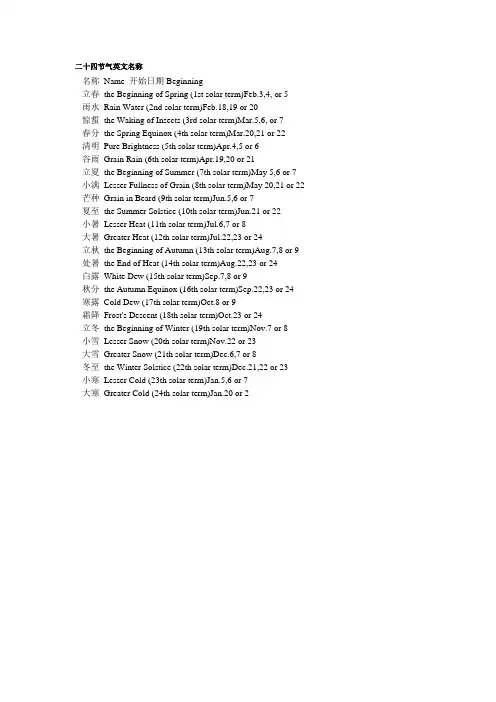
二十四节气英文名称名称Name 开始日期Beginning立春the Beginning of Spring (1st solar term)Feb.3,4, or 5雨水Rain Water (2nd solar term)Feb.18,19 or 20惊蜇the Waking of Insects (3rd solar term)Mar.5,6, or 7春分the Spring Equinox (4th solar term)Mar.20,21 or 22清明Pure Brightness (5th solar term)Apr.4,5 or 6谷雨Grain Rain (6th solar term)Apr.19,20 or 21立夏the Beginning of Summer (7th solar term)May 5,6 or 7 小满Lesser Fullness of Grain (8th solar term)May 20,21 or 22 芒种Grain in Beard (9th solar term)Jun.5,6 or 7夏至the Summer Solstice (10th solar term)Jun.21 or 22小暑Lesser Heat (11th solar term)Jul.6,7 or 8大暑Greater Heat (12th solar term)Jul.22,23 or 24立秋the Beginning of Autumn (13th solar term)Aug.7,8 or 9 处暑the End of Heat (14th solar term)Aug.22,23 or 24白露White Dew (15th solar term)Sep.7,8 or 9秋分the Autumn Equinox (16th solar term)Sep.22,23 or 24寒露Cold Dew (17th solar term)Oct.8 or 9霜降Frost's Descent (18th solar term)Oct.23 or 24立冬the Beginning of Winter (19th solar term)Nov.7 or 8小雪Lesser Snow (20th solar term)Nov.22 or 23大雪Greater Snow (21th solar term)Dec.6,7 or 8冬至the Winter Solstice (22th solar term)Dec.21,22 or 23小寒Lesser Cold (23th solar term)Jan.5,6 or 7大寒Greater Cold (24th solar term)Jan.20 or 2---------------------------------------------- 华丽丽的跳个舞~,ohoho~~~。