
新概念英语第二册 Lesson 25
- 格式:ppt
- 大小:969.50 KB
- 文档页数:30

中小学1对1课外辅导专家
1
龙文教育学科老师个性化教案
教师 学生姓名 上课日期 2013-12-29
学科 英语 年级 八年级 教材版本 人教版
学案主题 Lesson 17 课时数量
(全程或具体时间) 第(9)课时 授课时段 15-17
教学目标 教学内容 新概念lesson 17
个性化学习问题解决 新概念lesson 17
教学重点、难点 难点:词句分析
重点:语法点讲解
教学过程 一. Lesson 15& 16复习检测
坏消息 秘书
精神紧张的 瞧不起某人
负担得起 工资
插话,打断 交通灯
交通堵塞 交通拥挤
我们不允许大家在教室里吸烟。
你发生什么事了?
做笔记 注意
这张照片使我想起了他的父亲。
中小学1对1课外辅导专家
2
二. Lesson 11,12, 13 , 14,15&16单词听写
三.课文背诵 中小学1对1课外辅导专家
3
四.Lesson 17 Always young
My aunt Jennifer is an actress.
以-or,-er结尾的是男性,以-ess结尾的是女性(基本上是这样)
CDAN课程体系——NCE 新概念英语第2册.第25讲.教师版 Page 1 of 12
Do the English Speak English?
Part 1 Basic words and expressions
1. arrive (v) 到达
arrive in 后接大地点
arrive at 后接小地点
表示到达的词还有 reach(及物动词,直接加地点),get to;
例:He arrived in Shanghai last Sunday.
My brother arrived at the village yesterday.
I will reach there in ten minutes.
When will you get to school? 新概念二Lesson25
课堂内容
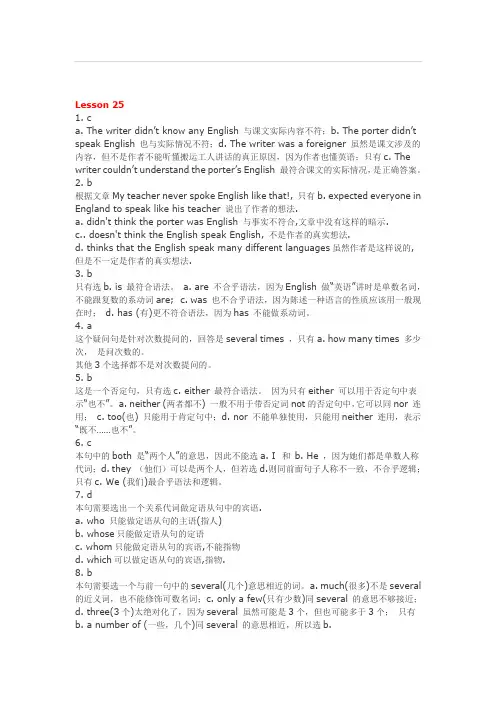
I arrived in London at last. The railway station was big, black
and dark. I did not know the way to my hotel, so I asked a
porter. I not only spoke English very carefully, but very clearly
as well. The porter, however, could not understand me. I
repeated my question several times and at last he understood.
He answered me, but he spoke neither slowly nor clearly. 'I am a
foreigner,' I said. Then he spoke slowly, but I could not
understand him. My teacher never spoke English like that! The
Lesson 25
1. c
a. The writer didn‟t know any English 与课文实际内容不符;b. The porter didn‟t
speak English 也与实际情况不符;d. The writer was a foreigner 虽然是课文涉及的内容,但不是作者不能听懂搬运工人讲话的真正原因,因为作者也懂英语;只有c. The
writer couldn‟t understand the porter‟s English 最符合课文的实际情况,是正确答案。
2. b
根据文章My teacher never spoke English like that!, 只有b. expected everyone in
England to speak like his teacher 说出了作者的想法.
a. didn't think the porter was English 与事实不符合,文章中没有这样的暗示.
c.. doesn't think the English speak English, 不是作者的真实想法.
d. thinks that the English speak many different languages虽然作者是这样说的,但是不一定是作者的真实想法.
3. b
只有选b. is 最符合语法。 a. are 不合乎语法,因为English 做“英语”讲时是单数名词,不能跟复数的系动词are; c. was 也不合乎语法,因为陈述一种语言的性质应该用一般现在时; d. has (有)更不符合语法,因为has 不能做系动词。
4. a
这个疑问句是针对次数提问的,回答是several times ,只有a. how many times 多少次, 是问次数的。
其他3个选择都不是对次数提问的。
5. b
这是一个否定句,只有选c. either 最符合语法。 因为只有either 可以用于否定句中表示“也不”。 a. neither (两者都不) 一般不用于带否定词not的否定句中,它可以同nor 连用; c. too(也) 只能用于肯定句中;d. nor 不能单独使用,只能用neither 连用,表示“既不……也不”。
1 / 19 Lesson 21 Mad or not? 是不是疯了?
学
习
目
标
全
解 必记单词 mad adj. 发疯; sum n. 量; reason n. 原因; determined adj. 坚定的,下决定的
常考短语 drive somebody mad 使某人发疯; night and day 日夜不停地; knock down 撞到
for some reason 由于某些原因; come into use 开始被使用
offer something to do something 提供……来做…….
a large sum of money 一大笔钱; be determined to 下决心
生词解析
mad adj. 发疯的
be mad 发疯,发狂 (强调状态); go mad 发疯,发狂 (强调转变)
drive sb mad 逼疯
/send sb mad
be mad about sth 对…疯狂的,狂热的
/be mad on sth
be mad on football 对足球狂热
be mad on pop music
be mad on jazz
be mad about/on sth
/be crazy about… 对…着迷
go mad 发疯,发狂
/go crazy
/go insane [in'sein]
(歌曲 “Right Here Waiting”中,”I slowly go insane…”)
the insane 精神病人
go bananas (sl.) become mad or angry, act very foolishly. 发疯,发怒,傻里傻气
go nuts 发疯
nut: (sl.) foolish, eccentric or mad person
mental patient 精神病患者
mental hospital 精神病医院