
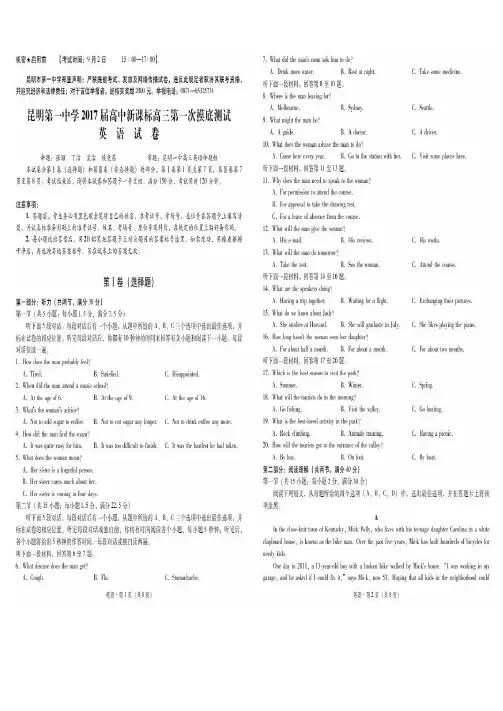
云南省昆明市第一中学高三英语第一次摸底考试试题(扫描版)
- 格式:doc
- 大小:1.03 MB
- 文档页数:13

第一次月考英语答案第I卷第一部分:听力(30分):1-5 CBACB 6-10 BACBC 11-15 ACBBA 16-20 ACBCA第二部分:阅读理解(40分)21-25 BDBCB 26-30 DAADD 31-35 CBCBA 36-40 GBCAF第三部分:完形填空(30分)41-45 BCADA 46-50 BCDBC 51-55 DBACD 56-60 ACABD第II卷第一部分:英语知识运用(15分)61.an 62.when 63.are being sold 64.for 65.others 66.including 67.original 68.Although / Though / While 69. pollution 70.published第二部分:写作(35分)第一节:短文改错(10分)1. instead 后加of2.me 改为myself3.去掉has4.picking 改为pick5. old 改为older6. independent 改为independence7.sign 改为signs8.Therefore 改为However9. that 改为what 10.make 改为making第二节:书面表达(25分)第I卷详解第一部分:阅读理解(40分):第一节:(30分)A篇本文为记叙文,讲述了Mick Polly免费帮助社区的孩子维修和组装自行车的善举。
21. B词义猜测题。
选项所给四个单词的意思分别为: purchase购买,constructed组建、建造,exchange交换,replace代替。
将其分别带入语句Mickrepaired a bike for the boy’s brother and assembled one for his sister,可知constructed符合语境, 可替换assemble,意为Mick帮助男孩的哥哥修了一辆自行车并帮他姐姐组装了一辆。

云南省昆明市第一中学2022-2023学年高中新课标高三第一次摸底测试英语试卷学校:___________姓名:___________班级:___________考号:___________一、阅读理解Every year, the biggest and the best garden designers get together to create the Chelsea Flower Show, providing inspiration, trendsetting ideas and a glimpse of how our gardens might look next year.On Trend: Green gardenSustainable gardens have become a big trend in our towns and cities. Joe Swift inspired gardeners with his gold-winning design for the Homebase Teenage Cancer Trust that featured drought-buster (治理) architectural planting.It could cope with even the driest conditions typically found in places where water is precious. His large pools of water had a cooling effect on people and plants.On Trend: Space-saving HerbsThe Brewin Dolphin garden designed by Cleve West and Steve Swatton followed the Arts and Craft tradition, showing the beautiful strong lines of neatly beech (山毛榉) among its soft herbs planting. It proved to be a style that has never gone out of fashion.You don’t need a large garden to have a piece of topiary (树木造型). These evergreens, which can be boxed or grown in pots, are easy to cut into shapes, such as balls, cubes and pyramids.On Trend: Rhododendrons (杜鹃花) WoodlandChris Beardshaw’s gold-winning design was packed with rhododendrons woodland bushes. It paid tribute (致敬) to Furzey Gardens in Hampshire, which celebrates its 100th anniversary this year.Rhododendrons might not be the trendiest choice but they deserve a comeback.On Trend: Drought BusterThe Herbert Smith garden for WaterAid was inspired by the work of the charity and the transforming power of clean water.Using water wisely is today’s issue, so invest in water butts (积水桶) to collect rainwater and gather waste water from baths, sinks and washing machines.1.Who can inspire those having a garden with limited space?A.Joe Swift.B.Cleve West and Steve Swatton.C.Chris Beardshaw.D.Herbert Smith.2.What does Furzey Gardens feature?A.Large pools.B.Rhododendrons woodland.C.Evergreens in shapes.D.Clean water transforming.3.What do the designs of Joe Swift and Herbert Smith have in common?A.They are the trendiest choices.B.They are gold-winning designs.C.They promoted the balance of environment.D.They attach great importance to saving water.A few people are born resilient (自强不息). Liz Murray is one of them. Her parents were cocaine addicts who spent most of the family’s money in feeding their habits. Liz explains that as a result, she and her sister were neglected. The girls often lacked food and warm clothes. By age 15, Liz was homeless. Her mother had died of AIDS, and her father was on the streets. Liz made a swear to herself after her mother’s death that her life would be different. She refused to end up like her mom and decided that the best way to avoid that fate was to go back to school.Liz Murray stuck to her plan firmly. She stood out in her high school courses in an accelerated two-year program. Liz Murray applied for a New York Times scholarship offered to needy local students. New York Times was looking to make a difference by helping kids who had overcome obstacles. Her story apparently came through loud and clear.Liz hoped to study at Harvard University on her scholarship. Harvard agreed that Liz Murray belonged at the university and accepted her as a member of the class of 2004. Her reaction to the acceptance letter was to scream with delight.When she looks back on where she has come from and the burdens her parents gave her, Liz says that she is neither bitter nor angry. She understood, from an early age, that they had a disease that prevented them from giving her more than they did. She misses having her family together. And her father, with whom she is now close, has developed AIDS. Liz says she doesn’t feel like she has moved past the events of her childhood, rather they’ve stayed with her and are part of everything about who she is. She has learned from her experiences and makes use of the lessons.4.Why were Liz and her sister neglected?A.Because their parents were homeless.B.Because their mother suffered from AIDS.C.Because their parents were addicted to drugs.D.Because their father was begging on the street.5.What did Liz do to achieve her goal?A.By contributing to New York Times.B.By sharing her story in public to raise money.C.By winning a scholarship offered by Harvard University.D.By accomplishing her high school courses in a short time.6.What attitude did Liz hold towards her parents?A.Annoyed.B.Understanding.C.Supporting.D.Disgusted. 7.What’s the best title for the passage?A.From Homeless to Harvard B.The Responsibility of ParentsC.The Abuse from Parents D.Confidence Makes You StrongAntarctica is the highest, driest, and coldest place on Earth. It is also the remotest, a factcomfortable place for people to stay once they arrive. It is widely described as the last true wilderness on our planet.The cold climate is responsible for maintaining the continent’s year-round ice fields: They never melt. Even though Antarctica receives more sunlight than the equator, the temperatures are lower because the ice sheet reflects the heat back into space. Thus, the coldest temperature ever recorded on Earth was in Antarctica in July, 1983. Soviet scientists shivered (瑟瑟发抖) through temperatures that fell to minus 89.2 degrees Celsius.Once completely inaccessible, Antarctica has more recently been playing host to adventurers seeking excitement, scientists interested in experimenting, and companies looking to exploit this wild zone for profit: gold, uranium and oil are just some of the valuable resources which lie beneath the continent’s icy covering.For centuries, Europeans wondered about the existence of a South-pole continent, but no one actually knew for certain Antactica was there until 1820 when European explorers “discover” it. Since then, men have gone to Antarctica in search of adventure. Testing their abilities, several teams of explorers set out in 1911 to be the first men to stand at the SouthPole.Yet, Antarctica’s fragile and complicated ecosystem is threatened by its human visitors. Damage to the environment occurs as people come looking for resources beneath the ice, or carelessly leave their garbage behind. Currently, countries are working to ensure that the damage to Antarctica’s environment is minimized, and that the last wilderness on Earth will remain an unspoiled place.8.What does the underlined word “demystifies” in Paragraph 1 probably mean?A.Does harm to.B.Lies in.C.Accounts for.D.Stays away from.9.Why are Soviet scientists mentioned in Paragraph 2?A.To make a comparison with other places.B.To show Soviet scientists’ fearless spirits.C.To stress the freezing weather of Antarctica.D.To explain the reason forAntarctica’s cold climate.10.When did people begin to explore Antarctica?A.In the late eighteenth century.B.In the early eighteenth century.C.In the early nineteenth century.D.In the late twentieth century. 11.What can we learn from the last paragraph?A.Measures are being taken to protect Antarctica.B.Antarctica’s eco-system has been destroyed by men.C.People visiting Antarctica leave garbage on purpose.D.In the icy covering are buried few precious resources.There are two kinds of memory: short-term and long-term. Information in long-term memory can be recalled at a later time when it is needed. The information may be kept for days or years. Sometimes information in the long-term memory is hard to remember. Students taking exams often have this experience. In contrast, information in short-term memory is kept for only a few seconds, usually by repeating the information over and over.Dr. Hunter studied short-term memory in rats. He used a special device which had a cage for the rat and three doors. There was a light in each door. First, the rat was placed in the closed cage. Next, one of the lights was turned on and then off. There was food for the rat only at this door. After the light was turned off, the rat had to wait a short time before it was released from its cage. Then, if it went to the correct door, it was rewarded with the food thatwas there. Hunter did this experiment many times. He always turned on the lights in a random order. Hunter’s results show that rats have a short-term memory of about ten seconds.Later, Dr. Henning studied how people learning English as a second language remember vocabulary. To begin with, the participants listened to a recording of a native speaker reading a paragraph in English. Following the recording, the participants took a 15-question test where they circled the word they remembered having in the recording. Some of the questions had four choices that sounded alike, while others had four choices having the same meaning.Henning found that people with a lower level in English made more of their mistakes on words that sound alike; people with a higher level made more of their mistakes on words that have the same meaning. Henning’s results suggest that beginning learners hold the sound of words in their short-term memory, while advanced learners hold the meaning of words in their short-term memory.12.What can we learn from Paragraph 1?A.Repetition contributes to people’s short-term memory.B.The information in long-term memory is easier to forget.C.People can rarely memorize the information learnt when young.D.Students taking exams are experienced in long-term memory.13.What does Paragraph 2 mainly talk about?A.How the rat experiment was conducted.B.The process of rats’ developing memory.C.Why the rat experiment was carried out.D.The relationship between rats’ memory and intelligence.14.Who might participate in Dr. Henning’s experiment?A.A Chinese expert in second language learning.B.An American student learning a second language.C.A British teacher teaching English as a second language.D.A Korean employee learning English as a second language.15.What does Henning’s experiment suggest?A.Beginning learners have a bad memory.B.Beginning learners depend more on short-term memory.C.Advanced learners easily remember words according to their pronunciation.D.Advanced learners can confuse the words just heard with those meaning the same.二、七选五An office party can be a double-edged sword. There are four questions about how employees should handle themselves at company parties:16 Dress to impress, but also present yourself appropriately. The location and time of the party should indicate what kind of dress code to expect. Remember you are attending a company outing; you are not a celebrity walking the red carpet. So leave the 4-inch heels at home, along with anything short, tight or revealing.Should I be “fashionably late”?No. 17 . Your co-workers will remember if you are 10 minutes late. Late arrival or early departure may not ruin your career, but your attendance shows loyalty to your manager and your organization.Should I talk with the senior executives? Yes! There are only a few opportunities to make yourself known to the CEO and executive directors, and this is one of them.18 .What if I’m not very social?Don’t be tempted to turn to your phone to avoid conversations by texting your friends or checking your Twitter feed the entire night.19 . This is the perfect opportunity to step outside of your comfort zone and introduce yourself to people from another division whom you may not have met. To help, think of a few topics or questions before the party that you can use to strike up a conversation with someone new.20 . Before you leave, make sure you find your boss, CEO and the staff that put the party together and thank them for a great event.A.How should I dress upB.What make-up should I wearC.Arrive in the first 30 minutesD.Don’t forget to convey appreciationE.Late arrival is a new trend nowadaysF.And don’t just hang out with those from your groupG.Thus, take advantage of it and give yourself a proper introduction三、完形填空A map is a drawing that give us information about a place at a particular time. Maps aremaking maps is called cartography (制图学). A person making maps is called a cartographer.26 of a place can be shown in different types of maps.There are two main types of maps—physical maps and political maps. Physical maps show the 27 of the land-hills, lakes, forests, the coast and so on. 28 maps show how the land is used by people—counties, provinces, countries, town boundaries, etc. Both types of map have 29 over time because forests are cut down, roads are built, towns expand and borders change. Most maps include a compass rose which indicates the 30 . In the meanwhile, they 31 include a scale (比例尺), which is useful for estimating 32 .People use or “read” maps because of different 33 . For example, we often use them when we are traveling to the places that we are not 34 with. News reporters use maps to tell us 35 things are happening in the world, 36 use them to navigate (导航) the skies and fishermen to navigate the seas.Maps have an exciting history of their own. Over time, they 37 from being rough sketches, often based on travelers’ tales and stories 38 through word of mouth that may or may not have been 39 . Nowadays maps are accurate scientific instruments. Their 40 runs along with the progress of civilisation. 21.A.accurately B.purposely C.occasionally D.permanently 22.A.wider B.larger C.longer D.smaller 23.A.behavior B.language C.learning D.communication 24.A.experiment B.instrument C.science D.result 25.A.downloaded B.put C.reported D.updated 26.A.locations B.aspects C.landscapes D.histories 27.A.origins B.views C.outlines D.benefits 28.A.Historic B.Delicate C.Political D.Abstract 29.A.changed B.disappeared C.arisen D.spread 30.A.time B.directions C.weather D.spots31.A.just B.ever C.also D.even 32.A.area B.width C.length D.distance 33.A.reasons B.hobbies C.stands D.levels 34.A.careful B.concerned C.satisfied D.familiar 35.A.how B.where C.why D.when 36.A.pilots B.drivers C.astronomers D.sailors 37.A.ranged B.advanced C.differed D.rose 38.A.written down B.heard of C.passed on D.set aside 39.A.charming B.funny C.direct D.true 40.A.development B.appearance C.operation D.function四、用单词的适当形式完成短文五、短文改错51.假定英语课上老师要求同桌之间交换修改作文,请你修改你同桌写的以下作文。
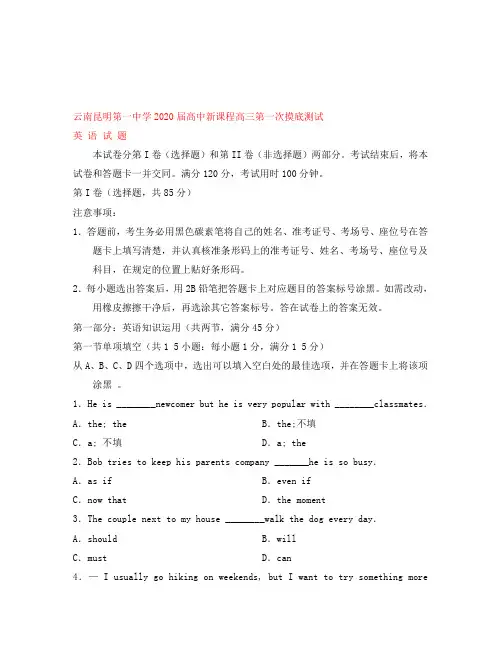
云南昆明第一中学2020届高中新课程高三第一次摸底测试英语试题本试卷分第I卷(选择题)和第II卷(非选择题)两部分。
考试结束后,将本试卷和答题卡一并交同。
满分120分,考试用时100分钟。
第I卷(选择题,共85分)注意事项:1.答题前,考生务必用黑色碳素笔将自己的姓名、准考证号、考场号、座位号在答题卡上填写清楚,并认真核准条形码上的准考证号、姓名、考场号、座位号及科目,在规定的位置上贴好条形码。
2.每小题选出答案后,用2B铅笔把答题卡上对应题目的答案标号涂黑。
如需改动,用橡皮擦擦干净后,再选涂其它答案标号。
答在试卷上的答案无效。
第一部分:英语知识运用(共两节,满分45分)第一节单项填空(共1 5小题:每小题1分,满分1 5分)从A、B、C、D四个选项中,选出可以填入空白处的最佳选项,并在答题卡上将该项涂黑。
1.He is ________newcomer but he is very popular with ________classmates.A.the; the B.the;不填C.a; 不填D.a; the2.Bob tries to keep his parents company _______he is so busy.A.as if B.even ifC.now that D.the moment3.The couple next to my house ________walk the dog every day.A.should B.willC.must D.can4.— I usually go hiking on weekends, but I want to try something morechallenging this time.—A.Let's go.B.Cheer up!C.Like what? D.Take care5.I have to see the doctor.I often see double and can't tell ________ far away things are.A.that B.whereC.what D.how6.— Look, he's late again!— What's excuse he'll ________ this time?A.give out B.make upC.work out D.take up7.Jane sent me an email ________ she explained why she hadn't attended our wedding.A.which B.to whichC.in which D.how8.— Can you get to the meeting-room on time?— Terribly sorry, itA.had rained B.has rainedC.has been raining D.will be raining9.Some people are always playing with their mobile phones _______ they are.A.whoever B.whateverC.whenever D.wherever10.John knows more about Europe as he _______ six European countries last vacation.A.covered B.finishedC.went D.ran11.After all the participants arrived, the judge kept them _______ of what to do next.A.inform B.informingC.informed D.to inform12.Smith gave up smoking, _______ I found a bit surprising.A.which B.thatC.when D.what13.Without our teachers' help we _______.A.won't have succeeded B.won't succeedC.wouldn't have succeeded D.mustn't succeed14.It's hard to believe he learned English so well, for _______ of his parents spoke the language.A.both B.neitherC.any D.none15.Tom told me it was in the library _______ they had met for the first time.A.which B.thatC.where D.in which第二节完形填空(共20小题;每小题1.5分,满分30分)阅读下面短文,从短文后各题所给的四个选项(A、B、C和D)中,选出可以填入空白处的最佳选项,并在答题卡上将该项涂黑。

2024届云南省昆明市第一中学高中新课标高三第一次摸底考试英语试题一、听力选择题1. What is the relationship between the speakers?A.Classmates.B.Teacher and student.C.Salesman and customer.2. Where does the conversation probably take place?A.In a supermarket.B.In a restaurant.C.In a hotel.3.A.He agrees with the woman on school life.B.He has much change after going to college.C.He dislikes his life on campus.D.He has remained the same since last year.4. What does the woman usually carry when she shops?A.A bag.B.A box.C.A basket.5. What is the man’s job probably?A.A novelist.B.A cartoonist.C.A reporter.二、听力选择题6. 听下面一段较长对话,回答以下小题。
1. Who might the woman be?A.The man’s wife.B.The man’s neighbor.C.The man’s landlady.2. What does the woman think of Leo Norris?A.Lazy.B.Competitive.C.Amusing.3. When does Leo Norris want to move in?A.On September 28th.B.On September 30th.C.On October 1st.4. What can we learn from the conversation?A.The man likes cycling very much.B.The woman never gets up until noon on weekends.C.Leo Norris made a good impression on the woman.7. 听下面一段较长对话,回答以下小题。