
ACCA_F9 03
- 格式:ppt
- 大小:578.50 KB
- 文档页数:38
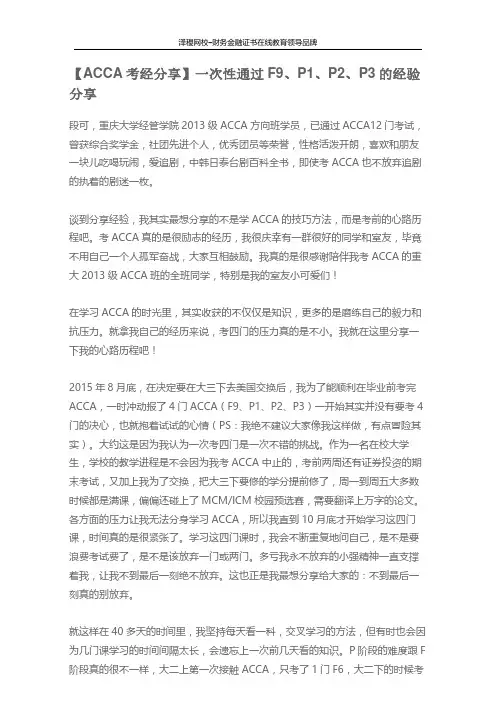
【ACCA考经分享】一次性通过F9、P1、P2、P3的经验分享段可,重庆大学经管学院2013级ACCA方向班学员,已通过ACCA12门考试,曾获综合奖学金,社团先进个人,优秀团员等荣誉,性格活泼开朗,喜欢和朋友一块儿吃喝玩闹,爱追剧,中韩日泰台剧百科全书,即使考ACCA也不放弃追剧的执着的剧迷一枚。
谈到分享经验,我其实最想分享的不是学ACCA的技巧方法,而是考前的心路历程吧。
考ACCA真的是很励志的经历,我很庆幸有一群很好的同学和室友,毕竟不用自己一个人孤军奋战,大家互相鼓励。
我真的是很感谢陪伴我考ACCA的重大2013级ACCA班的全班同学,特别是我的室友小可爱们!在学习ACCA的时光里,其实收获的不仅仅是知识,更多的是磨练自己的毅力和抗压力。
就拿我自己的经历来说,考四门的压力真的是不小。
我就在这里分享一下我的心路历程吧!2015年8月底,在决定要在大三下去美国交换后,我为了能顺利在毕业前考完ACCA,一时冲动报了4门ACCA(F9、P1、P2、P3)一开始其实并没有要考4门的决心,也就抱着试试的心情(PS:我绝不建议大家像我这样做,有点冒险其实)。
大约这是因为我认为一次考四门是一次不错的挑战。
作为一名在校大学生,学校的教学进程是不会因为我考ACCA中止的,考前两周还有证券投资的期末考试,又加上我为了交换,把大三下要修的学分提前修了,周一到周五大多数时候都是满课,偏偏还碰上了MCM/ICM校园预选赛,需要翻译上万字的论文。
各方面的压力让我无法分身学习ACCA,所以我直到10月底才开始学习这四门课,时间真的是很紧张了。
学习这四门课时,我会不断重复地问自己,是不是要浪费考试费了,是不是该放弃一门或两门。
多亏我永不放弃的小强精神一直支撑着我,让我不到最后一刻绝不放弃。
这也正是我最想分享给大家的:不到最后一刻真的别放弃。
就这样在40多天的时间里,我坚持每天看一科,交叉学习的方法,但有时也会因为几门课学习的时间间隔太长,会遗忘上一次前几天看的知识。
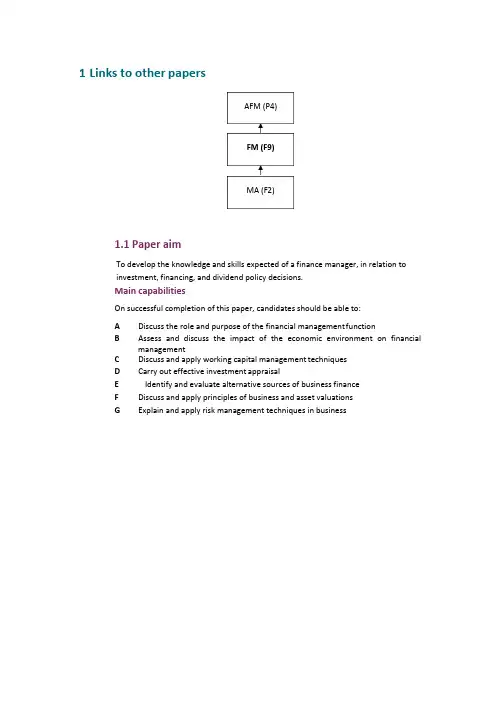
1Links to other papersAFM (P4)FM (F9)MA (F2)1.1 Paper aimTo develop the knowledge and skills expected of a finance manager, in relation toinvestment, financing, and dividend policy decisions.Main capabilitiesOn successful completion of this paper, candidates should be able to:A Discuss the role and purpose of the financial management functionB Assess and discuss the impact of the economic environment on financialmanagementC Discuss and apply working capital management techniquesD Carry out effective investment appraisalE Identify and evaluate alternative sources of business financeF Discuss and apply principles of business and asset valuationsG Explain and apply risk management techniques in businessRelational diagram of main capabilitiesRationaleThe syllabus for Paper F9, Financial Management, is designed to equip candidates with the skills that would be expected from a finance manager responsible for the finance function of a business. The paper, therefore, starts by introducing the role and purpose of the financial management function within a business. Before looking at the three key financial management decisions of investing, financing, and dividend policy, the syllabus explores the economic environment in which such decisions are made.The next section of the syllabus is the introduction of investing decisions. This is done in two stages - investment in (and the management of) working capital and the appraisal of long-term investments.The next area introduced is financing decisions. This section of the syllabus starts by examining the various sources of business finance, including dividend policy and how much finance can be raised from within the business. It also looks at the cost of capital and other factors that influence the choice of the type of capital a business will raise. The principles underlying the valuation of business and financial assets, including the impact of cost of capital on the value of business is covered next.The syllabus finishes with an introduction to, and examination of, risk and the main techniques employed in the management of such risk.The syllabus is assessed by a three-hour 15 minutes paper-based examination. All questions are compulsory. It will contain both computational and discursive elements. Some questions willadopt a scenario/case study approach.Financialmanagement function(A)Financial management environment (B)Working capitalmanagement (C)Investment appraisal(D)Businessfinance (E)Business valuations (F)Riskmanagement (G)Section A of the exam comprises 15 multiple choice questions of 2 marks each.Section B of the exam comprises three scenarios consisting of 15 multiple choice questions of 2 marks each.Section C contains two 20 mark questions.The two 20 mark questions will come from working capital management, investment appraisal and business finance areas of the syllabus. The section A and section B questions can cover any areas of the syllabus.Candidates are provided with a formulae sheet and tables of discount and annuity factors.1.2 Examination techniqueTime managementThe paper is very time pressured. Students should keep track of their time carefully, and not ‘over- run’ on one question to the detriment of another.Question requirementsAlways read the question carefully.。

acca各科考试大纲ACCA各科考试大纲是ACCA考试的重要参考,它详细说明了每门考试科目的内容、考试形式和评分标准。
以下是一些ACCA主要科目的考试大纲概述:1.F1《商业与科技》:本科目涵盖了商业组织、管理、营销、信息技术等方面的知识,旨在测试考生对商业运营和科技应用的理解能力。
2.F2《管理会计》:本科目主要涉及管理会计的基本概念、成本分类、预算编制、差异分析等内容,旨在培养考生的管理会计技能和决策能力。
3.F3《财务会计》:本科目主要考察财务会计的基本原则、财务报表的编制和解读、会计政策的选择等方面,旨在培养考生的财务会计技能和财务报告分析能力。
4.F4《公司法与商法》:本科目主要涉及公司法、合同法、商法等法律领域的基本概念和原则,旨在培养考生的法律意识和商业法律应用能力。
5.F5《业绩管理》:本科目涵盖了业绩评估、成本管理、预算控制等方面的内容,旨在培养考生的业绩管理技能和成本控制能力。
6.F6《税务》:本科目主要涉及税务法规、税务筹划、税务申报等方面的知识,旨在培养考生的税务处理能力和税务筹划能力。
7.F7《财务报告》:本科目是F3的延伸,更深入地探讨了财务报告的编制和分析,包括合并报表、财务分析等内容,旨在培养考生的高级财务报告技能和分析能力。
8.F8《审计与认证业务》:本科目主要涉及审计程序、内部控制评估、风险管理等方面的知识,旨在培养考生的审计技能和风险管理能力。
9.F9《财务管理》:本科目涵盖了投资决策、融资决策、资本结构管理等方面的内容,旨在培养考生的财务管理技能和资本运作能力。
10.P级科目(P1-P7):这些科目是ACCA的高级阶段课程,涵盖了更专业、更深入的领域,如高级业绩管理(P1/P3)、高级财务管理(P2)、高级税务(P6)、高级审计与鉴证(P7)等。
这些科目旨在培养考生在专业领域的高级技能和知识应用能力。

2023年ACCA F9考试大纲2023年ACCA F9考试大纲(以下简称“考纲”)旨在为考生提供关于ACCA F9财务管理考试的详细信息和要求。
本文将按照考纲的要求结构,介绍2023年ACCA F9考试的内容及考核要点。
第一部分:考试结构与形式2023年ACCA F9考试为计算机化考试(CBT),考试时间为3小时。
考试分为两个部分:A部分和B部分。
A部分为选择题,共60个单项选择题和两个多项选择题,共计80分。
每个单项选择题有4个选项,其中只有一个答案正确;每个多项选择题有5个选项,其中两个或以上答案正确。
B部分包含3道案例题,每个案例题含有若干小题,共计20分。
考生需要根据所给情境,进行相关财务管理分析与决策,提供合理解决方案。
答案要求清晰明了,逻辑严密。
考生应在规定的时间内完成试卷,按照考纲要求填涂答题卡。
第二部分:考核内容本部分将详细介绍2023年ACCA F9考试的考核内容,包括各个模块的重点考点和要求。
1. 公司融资和资本结构考生需要了解不同类型的公司融资方式,如股票发行、债务融资等,并能分析其对公司资本结构和风险的影响。
此外,要掌握资本成本的计算方法和资本结构优化的原则。
2. 长期投资决策考生需要学习如何评估和选择不同的长期投资项目,如现金流量分析、折现率计算、风险评估等。
能够运用相关的财务工具和技巧,做出明智的投资决策。
3. 资本预算考生需要了解资本预算的重要性和作用,包括资本预算的目标、技术评价指标,以及针对不同项目的资本预算方法。
能够进行资本预算分析和决策,为公司提供有效的财务建议。
4. 资本与财务结构考生需要了解资本结构的影响因素和财务杠杆效应的计算方法。
并能够评估资本结构与财务风险之间的关系,为公司选择适合的资本结构并管理财务风险。
5. 财务风险管理考生需要熟悉不同类型的财务风险,如利率风险、外汇风险、流动性风险等,并能运用衍生品工具进行风险管理。
了解并掌握杠杆和套利的原则,以及风险管理策略的制定。