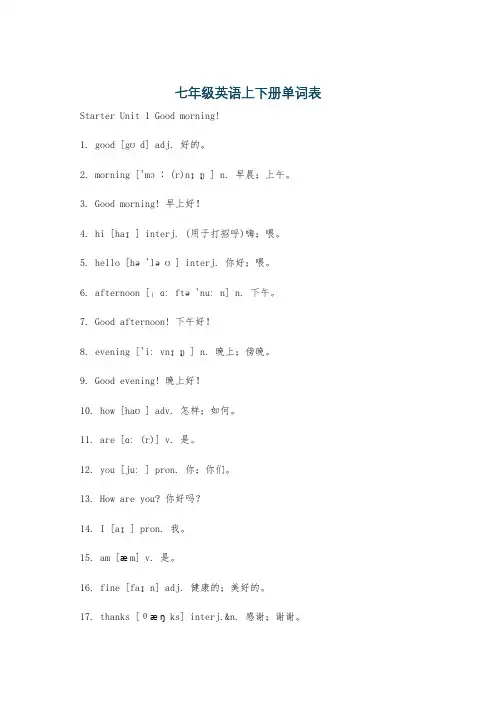
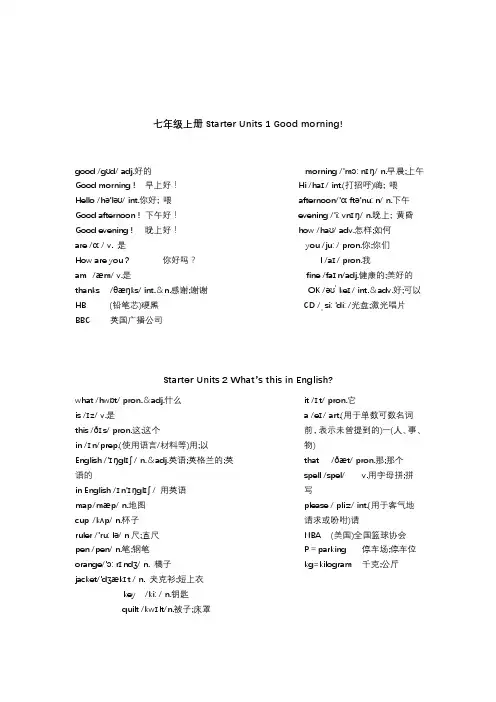
七年级英语上下册重点单词
- 格式:docx
- 大小:14.60 KB
- 文档页数:6
七年级英语上下册重点单词
Unit 1: Greetings
1. hello
- Definition: used to greet someone or attract attention.
- Example: Hello, how are you?
- Usage: It is a common greeting used in both formal and informal situations.
2. hi
- Definition: an informal greeting or expression of surprise.
- Example: Hi, I'm Tom.
- Usage: It is commonly used among friends and acquaintances in casual
conversations.
3. good morning
- Definition: a polite greeting used in the morning until around noon.
- Example: Good morning, have a great day!
- Usage: It is mainly used in formal situations, such as greeting colleagues
or teachers in the morning.
4. good afternoon
- Definition: a polite greeting used in the afternoon until around sunset.
- Example: Good afternoon, how can I help you?
- Usage: Similar to "good morning," it is used in formal situations during the
afternoon.
5. good evening
- Definition: a polite greeting used in the evening, typically after sunset.
- Example: Good evening, may I take your order?
- Usage: It is also used in formal situations when greeting someone in the
evening.
6. goodbye
- Definition: used to express good wishes when parting from someone.
- Example: Goodbye, see you tomorrow!
- Usage: It is commonly used when leaving someone or saying farewell.
7. goodnight
- Definition: used to express good wishes when parting from someone before
going to sleep. - Example: Goodnight, sleep tight!
- Usage: It is commonly used before going to bed or when saying goodnight to
someone.
Unit 2: Personal Pronouns
1. I
- Definition: the first person singular pronoun.
- Example: I am a student.
- Usage: It is used when referring to oneself.
2. you
- Definition: the second person pronoun, both singular and plural.
- Example: You are my best friend.
- Usage: It is used when referring to the person or people being spoken to.
3. he
- Definition: the third person singular masculine pronoun.
- Example: He is my brother.
- Usage: It is used when referring to a male subject.
4. she
- Definition: the third person singular feminine pronoun.
- Example: She is my sister.
- Usage: It is used when referring to a female subject.
5. it
- Definition: the third person singular neuter pronoun.
- Example: It is a cat.
- Usage: It is used when referring to objects, animals, or things that do not
have a specific gender.
6. we
- Definition: the first person plural pronoun.
- Example: We are going to the park.
- Usage: It is used when referring to a group of people that includes the
speaker.
7. they
- Definition: the third person plural pronoun.
- Example: They are my friends.
- Usage: It is used when referring to a group of people that does not include the speaker.
Unit 3: Numbers
1. one
- Definition: the number or quantity that follows zero and precedes two.
- Example: I have one pen.
- Usage: It is used to represent the number one in counting or when referring
to a single item.
2. two
- Definition: the number or quantity that follows one and precedes three.
- Example: There are two cats.
- Usage: It is used to represent the number two in counting or when referring
to a pair or couple.
3. three
- Definition: the number or quantity that follows two and precedes four.
- Example: I have three books.
- Usage: It is used to represent the number three in counting or when
referring to a small group of items.
4. four
- Definition: the number or quantity that follows three and precedes five.
- Example: There are four chairs in the room.
- Usage: It is used to represent the number four in counting or when referring
to a small group of items.
5. five
- Definition: the number or quantity that follows four and precedes six.
- Example: I have five fingers.
- Usage: It is used to represent the number five in counting or when referring
to a small group of items.
6. six
- Definition: the number or quantity that follows five and precedes seven.
- Example: There are six students in the class.
- Usage: It is used to represent the number six in counting or when referring
to a small group of items.
7. seven
- Definition: the number or quantity that follows six and precedes eight.