
八年级牛津(SZY)2012-2013年上学期 第8期答案
- 格式:doc
- 大小:27.50 KB
- 文档页数:2


牛津版英语初二上学期复习试卷与参考答案一、听力部分(本大题有20小题,每小题1分,共20分)1、Listen to the dialogue and answer the question.W: Hi, John! How was your math test yesterday?M: Oh, it was quite challenging. I think I did okay, but I’m not sure about the last question.Q: What did John think about the last question on the math test?A: He’s not sure about it.B: He thinks it was easy.C: He thinks it was challenging but he did well.Answer: AExplanation: In the dialogue, John says, “I think I did okay, but I’m not sure about the last question.” This indicates that he is unsure about the last question.2、Listen to the conversation and choose the best answer to the question.M: Have you finished reading the science book for our assignment?W: Not yet, I’m still on Chapter 5. It’s a bit difficult to understand.Q: What does the woman mean when she says “It’s a bit difficult to understand”?A: The book is easy for her to read.B: She has finished reading the entire book.C: The science book is too difficult for her.Answer: CExplanation: The woman says “It’s a bit difficult to understand,” which implies that the science book is challenging for her. Therefore, the correct answer is C.3、What subject have the students decided to do their project on?•A) History•B) Biology•C) MathematicsCorrect Answer: B) BiologyExplanation: In the dialogue, the male student mentions that they have decided on biology as the subject for their project because it’s his favorite and he knows a lot about it.4、Why did the female student agree to do the project on biology?•A) She loves biology too.•B) The male student is good at biology and can help her.•C) It is the easiest subject for her.Correct Answer: B) The male student is good at biology and can help her.Explanation: The female student states that although she struggles with biology, she agrees because her partner is very knowledgeable in this area and has offered to assist her with the project.Note: This is a hypothetical scenario designed for educational purposes.Actual listening materials would typically be accompanied by audio clips.5、Listen to the conversation and choose the best answer to the question you hear.Question: What is the woman’s opinion about the movie the man wants to watch?A. She thi nks it’s a great movie to watch.B. She suggests they go to the cinema instead.C. She believes the movie is too violent for children.D. She prefers to watch a different movie together.Answer: CExplanation: In the conversation, the woman says, “I think that movie is too violent for children. Maybe we should choose something else.”6、Listen to the dialogue and answer the following question.Question: Why does the man not want to go to the library today?A. He needs to finish his homework.B. He has to work late tonight.C. The library is too crowded.D. He doesn’t have enough time.Answer: AExplanation: The man explains, “I have a lot of homework to finish tonight, so I can’t go to the library today.”7、What topic did the student choose for her history project?A. The impact of technology on society.B. The history of space exploration.C. The role of music in cultural development.Answer: B.Explanation: In the dialogue, the student mentions that she chose to focus on the history of space exploration beca use she’s always been fascinated by the advancements made in getting humans into space.8、When is the deadline for submitting the project?A. Next Monday.B. Next Friday.C. This Wednesday.Answer: A.Explanation: The teacher clearly states in the conversation that the deadline for submission is next Monday, giving the student some extra days to finalize her research and presentation.9、What does the speaker suggest to do after the game?A. Go to the cinema.B. Have a rest.C. Continue playing.Answer: BExplanation: The speaker says, “Well, after the game, you all can take a break and have some snacks. It’s been a long day.” This implies that after the game, the speaker suggests taking a break, which is option B.10、How does the weather forecast for the weekend sound?A. It will be sunny and warm.B. It will be rainy and cold.C. It will be windy and cool.Answer: AExplanatio n: The speaker says, “According to the weather forecast, it will be sunny and warm this weekend. Perfect for outdoor activities!” This indicates that the forecast for the weekend is sunny and warm, which is option A.11、Conversation:M: Excuse me, could you tell me where the nearest bookstore is?W: Sure, it’s just two blocks straight ahead on the right side.Question:Where is the bookstore located?A. Three blocks down on the left.B. Two blocks straight ahead on the right.C. Right next to the post office.Answer: B. Two blocks straight ahead on the right.Explanation:The woman clearly states that the bookstore is just two blocks straight ahead on the right side.12、Conversation:W: I heard you’re planning a trip to Europe during summer break. Which coun try are you visiting first?M: Yes, I’m starting with France because I want to practice my French.Question:Which country is the man visiting first?A. GermanyB. ItalyC. FranceAnswer: C. FranceExplanation: The man mentions he is starting with France because he wants to practice his French, indicating that France is his first destination.13.Listen to the dialogue and answer the question.W: Hi, John. How was your science test yesterday?M: Oh, it was okay, but I’m not sure about my grade. How about you, Mary?W: I think I did well. I got all the questions right except for one.Question: How did John feel about his science test?A. He was confident.B. He was worried about his grade.C. He didn’t care about the test.D. He thought it was too easy.Answer: BExplanation: John said, “Oh, it was okay, but I’m not sure about my grade.” This indicates that he was worried about his grade.14.Listen to the conversation and choose the correct answer.M: Do you think we should study for the upcoming history exam?W: Absolutely! It’s important to review the material because the questions can be tricky.Question: What do the speakers think about the history exam?A. They think it will be easy.B. They think it will be difficult.C. They think it’s not necessary to study.D. They don’t know anything about the exam.Answer: BExplanation: The speaker said, “It’s important to review the material because the questions can be tricky.” This suggests that they think the exam will be difficult.15、(Conversation)M: Hey Jane, have you finished reading Chapter 7 of our history book? We have a test on it next week.W: Yes, I finished it yesterday. It’s all about the Industrial Revolution. Did you know it started in Britain around 1760?(Question)What topic does the conversation mention as being covered in Chapter 7?A. World War IIB. The RenaissanceC. The Industrial RevolutionD. The Cold WarAnswer: C. The Industrial RevolutionExplanation: The conversation clearly mentions that Chapter 7 is about the Industrial Revolution, which began in Britain around 1760.16、(Conversation)W: Hi Tom, I heard you’re going to join the school band. What instrument are you going to play?M: Well, I’ve been practicing the trumpet for a few months now, but my parents want me to play the violin like my sister. I’m not sure what to do.(Question)What dilemma is Tom facing?A. Choosing between playing football and basketballB. Selecting a science fair project topicC. Deciding whether to play the trumpet or violin in the bandD. Picking a subject to study harder for examsAnswer: C. Deciding whether to play the trumpet or violin in the band Explanation: Tom mentioned that he has been practicing the trumpet but his parents want him to play the violin. This indicates that he is unsure about which instrument to choose for the school band.17.You are listening to a conversation between two students, Sarah and Tom, discussing their weekend plans.Sarah: Hey Tom, have you d ecided what you’re going to do this weekend?Tom: Yeah, I’m thinking of going hiking. How about you, Sarah?Sarah: That sounds fun! I was actually planning to go to the beach. Do you want to join me?Tom: Sure, but I need to check the weather forecast firs t. Are you sure it’s going to be sunny?Sarah: I think so. I’ve been checking the weather app, and it says it’ll be clear all weekend.Tom: Alright, I’ll check the forecast too. Maybe we can go hiking on Saturday and the beach on Sunday.Question: What is Tom’s initial plan for this weekend?A) Go to the beachB) Go hikingC) Stay at homeD) Go shoppingAnswer: B) Go hikingExplanation: In the conversation, Tom says, “I’m thinking of going hiking,” which indicates that his initial plan is to go hiking.18.You are listening to a phone conversation between a teacher, Mr. Smith, and a student, Lisa.Mr. Smith: Hello, Lisa. This is Mr. Smith calling from the school. How are you doing today?Lisa: Hi, Mr. Smith. I’m doing well, thanks. How about you?Mr. Smith: I’m good, thanks. I wanted to discuss your recent performance in the math class. I noticed that you haven’t been attending class regularly.Lisa: I apologize for that, Mr. Smith. I’ve been dealing with some personal issues lately. I promise I’ll try to be m ore punctual from now on.Mr. Smith: I understand, Lisa. However, it’s important for you to be present in class to keep up with the material. Have you considered seeking help from a tutor?Lisa: Yes, I have. I’m going to talk to my parents about finding a tutor to help me catch up.Question: What is Mr. Smith’s concern about Lisa?A) She has been absent from classB) She is not performing well in mathC) She is dealing with personal issuesD) She needs to find a tutorAnswer: A) She has been absent from classExplanation: Mr. Smith mentions that he noticed Lisa hasn’t been attending class regularly, indicating his concern about her absence from class.19.You are listening to a conversation between two students discussing their weekend plans.A)They are planning to go hiking.B)They are planning to watch a movie.C)They are planning to go shopping.Answer: BExplanation: The conversation mentions that they will be watching a new movie that just came out, indicating their plan to go to the cinema. Therefore, the correct answer is B) They are planning to watch a movie.20.A teacher is asking students about their favorite subject in school.A)The student says, “I like science the best.”B)The student says, “Math is my favorite subject.”C)The student says, “I prefer English.”Answer: AExplanation: The student explicitly states, “I like science the best,” which means science is their favorite subject. Therefore, the correct answer is A) The student says, “I like science the best.”二、阅读理解(30分)Reading ComprehensionRead the following passage carefully and answer the questions that follow.The Internet has revolutionized the way we communicate, access information, and conduct business. With just a few clicks, we can connect with people from all over the world, gather knowledge on almost any topic, and even purchase goods without leaving our homes. However, this convenience comes with its own set of challenges, such as information overload and privacy concerns.One of the most significant benefits of the Internet is its ability to provide instant access to a vast amount of information. In the past, students had to rely on libraries and textbooks to find the information they needed forschool projects. Now, with just a few keystrokes, they can search for articles, videos, and educational resources online. This has greatly enhanced the learning experience and made research more efficient.Despite its advantages, the Internet also poses some risks. One major concern is the spread of misinformation. With so much content available online, it can be difficult to discern what is true and what is false. This can lead to confusion and misinformed decisions. Another risk is cyberbullying, which has become a growing problem among young people. Online platforms can provide a sense of anonymity, making it easier for individuals to harass or intimidate others.The following is an excerpt from an article about the impact of the Internet on education.Excerpt:“Education has been transformed by the Internet. Students can now access online courses, participate in virtual classrooms, and even earn degrees from prestigious universities without ever setting foot on campus. This has opened up new opportunities for learners who may not have had access to traditional educational institutions.”Questions:1.What is the main advantage of the Internet mentioned in the passage?A) It provides instant access to a vast amount of information.B) It allows people to communicate with others from all over the world.C) It has made libraries and textbooks obsolete.D) It eliminates the need for cyberbullying.2.According to the passage, what is one major concern regarding the Internet?A) It makes learning more inefficient.B) It increases the risk of misinformation and cyberbullying.C) It limits access to prestigious universities.D) It reduces the need for traditional educational institutions.3.Which of the following statements is supported by the excerpt?A) Online courses have become less popular due to the convenience of traditional education.B) Students can now only earn degrees from prestigious universities online.C) The Internet has made it easier for students to access and participate in education.D) The Internet has had no impact on the traditional educational system.Answers:1.A) It provides instant access to a vast amount of information.2.B) It increases the risk of misinformation and cyberbullying.3.C) The Internet has made it easier for students to access and participate in education.三、完型填空(15分)Task: Fill in the blanks with the appropriate words.If you are a beginner, it’s important to start with simple exercises. Manystudents believe that learning a language is difficult, but with practice and persistence, [1]___.The first step in learning English is to [2]. It is recommended to begin with [3]. This will help you get familiar with the pronunciation and rhythm of the language.One effective way to improve your listening skills is to [4]. Try to listen to [5]. This will not only help you understand the language better but also improve your pronunciation.1.A. becomes easyB. becomes challengingC. becomes enjoyableD. becomes frustrating2.A. taking frequent breaksB. setting realistic goalsC. memorizing vocabularyD. avoiding mistakes3.A. grammar rulesB. simple sentencesC. advanced conversationsD. professional literature4.A. reading out loudB. writing essaysC. watching moviesD. practicing grammar5.A. English songsB. technical manualsC. news broadcastsD. children’s storiesAnswer:1.C. becomes enjoyable2.B. setting realistic goals3.B. simple sentences4.C. watching movies5.A. English songs四、语法填空题(本大题有10小题,每小题1分,共10分)1、The teacher told us that we would have a vacation next week. However, it turned out that the vacation was canceled.答案:However解析:根据句意,这里需要一个表示转折关系的词。
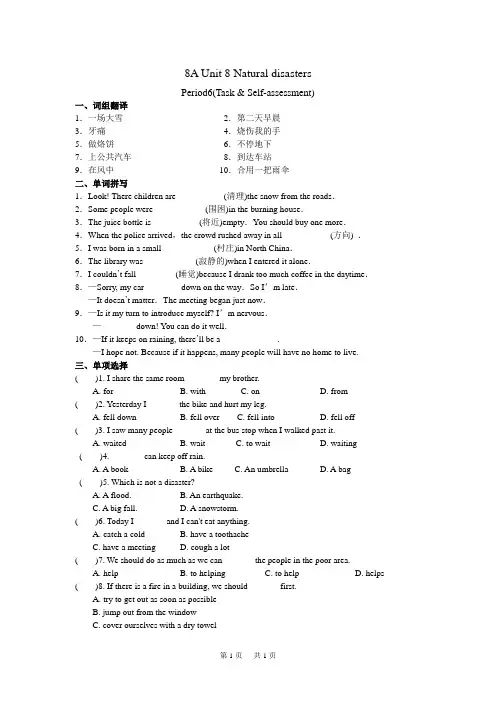
8A Unit 8 Natural disastersPeriod6(Task & Self-assessment)一、词组翻译1.一场大雪___________________ 2.第二天早晨________________________ 3.牙痛_______________________ 4.烧伤我的手________________________ 5.做烙饼_____________________ 6.不停地下__________________________ 7.上公共汽车_________________ 8.到达车站__________________________ 9.在风中_____________________ 10.合用一把雨伞______________________ 二、单词拼写1.Look! There children are___________(清理)the snow from the roads.2.Some people were____________(围困)in the burning house.3.The juice bottle is___________(将近)empty.You should buy one more.4.When the police arrived,the crowd rushed away in all___________(方向) .5.I was born in a small____________(村庄)in North China.6.The library was____________(寂静的)when I entered it alone.7.I couldn’t fall_________(睡觉)because I drank too much coffee in the daytime.8.—Sorry, my car ________down on the way.So I’m late.—It doesn’t matter.The meeting began just now.9.—Is it my turn to introduce myself? I’m nervous.—________down! You can do it well.10.—If it keeps on raining, there’ll be a_____________.—I hope not. Because if it happens, many people will have no home to live.三、单项选择( )1. I share the same room _______ my brother.A. forB. withC. onD. from( )2. Yesterday I_______ the bike and hurt my leg.A. fell downB. fell overC. fell intoD. fell off( )3. I saw many people_______ at the bus stop when I walked past it.A. waitedB. waitC. to waitD. waiting ( )4. _______ can keep off rain.A. A bookB. A bikeC. An umbrellaD. A bag( )5. Which is not a disaster?A. A flood.B. An earthquake.C. A big fall.D. A snowstorm.( )6. Today I_______ and I can't eat anything.A. catch a coldB. have a toothacheC. have a meetingD. cough a lot( )7. We should do as much as we can_______ the people in the poor area.A. helpB. to helpingC. to helpD. helps ( )8. If there is a fire in a building, we should _______first.A. try to get out as soon as possibleB. jump out from the windowC. cover ourselves with a dry towelD. hide under a strong desk or a table四、同义句改写1. Lily and I used one umbrella in the rain.Lily_______ the umbrella_______ me in the ram.2. What a strong wind last night!_______ _______ it_______ last night!3. We didn't know where we could go.We didn't know_______ _______ _______.4. The flood killed thousands of people.Thousands of people_______ _______ _______ in the flood.5. He drove slowly because it was very foggy.He drove slowly because_______ the_______ _______.五、完形填空An earthquake may hit some places 1 any time.Do you know 2 in an earthquake? Let me 3 you.During a quake,if you are outside, you must get into the open air and stay away 4 buildings,trees and 5 .things.If you are inside,you must stand in a doorway (门口) 6 in a corner,or under a heavy desk or table.If you drive a car,a truck or a bus,you must drive to the side of the road and stop.After a quake,you must check everyone in your family for 7 and see if gas,water and electrical lines(电线) 8 OK.Please don’t strike matches or light fires.A gas line may be 9 .You must keep the telephone lines clear.Don’t use your phone or drive your car 10 you are badly in need.( )1.A.in B.at C.for D.during( )2.A.to do what B.how to do C.what to do D.what do( )3.A.to tell B.telling C.to telling D.tell( )4.A.from B.to C.near D.close to( )5.A.other danger B.others dangerousC.others danger D.other dangerous( )6.A.and B.or C.but D.except( )7.A.safe B.safely C.safety D.save( )8.A.are B.is C.were D.was( )9.A.breaks B.broken、C.broke D.break( )10.A.when B.until C.if D.maybe六、阅读理解Today there are many fires than in the past. Over 100,000 wildfires burn each year in America. Russia has 20,000 to 35,000 wildfires every year. Australia has on average 60,000 each year. These fires destroy(损害)huge areas of forests and burn hundreds of homes.Many experts believe there are several reasons for this sudden increase in fires. The first reason is climate(气候)change. Recent weather has been warmer and drier. This leads to dangerous fire conditions. When lightening strikes(发生雷电),dry grass easily catches fire. Hot winds add to the problem. The wind spreads a fire quickly. In 2010, Russia had the hottest and driest summer in a century. In just one month, 500 fires destroyed over 2,000 homes. Some people lost their lives.Traditional fire-fighting practices are another reason for the increase in fires. In America, firefighters used to quickly put out every fire. They didn’t allow the grass and trees to burn. As a result, today many forests have thicker vegetation(植被).Thicker vegetation means more fuel(燃料)for fires. Also, without fires from time to time, forests become overcrowded and unhealthy. Some trees are dead. The dead wood then easily catches fire. So surprisingly, America has many more fires today partly because of its past fire-fighting practices.Scientists now understand that a fire can be a natural part of a healthy forest. As a result, countries like Australia allow more fires to burn naturally. Sometimes, fire fighters even start fires to get rid of(去除)dead wood. Of course, they carefully control the fires. The fire thins out old trees. This allows sunlight to reach the ground. As a result, fires help new trees to grow. Therefore, if a fire is not a serious threat(威胁)to people, firefighters may let it burn naturally.1. Why did Russia have so many fires in one month in 2010?A. Because lightening spread the fire.B. Because there was much fuel for fires.C. Because there were not enough firefighters.D. Because it was unusually hot, dry and windy.2. What happens because of the traditional fire-fighting practices in the USA?A. There are fewer wildfires.B. Trees and grass become thicker.C. The weather becomes warmer and drier.D. Sunlight reaches the ground to help forests.3. What is the main idea of Paragraph 4?A. Fires are serious threats to human beings.B. Australian firefighters don’t put out fires.C. Fires can play an important role I forests.D. It’s difficult for firefighters to control the fires.4. Which of the following is true according to the passage?A. Not all the fires in the forests must be put out.B. People’s carelessness leads to dangerous fires.C. Australia allows all the fires to burn naturally.D. There are more fires in Russia than in the USA.七、书面表达根据以下提示,描述你所看到的一次沙尘暴(sandstorm)。
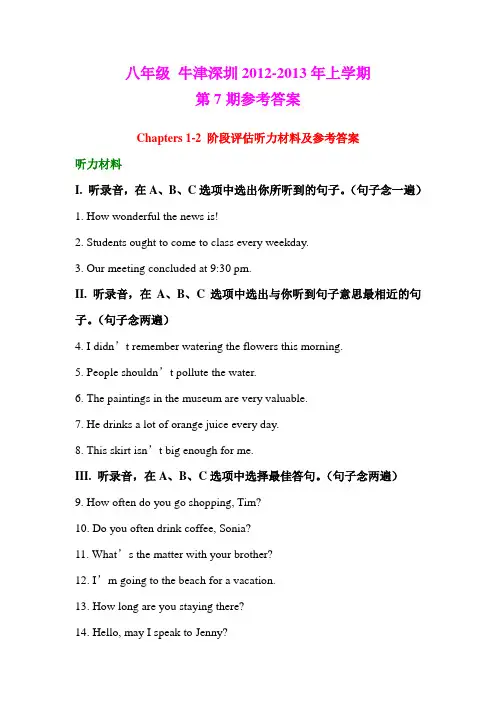
八年级牛津深圳2012-2013年上学期第7期参考答案Chapters 1-2 阶段评估听力材料及参考答案听力材料I. 听录音,在A、B、C选项中选出你所听到的句子。
(句子念一遍)1. How wonderful the news is!2. Students ought to come to class every weekday.3. Our meeting concluded at 9:30 pm.II. 听录音,在A、B、C选项中选出与你听到句子意思最相近的句子。
(句子念两遍)4. I didn’t remember watering the flowers this morning.5. People shouldn’t pollute the water.6. The paintings in the museum are very valuable.7. He drinks a lot of orange juice every day.8. This skirt isn’t big enough for me.III. 听录音,在A、B、C选项中选择最佳答句。
(句子念两遍)9. How often do you go shopping, Tim?10. Do you often drink coffee, Sonia?11. What’s the matter with your brother?12. I’m going to the beach for a vacation.13. How long are you staying there?14. Hello, may I speak to Jenny?15. Would you like to come and cheer me on?IV. 听短文,从下面每小题的A、B、C三个选项中选择最佳答案。
(读两遍)下面你有15秒钟的时间阅读16-20小题。
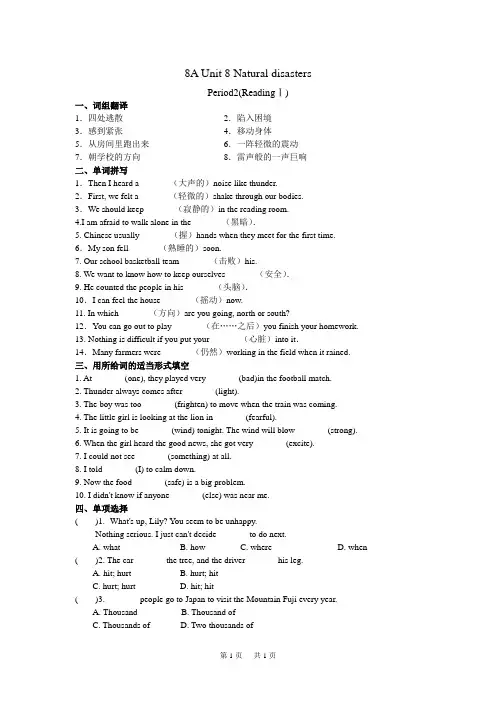
8A Unit 8 Natural disastersPeriod2(ReadingⅠ)一、词组翻译1.四处逃散____________________ 2.陷入困境_________________________ 3.感到紧张____________________ 4.移动身体_________________________ 5.从房间里跑出来______________ 6.一阵轻微的震动___________________ 7.朝学校的方向________________ 8.雷声般的一声巨响_________________ 二、单词拼写1.Then I heard a_______(大声的)noise like thunder.2.First, we felt a_______(轻微的)shake through our bodies.3.We should keep_______(寂静的)in the reading room.4.I am afraid to walk alone in the_______(黑暗).5. Chinese usually_______(握)hands when they meet for the first time.6.My son fell_______(熟睡的)soon.7. Our school basketball team_______(击败)his.8. We want to know how to keep ourselves_______(安全).9. He counted the people in his_______(头脑).10.I can feel the house_______(摇动)now.11. In which_______(方向)are you going, north or south?12.You can go out to play_______(在……之后)you finish your homework.13. Nothing is difficult if you put your_______(心脏)into it.14.Many farmers were_______(仍然)working in the field when it rained.三、用所给词的适当形式填空1. At_______ (one), they played very_______ (bad)in the football match.2. Thunder always comes after_______ (light).3. The boy was too_______ (frighten) to move when the train was coming.4. The little girl is looking at the lion in_______ (fearful).5. It is going to be_______ (wind) tonight. The wind will blow_______ (strong).6. When the girl heard the good news, she got very_______ (excite).7. I could not see_______ (something) at all.8. I told_______ (I) to calm down.9. Now the food_______ (safe) is a big problem.10. I didn't know if anyone_______ (else) was near me.四、单项选择( )1. -What's up, Lily? You seem to be unhappy.-Nothing serious. I just can't decide_______ to do next.A. whatB. howC. whereD. when ( )2. The car_______ the tree, and the driver_______ his leg.A. hit; hurtB. hurt; hitC. hurt; hurtD. hit; hit( )3. _______ people go to Japan to visit the Mountain Fuji every year.A. ThousandB. Thousand ofC. Thousands ofD. Two thousands of( )4. Betty didn't come to school yesterday_______ she was ill.A. butB. thanC. ifD. because( )5. They waited and waited, and_______ he came back.A. at once B.at first C.at the end D.at last( )6. I tried to_______ but could _______ nothing.A. hear; listenB. listen; hearC. listen; listenD. hear; hear( )7. We were all very_______ since we _______ the sunrise at last.A. exciting; sawB. excited; looked.C. exciting; lookedD. excited; saw( )8. I want to put up a bookshelf _______ my bed.A. belowB. aboveC. inD. with( )9. Timmy was_______ after he went to bed.A. fall asleepB. fell asleepC. soon asleepD. fast asleep( )10. -What do you think of the lecture of Li Yang's Crazy English?-I think it's_______ ,but someone thinks it's much too_______.A. wonderful enough; boredB. enough wonderful; boringC. wonderful enough; boringD. enough wonderful; bored五、句型转换1. Tom didn't have his breakfast and went to school in a hurry.(改为同义句)Tom_______ _______ school in a hurry_______ breakfast.2.Animals ran wildly everywhere.(改为同义句)Animals ran in_______ _______.3.They were watching TV at that time.(对画线部分提问)_______ were they_______ at that time?4. You are ill. You don't have to go to school.(用since将两个句子改为主从复合句)_____________________________________________________________________________ 六、完形填空After the earthquake took place (发生), I found 1 in the dark. I couldn't move. The bottom(底部) parts of 2 my legs and my feet were hurting 3 . All around me was quiet. But below me I could hear shouts and a lot of noise. Then I remembered 4 had happened, I had been in an earthquake.For about two hours nobody came. 5 I could reach the bag of apples, so at least I had much to eat. Then I heard people 6 to me. A team of people had come to see 7 anyone was under the broken road. I called out "I'm here!" I heard a shout. Soon a stranger climbed to the bridge near my car. "How are you doing?" he asked. "Not too bad," I said, "but my feet and legs feel 8 they're broken". "We'll do our best 9 you out of there," he said. They didn't get me out 10 the next morning. I had been in my car for fourteen hours.( )1. A. me B. mine C. him D. myself( )2. A. other B. either C. both D. all( )3. A. well B. bad C. better D. badly( )4. A. what B. how C. when D. why( )5. A. Quickly B. Quietly C. Luckily D. Sadly( )6. A. running B. walking C. climbing D. going( )7. A. how B. if C. where D. why( )8. A. which B. because C. as if D. when( )9. A. to look B. to take C. to put D. to get( )10. A. that B. until C. since D. as七、阅读理解In March 1964, Alaska began to shake. There was a great earthquake. It was the biggest earthquake the country ever had.Shops and houses fell down. One street dropped 30 feet. One island rose about 11 metres into the air. Parts of the sea bottom became dry land. People felt the earthquake hundreds of kilometers away.Each year there are many earthquakes. Most of them are small. They happen in different parts of the world. We are not sure what makes them. But if you are near, you can see the earth move. You may see a big crack(裂缝) in the ground. Sometimes the land drops on one side of the crack. It goes up on the other side of the crack. There is a new hill, The old world has a new shape. ( )1. The strongest earthquake in Alaska happened in_______.A. April 1967B. June 1864C. March 1964D. May 1867( )2. The word "earthquake" in the story means_______.A. a sudden dropping of the islandB. the making of a new hillC. a strong shaking or moving of the groundD. the rising and falling of the sea bottom( )3. The story wants to tell us_______.A. earthquakes change the landR houses fall down and streets are brokenC. Alaska shakes a lotD. how the strongest earthquake happened( )4. From the story we know earthquakes happen _______.A. in shops and other buildingsB. only in big citiesC. in small countriesD. in different parts of the world( )5. From this story we can see_______.A. earthquakes often do a lot of harmB. people are trying to stop earthquakesC. the bottom of the sea is nearly dryD. most people are afraid of earthquakes八、翻译句子1.当事故发生时,学生们惊恐地尖叫。