animal 1
- 格式:ppt
- 大小:288.50 KB
- 文档页数:7

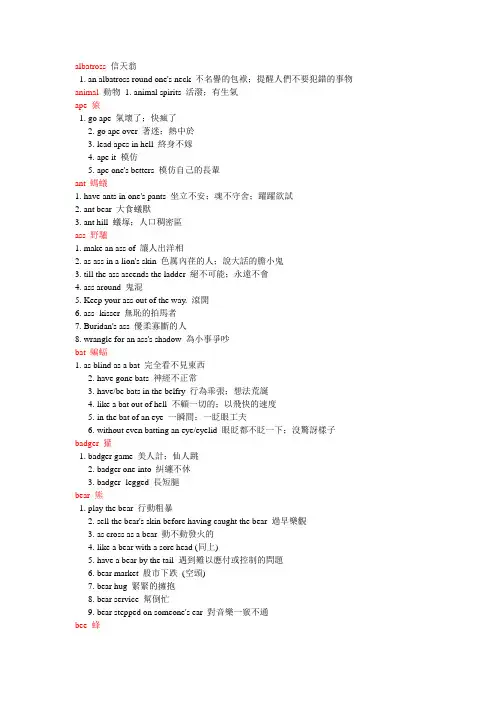
albatross 信天翁1. an albatross round one's neck 不名譽的包袱;提醒人們不要犯錯的事物animal動物1. animal spirits 活潑;有生氣ape 猿1. go ape 氣壞了;快瘋了2. go ape over 著迷;熱中於3. lead apes in hell 終身不嫁4. ape it 模仿5. ape one's betters 模仿自己的長輩ant 螞蟻1. have ants in one's pants 坐立不安;魂不守舍;躍躍欲試2. ant bear 大食蟻獸3. ant hill 蟻塚;人口稠密區ass 野驢1. make an ass of 讓人出洋相2. as ass in a lion's skin 色厲內荏的人;說大話的膽小鬼3. till the ass ascends the ladder 絕不可能;永遠不會4. ass around 鬼混5. Keep your ass out of the way. 滾開6. ass- kisser 無恥的拍馬者7. Buridan's ass 優柔寡斷的人8. wrangle for an ass's shadow 為小事爭吵bat 蝙蝠1. as blind as a bat 完全看不見東西2. have gone bats 神經不正常3. have/be bats in the belfry 行為乖張;想法荒誕4. like a bat out of hell 不顧一切的;以飛快的速度5. in the bat of an eye 一瞬間;一眨眼工夫6. without even batting an eye/eyelid 眼眨都不眨一下;沒驚訝樣子badger 獾1. badger game 美人計;仙人跳2. badger one into 糾纏不休3. badger- legged 長短腿bear 熊1. play the bear 行動粗暴2. sell the bear's skin before having caught the bear 過早樂觀3. as cross as a bear 動不動發火的4. like a bear with a sore head (同上)5. have a bear by the tail 遇到難以應付或控制的問題6. bear market 股市下跌(空頭)7. bear hug 緊緊的擁抱8. bear service 幫倒忙9. bear stepped on someone's ear 對音樂一竅不通bee 蜂1. as busy as a bee 忙得團團轉2. spelling bee 拼字比賽3. the bee's knees 頂尖人物;了不起的人或事4. bee bites 打針的痕跡5. a bee in his head 想得入了迷6. bee- line 直線;近路7. bee in one's bonnet 奇怪思想beaver 狸1. beaver away 努力幹活2. eager beaver 工作特別賣力的人;常用來嘲諷討好上司的同事beetle 甲蟲1. beetle off/away 不想讓人發現地匆匆走開bird 鳥1. eat like a bird 吃得很少2. do bird 坐牢;服刑3. get the bird 被喝倒采;被解雇;被開除4. give one the bird 發出噓聲;喝倒采5. for the birds 可笑的;毫無價值的6. birds of a feather 志趣相同;臭味相投7. a bird in the hand 到手的東西;成定局的事情8. the birds and (the) bees 有關性的基本常識9. kill two birds with one stone 一箭雙鵰;一舉兩得10. a little bird told me 我聽說11. The bird has flown. 人去樓空12. Birds of a feather flock together. 物以類聚13. The early bird gets the worm. 捷足先登14. A bird in the hand is worth two in the bush. 一鳥在手勝過兩鳥在林15. bird cage 鳥籠;小客棧;戰俘營;女子宿舍16. bird call 哨子;鳥叫聲17. bird dog 捕鳥獵犬;搜羅人才者18. bird fancier 愛玩鳥的人;鳥販子19. bird in one's bosom 良心;內心的秘密20. bird in the bush 未到手的東西;未定局的事情21. bird man 捕鳥者;鳥類學家;飛行員22. bird of Jove (Jupiter) 鷹23. bird of Juno 孔雀24. bird of one's own hatching 自作自受;自作孽25. bird of paradise 極樂鳥26. bird of passage 候鳥;到處漂泊者;行蹤不定的人27. bird's eye view 鳥瞰圖28. bird of ill omen 報凶訊的人;不吉利的人29. have an egg from the oof bird 接受遺產( oof : 錢)30. old bird 老鳥;謹慎老練的人31. put a pinch of salt on a bird's tail 使落圈套bull 公牛1. bull market 股市上揚(多頭)2. take the bull by the horns 挺身面對問題3. hit the bull's eye 射中標的;說話中肯4. a bull in a china shop 行事笨拙、魯莽5. shoot the bull 吹牛6. like a bull at a gate 兇猛的7. bull one's way through a crowd 從人群中硬擠過去8. a red rag to a bull 使人生氣的原因9. bull fiddle 大提琴10. bull session 閒談11. bull- back 障礙12. bulldog 牛頭犬;頑固的人13. John Bull 英國;英國人butterfly 蝶1. social butterfly 交際花2. have/get butterflies in one's stomach 忐忑不安3. butterfly table 桌面兩端可以折下的桌子cat 貓1. Curiosity killed the cat. 好奇心足以致命;別太好奇2. the cat gets one's tongue 說不出話來3. let the cat out of the bag 洩漏祕密4. look like something the cat dragged in 一身污漬邋遢5. fat cat 闊佬6. cat- and- dog life 爭吵不休的7. bell the cat 為眾人利益主動冒險;捨己為人8. rain cats and dogs 傾盆大雨9. land like a cat 安然脫離困境10. play cat and mouse with 愚弄;欲擒故縱11. set the cat among the pigeons 引起騷動;製造紛擾;興風作浪12. see which way the cat jumps 靜觀其變;伺機而動13. Care killed the cat. 憂能傷身14. a cat on hot bricks ; a cat on a hot tin roof 坐立不安15. there is no room to swing a cat 地方狹小16. It's enough to make a cat laugh. 實在太可笑了17. Even a cat may look at the king. 身分卑微者也有應享的權利18. When the cat's away, the mice will play. 閻王不在,小鬼翻天19. fight like Kilkenny cats 兩敗俱傷;死鬥20. cat's paw 爪牙;被人利用的人;傀儡21. cat's- eye 貓眼石22. cat- foot 偷偷摸摸地前進23. cat- sleep 假寐24. A cat has nine lives. 貓有九條命;不易死25. lead a cat- and- dog life 經常吵架的夫妻26. turn the cat in the pan 變節;反叛27. catcall 口哨聲28. cat typing 搞不清楚狀況29. cat burglar 動作迅速的小偷30. cat nap 小睡31. All cats love fish but fear to wet their paws. 渴望某物又不願付出代價32. All night all cats are gray. 人在未出名時,很難看出與眾不同之處33. as bad as a cat 像貓的胃一樣大小;貓兒食34. black cat has run between them 有了嫌隙;反目不和35. cat in gloves catches no mice 怕髒又怕累的人一事無成36. cat's meow; cat's pyjamas 妙極了37. enough to make a cat speak 事情出人意料;出奇得令人驚訝38. look like the cat that ate (swallowed) the canary 自鳴得意;躊躇滿志39. to let the old cat die 平靜下來calf 小牛1. to kill the fatted calf 熱烈慶祝;熱情款待2. to worship the golden calf 崇拜金錢或物質財富;為金錢放棄理想3. calf teeth 乳牙4. calf round 在原地打轉;徘徊5. calf love 初戀6. eat the calf in the cow's belly 指望過早;過早樂觀chicken 雞1. chicken out 臨陣脫逃2. no spring chicken 不再是少女;不再是年輕人3. chicken feed 小錢;微不足道4. Don't count your chickens before they are hatched. 別打如意算盤5. chicken and egg 因果難定;先後次序難定6. the chickens will come home to roost 自作自受;搬石頭砸自己的腳7. run round like a headless chicken 毫無頭緒8. play chicken 比膽量;互相威嚇以嚇退對方9. chicken breast 雞胸10. chicken pox 水痘11. chicken switch 緊急按鈕;呼救電話12. go to bed with the chickens 晚上早睡cock 公雞1. a cock- and- bull story 無稽之談2. live like a fighting cock 吃得飽、睡得好3. to go off at half cock 時機未成熟就過早行事4. cock up 弄得一團糟5. the cock of the walk 領袖人物6. old cock 老朋友7. cock sparrow 豪爽的短子8. at full cock 準備充分9. That cock won't fight. 那一招沒有用10. knock into a cocked hat 打得不成樣子11. cock one's eye at 使眼色12. cock- a- hoop 得意洋洋的13. cock- crow 黎明;清晨14. cockchafer 金龜子15. cock- eyed 斜眼的;醉的16. cockfight 鬥雞17. cockhorse 玩具木馬18. cockpit 鬥雞場;戰場;駕駛艙19. cockroach 蟑螂20. cockscomb 雞冠21. cocksure 過於自信的22. cocktail 雞尾酒23. cock of the school 學校裡稱霸的學生;學生中的首領crow 烏鴉1. crow's feet 魚尾紋2. as the crow flies 不繞道的;取捷徑的3. have a crow to pick/pull/pluck with 對人不滿;非和某人說清楚不可4. crow's nest 瞭望台;桅杆5. eat crow 被迫承認錯誤或失敗;被迫做厭惡的事;收回前言6. crow over 幸災樂禍7. crow about 吹噓8. crow one's head off 大吹大擂9. in a crow line 筆直地10. white crow 珍品11. crowbar 鐵撬camel 駱駝1. swallow a camel 忍人所不能忍的事2. the last straw that break the camel's back 壓垮駱駝的最後一根麥草3. It is easier for a camel to go through the eye of a needle than for a rich man to enter into the kingdom of God. 富人進不了天堂4. camelback 駱駝背;蒸汽火車頭5. strain at a gnat and swallow a camel 對小事拘謹,對大事糊塗cuckoo 杜鵑,1. a cuckoo in the nest 不速之客布穀鳥2. cuckooflower 酢醬草3. exchange a cuckoo for a hawk 估計錯誤;打錯算盤coot 白冠雞1. as bold as a coot 頭頂光禿禿的2. as stupid as a coot 非常愚蠢cow 母牛1. till the cows come home 有得等了;沒完沒了2. a sacred cow 神聖不可侵犯的人或事物;不許批評的人事物3. Holy cow! 我的天啊4. as if a cow has licked it off with its tongue 一乾二淨5. cow's tail 落在後面的人crocodile鱷魚1. crocodile tears 假慈悲。

剑桥少儿英语一级单词表一动物Animal剑桥少儿英语一级单词表二食物Food剑桥少儿英语一级单词表三Home 家剑桥少儿英语一级单词表四家庭Family剑桥少儿英语一级单词表五Body and clothes身体和衣服剑桥少儿英语一级单词表六Games and transport 游戏和交通剑桥少儿英语一级单词表七Place 地点剑桥少儿英语一级单词表八学校 School剑桥少儿英语一级单词表九剑桥少儿英语一级单词表十Sports 运动娱乐剑桥少儿英语一级单词表十一其它 Other剑桥少儿英语一级分类词汇总结01 剑桥少儿英语一级分类词汇总结Food 食物 1. hamburger / burger hamburgers / burgers 汉堡 2. rice 米饭 13. lamb 羊肉 3. noodles 面条 14. beef 牛肉 4. sausage sausages 香肠 16. steak 牛排 5. hot dog hot dogs 热狗 17. bread 面包 6. pizza 比萨饼 18. popcorn 爆米花 7. cake cakes 蛋糕 19. pasta 意大利面食意大利同心粉 8. French fries / chips 炸薯条 20. sandwich sandwiches 三明治 9. meat 肉 21. ice cream 冰激凌 22.salad 色拉 10. meal meals 饭11. chicken 鸡肉 12. fish 鱼肉Vegetable 蔬菜 1. potato potatoes 土豆 2. tomato tomatoes 西红柿 3. cucumber cucumbers 黄瓜 4. bean beans 豆角 Fruits 水果 1. apple an apple / apples 苹果 2. orange an orange / oranges 桔子 3. banana bananas香蕉 4. pear pears 梨 5. pineapple pineapples 菠萝 6. watermelon watermelons 西瓜 7. lemon lemons 柠檬 8. mango mangoes 芒果 9. grape grapes 葡萄 10. coconut coconuts 椰子11. nut nuts 坚果 5. pea peas 豌豆 6. carrot carrots 胡萝卜 7. egg an egg / eggs 鸡蛋 8. onionan onion / onions 洋葱Human Body 人体 1. head 头 2. neck 脖子 3. shoulder shoulders 肩膀 4. forehead 额头 5. nose 鼻子 6. mouth 嘴 7. eye an eye / eyes 眼睛 8. ear an ear / ears 耳朵 9. tooth teeth 牙齿 10. arm an arm / arms 胳膊 11. hand hands 手 12. leg legs 腿 13. foot feet 脚 14. knee knees 膝盖 15. face faces 脸 16. finger fingers手指 17. pointer 食指 18. thumb 拇指 19. nail 指甲 20. child children 儿童 21. man men 男人 22. woman women 女人 23. baby babies 婴儿Animals 动物 1. bee bees蜜蜂 2. cat cats猫 3. dog dogs狗 4. bird birds鸟 5. rabbit rabbits 兔子 6. cow cows奶牛 7. tiger tigers 老虎 8. lion lions狮子 9. giraffe giraffes长颈鹿 10. snake snakes 蛇snails蜗牛12. mouse mice老鼠School 学校 1. teacher teachers老师 2. student students学生 3. pupil pupils 小学生 4. ruler rulers尺子 5. eraser erasers橡皮 6. book books 书 7. bag bags书包 8. pencil pencils 铅笔 9. pen pens钢笔 10. pencil-box pencil-boxes 铅笔盒 11. pencil-case pencil-cases 文具 12. classroom classrooms 教室 13. blackboard blackboards 黑板 14. chalk 粉笔 15. table tables桌子 16. desk desks 课桌 17. computer computers电脑 18. playground 操 13. chick chicks 小鸡 14. sheep sheep 绵羊 15. goat goats 山羊 16. fish fish鱼 17. butterfly butterflies蝴蝶 18. dragonfly dragonflies蜻蜓 19. fly flies 苍蝇 20. whale whales鲸鱼 21. shark sharks鲨鱼 22. dolphin dolphins 海豚 23. hippo hippos河马 24. frog frogs青蛙25. elephant elephants大象 26. duck ducks鸭子 27. horse horses 马 28. pig pigs 猪 29. monkey monkeys猴子 30. spider spiders 蜘蛛 31. kangaroo kangaroos 袋鼠 32. parrot parrots 鹦鹉 33. bat bats 蝙蝠Colors 颜色 1. brown 棕色 2. yellow 黄色 3. orange 橙色 4. green 绿色 6. purple 紫色 7. gray 灰色 9. red 红色 10. white 白色 11. blue 蓝色 12. indigo 青紫色 13. violet 紫罗兰 14. black 黑色Vehicles 交通工具 1. car cars汽车 2. van vans 货车 3. bike bikes 自行车 4. helicopter helicopters直升飞机 5. train trains火车Family 家庭 1. father 爸爸 2. mother 妈妈 3. sister 姐姐、妹妹4. brother 哥哥、弟弟 5. son 儿子 6. daughter 女儿 7. aunt 阿姨、婶婶、姑姑 8. uncle 叔、伯 9. nephew 侄子 10. niece 侄女 11. cousin 堂兄妹12. grandfather / grandpa 爷爷、外公13. grandmother / grandma / granny 奶奶、外婆 Preposition 介词 1. on 在…上面 2. in 在…里面 3. under 在…下面 4. over 垂直上方 5. above 在上方 6. next to 在旁边 7. between 在…之间 8. behind 在后面 9. in front of 在…的前面6. plane planes 飞机7. taxi / cab 出租车8. bus buses公共汽车14. study 书房15. bedroom bedrooms 卧室16. living-room / sitting-room 客厅 17. bathroom bathrooms 浴室 18. clock clocks 时钟 19. TV 电视 20. photo photos 相片 21. flower flowers 花 22. door doors 门 23. window windows 窗户 24. bed beds 床 25. sofa sofas 沙发 26. bookcase bookcases 书柜 27. wardrobe wardrobes 衣柜10. of …的 11. among 在…之中 12. to 给… 向往 13. from 从…来 14. off 从…离开 15. up 向上 16. down 向下 17. on top of 在顶上 18. at the foot of 在…的脚下。

绝密★启用前2009年全国硕士研究生招生考试英语(科目代码:201)☆考生注意事项☆1.答题前,考生须在试题册指定位置上填写考生编号和考生姓名;在答题卡指定位置上填写报考单位、考生姓名和考生编号,并涂写考生编号信息点。
2.考生须把试题册上的“试卷条形码”粘贴条取下,粘贴在答题卡的“试卷条形码粘贴位置”框中。
不按规定粘贴条形码而影响评卷结果的,责任由考生自负。
3.选择题的答案必须涂写在答题卡相应题号的选项上,非选择题的答案必须书写在答题卡指定位置的边框区域内。
超出答题区域书写的答案无效;在草稿纸、试题册上答题无效。
4.填(书)写部分必须使用黑色字迹签字笔书写,字迹工整、笔迹清楚;涂写部分必须使用2B铅笔填涂。
5.考试结束,将答题卡和试题册按规定交回。
(以下信息考生必须认真填写)考生编号考生姓名Section I Use of EnglishDirections:Read the following text. Choose the best word(s) for each numbered blank and mark A, B, C or D on ANSWER SHEET 1. (lOpoints)Research on animal intelligence always makes us wonder just how smart humans are. _1_ the fruit-fly experiments described by Carl Zimmer in the Science Times. Fruit flies who were taught to be smarter than the average fruit fly 2 to live shorter lives. This suggests that 3 bulbs bum longer, that there is a(n) 4 in not being too bright.Intelligence, it_5_, is a high-priced option. It takes more upkeep, bums more fuel and is slow 6 the starting line because it depends on learning -a(n) _?_process -instead of instinct. Plenty of other species are able to learn, and one of the things they've apparently learned is when to -�8__ _Is there an adaptive value to _9_ intelligence? That's the question behind this new research. Instead of casting a wistful glance 10 at all the species we've left in the dust I.Q.-wise, it implicitly asks what the real_l_l_ of our own intelligence might be. This is...U the mind of every animal we've ever met.Research on animal intelligence also makes us wonder what experiments animals would 13 on humans if they had the chance. Every cat with an owner, 14is running a small-scale study in operant conditioning. We believe that ____lL animals ran the labs, they would test us to ___lQ__ the limits of our patience, our faithfulness, our memory for locations. They would try to decide what intelligence in humans is really 17 , not merely how much of it there is. 18 they would hope to study a(n) 19 question: Are humans actually aware of the world they live in? 2Q__ the results are inconclusive.1. [A] Suppose [B] Consider [C] Observe [D] Imagine2. [A] tended [B] feared [ C] happened [D] threatened3. [A] thinner [B] stabler [C] lighter [D] dimmer4. [A] tendency [B] advantage [C] inclination [D] priority5. [A] insists on [B] sums up [C] turns out [D] puts forward6. [A] off [B] behind [C] over [D] along7. [A] incredible [B] spontaneous [C] inevitable [D] gradual8. [A] fight [B] doubt [C] stop [D] think9. [A] invisible [B] limited [C] indefinite [D] different10. [A] upward [B] forward [ C] afterward [D] backward11. [A] features [B] influences [C] results [D] costs12. [A] outside [B] on [C] by [D] across13. [A] deliver [B] carry [C] perform [D] apply14. [A] by chance [B] in contrast [C] as usual [D] for instance15. [A] if [B] unless [C] as [D] lest16. [A] moderate [B] overcome [ C] determine [D] reach17. [A] at [B] for [C] after [D] with18. [A] Above all [B] After all [C] However [D] Otherwise19. [A] fundamental [BJ c omprehensive [C] equivalent [D] hostile20.[A] By accident [B] In time [C] So far [D] Better stillSection II Reading ComprehensionPart ADirections:Read the following four texts. Answer the questions below each text by choosing A, B, C or D. Mark your answers on ANSWER SHEET 1. (40 points)Text 1Habits are a funny thing. We reach for them mindlessly, setting our brains on auto-pilot and relaxing into the unconscious comfort of familiar routine. "Not choice, but habit rules the unreflecting herd," William Wordsworth said in the 19th century. In the ever-changing 21 st century, even the word "habit" carries a negative implication.So it seems paradoxical to talk about habits in the same context as creativity and innovation. But brain researchers have discovered that when we consciously develop new habits, we create parallel paths, and even entirely new brain cells, that can jump our trains of thought onto new, innovative tracks.Rather than dismissing ourselves as unchangeable creatures of habit, we can instead direct our own change by consciously developing new habits. In fact, the more new things we try -the more we step outside our comfort zone -the more inherently creative we become, both in the workplace and in our personal lives.But don't bother trying to kill off old habits; once those ruts of procedure are worn into the brain, they're there to stay. Instead, the new habits we deliberately press into ourselves create parallel pathways that can bypass those old roads."The first thing needed for innovation is a fascination with wonder," says Dawna Markova, author of The O p en Mind. "But we are taught instead to 'decide' , just as our president calls himself 'the Decider'. " She adds, however, that "to decide is to kill off all possibilities but one. A good innovational thinker is always exploring the many other possibilities."All of us work through problems in ways of which we're unaware, she says. Researchers in the late 1960s discovered that humans are born with the capacity to approach challenges in four primary ways: analytically, procedurally, relationally ( o r collaboratively) and innovatively. At the end of adolescence, however, the brain shuts down half of that capacity, preserving only those modes of thought that have seemed most valuable during the first decade or so of life.The current emphasis on standardized testing highlights analysis and procedure, meaning that few of us inherently use our innovative and collaborative modes of thought. "This breaks the major rule in the American belief system -that anyone can do anything," explains M. J. Ryan, author of the 2006 book This Year I Will ... and Ms. Markova's business partner. "That's a lie that we have perpetuated, and it fosters commonness. Knowing what you're good at and doing even more of it creates excellence." This is where developing new habits comes in.21. In Wordsworth's view, "habits" is characterized by being[A] casual.[B] familiar.[C] mechanical.[D] changeable.22. Brain researchers have discovered that the formation of new habits can be[A] predicted.[B] regulated.[C] traced.[D] guided.23. The word "ruts" (Para. 4) is closest in meaning to[A] tracks.[B] series.[C] characteristics.[D] connections.24. Dawna Markova would most probably agree that[A] ideas are born of a relaxing mind.[B] innovativeness could be taught.[C] decisiveness derives from fantastic ideas.[D] curiosity activates creative minds.25. Ryan's comments suggest that the practice of standardized testing[A] prevents new habits from being formed.[B] no longer emphasizes commonness.[C] maintains the inherent American thinking mode.[D] complies with the American belief s ystem.Text2It is a wise father that knows his own child, but today a man can boost his paternal (fatherly) wisdom -or at least confirm that he's the kid's dad. All he needs to do is shell out $30 for a paternity testing kit (PTK) at his local drugstore -and another $120 to get the results.More than 60, 000 people have purchased the PTKs since they first became available without prescriptions last year, according to Doug Fogg, chief operating officer of Identigene, which makes the over-the-counter kits. More than two dozen companies sell DNA tests directly to the public, ranging in price from a few hundred dollars to more than $ 2, 500.Among the most popular: paternity and kinship testing, which adopted children can use to find their biological relatives and families can use to track down kids put up for adoption. DNA testing is also the latest rage among passionate genealogists -and supports businesses that offer to search for a family's geographic roots.Most tests require collecting cells by swabbing saliva in the mouth and sending it to the company for testing. All tests require a potential candidate with whom to compare DNA.But some observers are skeptical. "There's a kind of false precision being hawked by people claiming they are doing ancestry testing," says Troy Duster, a New York University sociologist. He notes that each individual has many ancestors -numbering in the hundreds just a few centuries back. Yet most ancestry testing only considers a single lineage, either the Y chromosome inherited through men in a father's line or mitochondrial DNA, which is passed down only from mothers. This DNA can reveal genetic information about only one or two ancestors, even though, for example, just three generations back people also have six other great-grandparents or, four generations back, 14 other great-great-grandparents.Critics also argue that commercial genetic testing is only as good as the reference collections to which a sample is compared. Databases used by some companies don't rely on data collected systematically but rather lump together information from different research projects. This means that a DNA database may have a lot of data from some regions and not others, so a person's test results may differ depending on the company that processes the results. In addition, the computer programs a company uses to estimate relationships may be patented and not subject to peer review or outside evaluation.26. In Paragraphs 1 and 2, the text shows PTK's[A] easy availability.[B] flexibility in pricing.[C] successful promotion.[D] popularity with households.27. PTK is used to[A] locate one's birth place.[B] promote genetic research.[C] identify parent-child kinship.[D] choose children for adoption.28. Skeptical observers believe that ancestry testing fails to[A] trace distant ancestors.[B] rebuild reliable bloodlines.[C] fully use genetic information.[D] achieve the claimed accuracy.29. In the last paragraph, a problem commercial genetic testing faces is[A] disorganized data collection.[B] overlapping database building.[C] excessive sample comparison.[D] lack of patent evaluation.30. An appropriate title for the text is most likely to be[A] Fors and Againsts of DNA Testing.[B] DNA Testing and Its Problems.[C] DNA Testing Outside the Lab.[D] Lies Behind DNA Testing.Text3The relationship between formal education and economic growth in poor countries is widely misunderstood by economists and politicians alike. Progress in both areas is undoubtedly necessary for the social, political, and intellectual development of these and all other societies; however, the conventional view that education should be one of the very highest priorities for promoting rapid economic development in poor countries is wrong. We are fortunate that it is, because building new educational systems there and putting enough people through them to improve economic performance would require two or three generations. The findings of a research institution have consistently shown that workers in all countries can be trained on the job to achieve radically higher productivity and, as a result, radically higher standards ofliving.Ironically, the first evidence for this idea appeared in the United States. Not long ago, with the country entering a recession and Japan at its pre-bubble peak, the U.S. workforce was derided as poorly educated and one of the primary causes of the poor U.S. economic performance. Japan was, and remains, the global leader in automotiveassembly productivity. Yet the research revealed that the U.S. factories of Honda, Nissan, and Toyota achieved about 95 percent of the productivity of their Japanese counterparts -a result of the training that U.S. workers received on the job.More recently, while examining housing construction, the researchers discovered that illiterate, non-English-speaking Mexican workers in Houston, Texas, consistently met best-practice labor productivity standards despite the complexity of the building industry's work.What is the real relationship between education and economic development? We have to suspect that continuing economic growth promotes the development of education even when governments don't force it. After all, that's how education got started. When our ancestors were hunters and gatherers 10, 000 years ago, they didn't have time to wonder much about anything besides finding food. Only when humanity began to get its food in a more productive way was there time for other things.As education improved, humanity's productivity potential increased as well. When the competitive environment pushed our ancestors to achieve that potential, they could in tum afford more education. This increasingly high level of education is probably a necessary, but not a sufficient, condition for the complex political systems required by advanced economic performance. Thus poor countries might not be able to escape their poverty traps without political changes that may be possible only with broader formal education. A lack of formal education, however, doesn't constrain the ability of the developing world's workforce to substantially improve productivity for the foreseeable future. On the contrary, constraints on improving productivity explain why education isn't developing more quickly there than it is.31. The author holds in Paragraph 1 that the importance of education in poorcountries[A] is subject to groundless doubts.[B] has fallen victim of bias.[C] is conventionally downgraded.[D] has been overestimated.32. It is stated in Paragraph 1 that the construction of a new educational system[A] challenges economists and politicians.[B] takes efforts of generations.[C] demands priority from the government.[D] requires sufficient labor force.33. A major difference between the Japanese and U.S. workforces is that[A] the Japanese workforce is better disciplined.[B] the Japanese workforce is more productive.[C] the U.S. workforce has a better education.[D] the U.S. workforce is more organized.34. The author quotes the example of our ancestors to show that education emerged[A] when people had enough time.[B] prior to better ways of finding food.[C] when people no longer went hungry.[D] as a result of pressure on government.3 5. According to the last paragraph, development of education[A] results directly from competitive environments.[B] does not depend on economic performance.[C] follows improved productivity.[D] cannot afford political changes.Text4The most thoroughly studied intellectuals in the history of the New World are the ministers and political leaders of seventeenth-century New England. According to the standard history of American philosophy, nowhere else in colonial America was "so much importance attached to intellectual pursuits." According to many books and articles, New England's leaders established the basic themes and preoccupations of an unfolding, dominant Puritan tradition in American intellectual life.To take this approach to the New Englanders normally means to start with the Puritans' theological innovations and their distinctive ideas about the church -i mp ortant subjects that we may not neglect. But in keeping with our examination of southern intellectual life, we may consider the original Puritans as carriers of European culture, adjusting to New World circumstances. The New England colonies were the scenes of important episodes in the pursuit of widely understood ideals of civility and virtuosity.The early settlers of Massachusetts Bay included men of impressive education and influence in England. Besides the ninety or so learned ministers who came to Massachusetts churches in the decade after 1629, there were political leaders like John Winthrop, an educated gentleman, lawyer, and official of the Crown before he journeyed to Boston. These men wrote and published extensively, reaching both New World and Old World audiences, and giving New England an atmosphere of intellectual earnestness.We should not forget, however, that most New Englanders were less well educated. While few craftsmen or farmers, let alone dependents and servants, left literary compositions to be analyzed, it is obvious that their views were less fully intellectualized. Their thinking often had a traditional superstitious quality. A tailor named John Dane, who emigrated in the late 1630s, left an account of his reasons for leaving England that is filled with signs. Sexual confusion, economic frustrations, and religious hope -all came together in a decisive moment when he opened the Bible, told his father that the first line he saw would settle his fate, and read the magical words: "Come out from among them, touch no unclean thing, and I will be your God and you shall be my people." One wonders what Dane thought of the careful sermons explaining the Bible that he heard in Puritan churches.Meanwhile, many settlers had slighter religious commitments than Dane's, as one clergyman learned in confronting folk along the coast who mocked that they had not come to the New World for religion. "Our main end was to catch fish."36. The author holds that in the seventeenth-century New England[A] Puritan tradition dominated political life.[B] intellectual interests were encouraged.[C] politics benefited much from intellectual endeavors.[D] intellectual pursuits enjoyed a liberal environment.3 7. It is suggested in Paragraph 2 that New Englanders[A] experienced a comparatively peaceful early history.[B] brought with them the culture of the Old World.[C] paid little attention to southern intellectual life.[D] were obsessed with religious innovations.38. The early ministers and political leaders in Massachusetts Bay[A] were famous in the New World for their writings.[B] gained increasing importance in religious affairs.[C] abandoned high positions before coming to the New World.[D] created a new intellectual atmosphere in New England.39. The story of John Dane shows that less well-educated New Englanders wereoften[A] influenced by superstitions.[B] troubled with religious beliefs.[C] puzzled by church sermons.[D] frustrated with family earnings.40. The text suggests that early settlers in New England[A] were mostly engaged in political activities.[B] were motivated by an illusory prospect.[C] came from different intellectual backgrounds.[D] left few formal records for later reference.PartBDirections:In the following text, some segments have been removed. For Questions 41-45, choose the most suitable one from the list A-G to fit into each of the numbered blanks. There are two extra choices, which do not fit in any of the blanks. Mark your answers on ANSWER SHEET 1. (10 points)Coinciding with the groundbreaking theory of biological evolution proposed by British naturalist Charles Darwin in the 1860s, British social philosopher Herbert Spencer put forward his own theory of biological and cultural evolution. Spencer argued that all worldly phenomena, including human societies, changed over time, advancing toward perfection. ( 41) ________ _American social scientist Lewis Henry Morgan introduced another theory of cultural evolution in the late 1800s. Morgan helped found modem anthropology -the scientific study of human societies, customs and beliefs -thus becoming one of the earliest anthropologists. In his work, he attempted to show how all aspects of culture changed together in the evolution of societies. ( 42) ________ _ In the early 1900s in North America, German-born American anthropologist Franz Boas developed a new theory of culture known as historical particularism. Historical particularism, which emphasized the uniqueness of all cultures, gave new direction to anthropology. (43) ________ _Boas felt that the culture of any society must be understood as the result of a unique history and not as one of many cultures belonging to a broader evolutionary stage or type of culture. ( 44) ________Historical particularism became a dominant approach to the study of culture in American anthropology, largely through the influence of many students of Boas. But a number of anthropologists in the early 1900s also rejected the particularist theory of culture in favor of diffusionism. Some attributed virtually every important cultural achievement to the inventions of a few, especially gifted peoples that, according to diffusionists, then spread to other cultures. ( 45) ________ _ Also in the early 1900s, French sociologist Emile Durkheim developed a theory of culture that would greatly influence anthropology. Durkheim proposed that religious beliefs functioned to reinforce social solidarity. An interest in the relationship between the function of society and culture became a major theme in European, and especially British, anthropology.[A] Other anthropologists believed that cultural innovations, such as inventions, hada single origin and passed from society to society. This theory was known asdiffusionism.[B] In order to study particular cultures as completely as possible, he became skilledin linguistics, the study of languages, and in physical anthropology, the study of human biology and anatomy.[C] He argued that human evolution was characterized by a struggle he called the"survival of the fittest," in which weaker races and societies must eventually be replaced by stronger, more advanced races and societies.[D] They also focused on important rituals that appeared to preserve a people's socialstructure, such as initiation ceremonies that formally signify children's entrance into adulthood.[E] Thus, in his view, diverse aspects of culture, such as the structure of families,forms of marriage, categories of kinship, ownership of property, forms of government, technology, and systems of food production, all changed as societies evolved.[F] Supporters of the theory viewed culture as a collection of integrated parts thatwork together to keep a society functioning.[G] For example, British anthropologists Grafton Elliot Smith and W. J. Perryincorrectly suggested, on the basis of inadequate information, that farming, pottery making, and metallurgy all originated in ancient Egypt and diffused throughout the world. In fact, all of these cultural developments occurred separately at different times in many parts of the world.PartCDirections:Read the following text carefully and then translate the underlined segments into Chinese. Your translation should be written clearly on ANSWER SHEET 2. (10 points)There is a marked difference between the education which every one gets from living with others and the deliberate educating of the young. In the former case the education is incidental; it is natural and important, but it is not the express reason of the association. ( 46) It may be said that the measure of the worth of any social institution is its effect in enlarging and improving experience, but this effect is not a part of its original motive. Religious associations began, for example, in the desire to secure the favor of overruling powers and to ward off evil influences; family life in the desire to gratify appetites and secure family perpetuity; systematic labor, for the most part, because of enslavement to others, etc. (47) Only gradually was the QY:product of the institution noted, and only more gradually still was this effect considered as a directive factor in the conduct of the institution. Even tod ay, in our industrial life, apart from certain values of industriousness and thrift, the intellectual and emotional reaction of the forms of human association under which the world' s work is carried on receives little attention as compared with physical output.But in dealing with the young, the fact of association itself as an immediate human fact, gains in importance. ( 48) While it is easy to ignore in our contact with them the effect of our acts upon their disposition, it is not so easy as in dealing with adults. The need of training is too evident and the pressure to accomplish a change in their attitude and habits is too urgent to leave these consequences wholly out of account. ( 49) Since our chief business with them is to enable them to share in a common life we cannot help considering whether or not we are forming the powers which will secure this ability. If humanity has made some headway in realizing that the ultimate value of every institution is its distinctively human effect we may well believe that this lesson has been learned largely through dealings with the young.(50) We are thus led to distinguish, within the broad educational process which we have been so far considering, a more formal kind of education -that of direct tuition or schooling. In undeveloped social groups, we find very little formal teaching and training. These groups mainly rely for instilling needed dispositions into the young upon the same sort of association which keeps adults loyal to their group.Section III WritingPart A51. Directions:Restrictions on the use of plastic bags have not been so successful in some regions. "White Pollution" is still going on.Write a letter to the editor(s) of your local newspaper to1) give your opinions briefly, and2) make two or three suggestions.You should write about 100 words on ANSWER SHEET 2.Do not si gn your own name at the end of the letter. Use "Li Ming" instead.Do not write the address. (10 points)PartB52. Directions:Write an essay of 160-200 words based on the following drawing. In your essay, you should1) describe the drawing briefly,2) explain its intended meaning, and then3) give your comments.You should write neatly on ANSWER SHEET 2. (20 points)。