
A New Synthesis Method for Sum and Difference Beam Pattern with Low Sidelobe
- 格式:pdf
- 大小:243.58 KB
- 文档页数:6

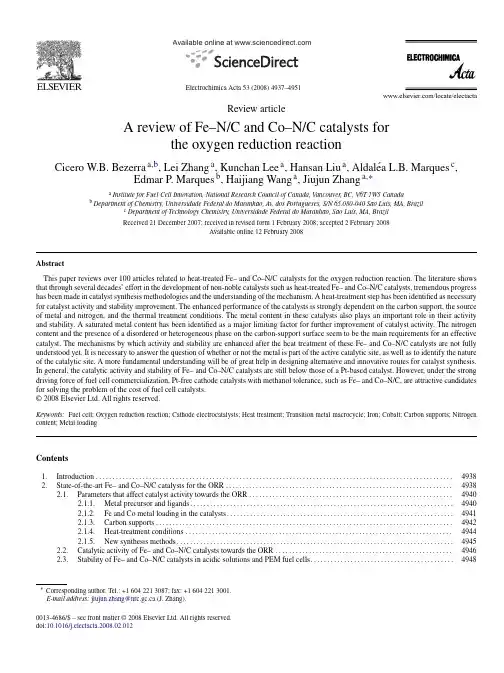
Available online at Electrochimica Acta53(2008)4937–4951Review articleA review of Fe–N/C and Co–N/C catalysts forthe oxygen reduction reactionCicero W.B.Bezerra a,b,Lei Zhang a,Kunchan Lee a,Hansan Liu a,Aldal´e a L.B.Marques c,Edmar P.Marques b,Haijiang Wang a,Jiujun Zhang a,∗a Institute for Fuel Cell Innovation,National Research Council of Canada,Vancouver,BC,V6T1W5Canadab Department of Chemistry,Universidade Federal do Maranh˜a o,Av.dos Portugueses,S/N65.080-040S˜a o Lu´ıs,MA,Brazilc Department of Technology Chemistry,Universidade Federal do Maranh˜a o,S˜a o Lu´ıs,MA,BrazilReceived21December2007;received in revised form1February2008;accepted2February2008Available online12February2008AbstractThis paper reviews over100articles related to heat-treated Fe–and Co–N/C catalysts for the oxygen reduction reaction.The literature shows that through several decades’effort in the development of non-noble catalysts such as heat-treated Fe–and Co–N/C catalysts,tremendous progress has been made in catalyst synthesis methodologies and the understanding of the mechanism.A heat-treatment step has been identified as necessary for catalyst activity and stability improvement.The enhanced performance of the catalysts is strongly dependent on the carbon support,the source of metal and nitrogen,and the thermal treatment conditions.The metal content in these catalysts also plays an important role in their activity and stability.A saturated metal content has been identified as a major limiting factor for further improvement of catalyst activity.The nitrogen content and the presence of a disordered or heterogeneous phase on the carbon-support surface seem to be the main requirements for an effective catalyst.The mechanisms by which activity and stability are enhanced after the heat treatment of these Fe–and Co–N/C catalysts are not fully understood yet.It is necessary to answer the question of whether or not the metal is part of the active catalytic site,as well as to identify the nature of the catalytic site.A more fundamental understanding will be of great help in designing alternative and innovative routes for catalyst synthesis. In general,the catalytic activity and stability of Fe–and Co–N/C catalysts are still below those of a Pt-based catalyst.However,under the strong driving force of fuel cell commercialization,Pt-free cathode catalysts with methanol tolerance,such as Fe–and Co–N/C,are attractive candidates for solving the problem of the cost of fuel cell catalysts.©2008Elsevier Ltd.All rights reserved.Keywords:Fuel cell;Oxygen reduction reaction;Cathode electrocatalysts;Heat treatment;Transition metal macrocycle;Iron;Cobalt;Carbon supports;Nitrogen content;Metal loadingContents1.Introduction (4938)2.State-of-the-art Fe–and Co–N/C catalysts for the ORR (4938)2.1.Parameters that affect catalyst activity towards the ORR (4940)2.1.1.Metal precursor and ligands (4940)2.1.2.Fe and Co metal loading in the catalysts (4941)2.1.3.Carbon supports (4942)2.1.4.Heat-treatment conditions (4944)2.1.5.New synthesis methods (4945)2.2.Catalytic activity of Fe–and Co–N/C catalysts towards the ORR (4946)2.3.Stability of Fe–and Co–N/C catalysts in acidic solutions and PEM fuel cells (4948)∗Corresponding author.Tel.:+16042213087;fax:+16042213001.E-mail address:jiujun.zhang@nrc.gc.ca(J.Zhang).0013-4686/$–see front matter©2008Elsevier Ltd.All rights reserved.doi:10.1016/j.electacta.2008.02.0124938 C.W.B.Bezerra et al./Electrochimica Acta53(2008)4937–49513.Conclusion (4949)Acknowledgements (4949)Appendix A.Nomenclature (4950)References (4950)1.IntroductionFuel cells have been recognized as clean energy-converting devices due to their high efficiency and low emissions.How-ever,two major technical gaps limit their commercialization: cost and reliability.Currently,platinum(Pt)-based catalysts and their corresponding cathode catalyst layers are among the major causes of limited performance and high cost for proton exchange membrane(PEM)fuel cells,although these are the most promis-ing and practical fuel cell catalysts[1].Some approaches to cost reduction and performance improvement have been put forward and researched for many years.However,there has been no real breakthrough yet.Two approaches to reducing catalyst cost are currently being actively pursued:one is to reduce Pt loading,and the other is to explore non-noble catalysts.In the short-term,catalysts contain-ing low amounts of Pt are the priority and are also practical,but in the long term,non-noble metal catalysts would be the better solution.The two major approaches to reducing Pt loading in a catalyst or catalyst layer are the use of alloying and carbon supports. Alloy catalysts have several benefits,such as specific activity improvement as well as enhancement of contaminant tolerance [2].Supported catalysts also have several advantages,such as improvement of catalyst utilization.However,Pt still remains a major limiting factor in the overall cost.Tremendous efforts have been made towards the cost reduc-tion of non-noble catalysts in the last several decades.Although no significant breakthrough has yet occurred,the strong driving force of fuel cell commercialization has stimulated a great deal of interest in the non-noble catalyst approach.Several types of non-noble catalysts have been explored in recent years,including transition metal alloys and chalcogenides[1–7].These catalysts have shown promising activity towards fuel cell reactions,but their reactions are still quite low when compared to those of Pt catalysts.More intensive research must be carried out in order to improve their reactions.A promising feature of non-noble metal catalysts is their tolerance to methanol,which is particu-larly important in direct alcohol fuel cells.Biofuels have been ranked as a top priority in today’s energy strategy.It thus fol-lows that developing fuel-tolerant non-noble catalysts in a direct alcohol fuel cell is very important.In a PEM fuel cell,the major limit on performance is the cathodic oxygen reduction reaction(ORR).Over the last sev-eral decades,a great deal of research has focused on cathode electrocatalyst development for the ORR.Metal–N4macrocy-cles,such as Fe-and Co-macrocycles,are important non-noble catalysts which have attracted attention due to their reasonable activity and remarkable selectivity towards the ORR.In addi-tion,this class of catalyst usually shows inertness to alcohol oxidation,and many of them can catalyze the ORR to water through a four-electron process without significant production of peroxide[8].A major drawback of this kind of catalyst is its low stability in acidic media(or in the PEM fuel cell oper-ation environment)[1,3,6].It has been suggested that this can be attributed primarily to the loss of the active site caused by the attack of hydrogen peroxide generated during the O2reduc-tion[4,5,8].When the catalysts are heat treated,the stability is improved significantly and the catalyzed ORR is better suited to a four-electron pathway,producing less hydrogen peroxide [4].However,this improvement is still not enough for practical applications[3].A variety of carbon-supported transition metal(M)N4-macrocyclic compounds have also been explored as catalysts for the ORR,where N4macrocycles represent phthalocyanines,por-phyrins,Schiff bases,and related derivatives,and M is usually Fe [9–56],Co[10–13,22,28,29,38,46,56–85],Ni[10,28,44,52,56], or Cu[10,28,29,44,56].These studies have focused on the opti-mal conditions and compound structures necessary to obtain maximum catalyst activity and stability.Although the reasons behind the enhanced activity and stabil-ity of heat-treated Fe–and Co–N4catalysts remain unclear,great efforts have been made in identifying the chemical nature of their catalytic sites,and remarkable progress has been achieved.It is believed that if the nature,structure,and reaction mechanism of the catalytic sites can be identified,new experimental procedures can be designed and implemented to develop more active and durable catalysts for fuel cell applications.In order to facilitate this development and understanding,this paper reviews the lit-erature with the intention of providing better insight into current progress and future directions in thisfield,focusing particularly on heat-treated Fe–and Co–N/C catalysts,which are believed to be the most promising non-noble catalysts.2.State-of-the-art Fe–and Co–N/C catalysts for theORRCatalyst performance(activity,stability,and selectivity)is directly related to catalyst structure,which varies greatly accord-ing to preparation conditions,including the synthesis method, metal precursor,ligand structure,carbon support,and heat treatment[10,15,16,27,43,49,67,86].Traditional methods for preparing catalysts involve the pyrolysis of carbon-supported metal N4-macrocycles.These methods primarily involve an impregnation procedure and heat treatment at temperatures rang-ing from600to900◦C in an inert atmosphere such as Ar or N2, as summarized in Tables1and2.However,depending on the heat-treatment temperatures,the M-N4moiety can be partially or completely decomposed,forming new catalytic sites,which are no longer N4-macrocycles.C.W.B.Bezerra et al./Electrochimica Acta53(2008)4937–49514939 Table1Summary of typical Fe precursors and heat treatment conditions for Fe–N/C catalystsMetal precursor Ligand Heat treatment(◦C;time in h;gas composition)Reference FeTPP-Cl–450–850;0.5;N2or Ar[11,12]–700;2;Ar[18]–225–800;2;Ar[35] FeTPP–450–850;0.5;N2or Ar[12]–100–1100;Ar[13]–1000;2;Ar[21]–500–900;2;Ar[29]–500–800;2;Ar[36] FeTMPP-Cl–800;2;Ar[16,23]–200–1000;2;Ar[17,24,25]–900;NH3:H2:Ar(PTCDA)[31,41,50]–400–1000;H2:Ar(PTCDA)[31,33,41]–200–1000;2;Ar[32]–900;1;H2:Ar[37] FeTAA–100–1100;2–8;Ar[58] FePc–100–1100;2;Ar[14]–300–900;2;N2[30]–700;2;Ar[46] FePcTc–100–1100;2;Ar[14]Fe-cyclame–300–900;2;N2[30] Ferrocene–1000;2;Ar:CH3CN[54]Polyestirene1000;2;Ar:CH3CN[54]–1000;2;Ar:CH3CN[54] Vinyl ferrocene–1000;2;Ar:CH3CN[54]5-Vinyl-2-norboneno–1000;2;Ar:CH3CN[54] FeSO4·7H2O PAN850;5;Ar[10]OH−1000;2;Ar:CH3CN[15]OH−400–1000;2;Ar:CH3CN[19]OH−/H2Pc/PAN/TCNQ/CH3CN1000;2;Ar:CH3CN or Ar:NH3[20]NH3Phen900;2;Ar[26]Phen900;2;Ar or NH3[34]Phen650–1000;2;Ar or NH3[35]K3Fe(CN)6700–1000;2;Ar[39]300–800;0.16;N2[44] FeCl2–1000;2;Ar:CH3CN[15] FeCl3–1000;2;Ar:CH3CN[15] FeAc–600–1000;1;Ar:NH3:H2a[27]–900;1;Ar:NH3:H2[28]–900;NH3:H2:Ar(PTCDA)[31,41,47]–400–1000;H2:Ar(PTCDA)[31,33,41]–900;1;NH3:H2:Ar[42,49,50]–600–900;0.3–12;N2/CH3CN[52]–900;N2/CH3CN[55]PAN300–900;2;Ar[57]a Ar:H2;Ar/CH3CN:H2;Ar:CH3CN,were also used.Jasinski[87]reported thefirst ORR catalysts with macro-cyclic structure containing nitrogen–metal coordination in1964. However,subsequent works using several carbon-supported metal–N4macrocycles came to the conclusion that such struc-tures are not stable enough in acidic media,and are therefore not practical for PEM fuel cell applications.In the1970s,it was discovered that the heat treatment of the M-macrocycles in an inert atmosphere can significantly improve ORR activ-ity as well as stability[9,88].Furthermore,it was pointed out that even when the metallic center is not chemically bound to the macrocycle,a highly catalytic site can be obtained after heat treatment[89].Soon afterwards,Gupta et al.[57]were able to prepare thefirst ORR catalyst from non-N4-macrocycles as the nitrogen source.Since then,many other catalysts have been prepared in a similar manner,using cheaper and more common inorganic salts and carbon as the starting materials4940 C.W.B.Bezerra et al./Electrochimica Acta53(2008)4937–4951Table2Summary of typical Co precursors and heat treatment conditions for Co–N/CMetal precursor Ligand Heat treatment(◦C;time in h;gas composition)Reference CoSO4PAN850;5;Ar[10] K3Co(CN)6300–800;0.16;N2[44] CoTPP–450–850;0.5;N2or Ar[11]–100–1100;Ar[13]–700;2;Ar[18]–500–900;2;Ar[29] CoAc–900;1;Ar:NH3:H2[28] PAN300–900;2;Ar[57]PAN200–1100;2;Ar[60]PAN/N-methylpyrrole/2,5-dimehylpyrrole/2,5-dimethyl-3-pyrrolin/maleimid/imidazole700;2;vacuum[70]–900;1;Ar:NH3:H2[72]400–1000;Ar:NH3:H2(PTCDA)[76] CoCyclame–300–900;2;N2[30] CoPc–300–900;2;N2[30]–400–1100;2;Ar[63] CoPcTc–100–1100;Ar[62] CoTMPP–900;2;H2:Ar(PTCDA)[33]–200–1200;5;Ar[59]–600–800;2;N2/Ar[64]–500–800;2;N2/Ar[63]–200–1000;2;Ar[73]–400–1000;Ar:NH3:H2(PTCDA)[76]900;2;Ar[82] CoPc–200–1100;2;Ar[60]–500–1100;2;Ar[61] CoTTFPP–600–800;2;N2/Ar[64] CoTFPP–600–800;2;N2/Ar[64]–500–800;2;N2/Ar[65] CoTAA–500–800;2;N2/Ar[65,66]–500–900;2;N2/Ar[67,68]–600–800;2;N2[70]Thiurea600–800;2;N2[70]Co(NO3)2EDA800;1;Ar[77]and a wide variety of N-containing chemicals as the precur-sors.2.1.Parameters that affect catalyst activity towards theORR2.1.1.Metal precursor and ligandsTables1and2show details of the preparation of typical Fe–and Co–N/C electrocatalysts.As shown,the metal precursors are either organometallic(ferrocene),N x–metal chelates(Fe or CoPc,FePhen),or simple salts such as sulphate or acetate.The nature of the metallic center in the precursor plays a critical role in activity improvement after heat treatment.All experimental evidence clearly shows that,compared to other metal centers,iron and cobalt centers exhibit the highest activity towards the ORR.Ohms et al.[10],for example,prepared active carbon-supported catalysts for the ORR by a heat-treatment process,using MSO4(M=Mn,Fe,Co,Ni,Cu)and ZnCl2as metal precursors and PAN as the nitrogen source.Fig.1 shows the polarization curves of synthetic catalysts as a func-tion of the metal precursor.Fig.1(a)shows the ORR results in acidic media and Fig.1(b)shows them in alkaline media.Fig.1 clearly indicates that under the same experimental conditions, different metals give different ORR activities.In acidic media, the best results were obtained using Co,followed by Fe and Mn.However,Fe-containing catalysts show more positive onset potential than Co catalysts.As indicated by the authors,these Fe-containing catalysts can catalyze the ORR through a quasi-four-electron reduction.However,in an alkaline electrolyte,Fe-and Co-electrocatalysts show similar performance.High ORR catalytic activity has also been reported for binary transition metal macrocycles.Jiang and Chu[29]prepared heat-treated CoTPP/FeTPP,which showed better catalytic activity than the respective catalysts containing single metals.As established by Dodelet and co-workers[15,54]and now widely confirmed by experiments,nitrogen is a necessary com-C.W.B.Bezerra et al./Electrochimica Acta53(2008)4937–49514941Fig.1.Polarization curves of oxygen electrodes made from different materials in(a)2.25M H2SO4;(b)7M KOH at298K.Reproduced from[10]by permission of Elsevier.ponent of the catalyst site in order to form an active catalyst. Therefore,an N-containing precursor must be added to the syn-thetic reactions during preparation.Wei et al.[72]also observed that the catalytic activity of heat-treated Co–N/C is directly related to the surface concentration of N.So far,the most com-mon N sources are NH3,acetonitrile,pyrrole,N-containing polymers,and carbon carrier modified with N.However,the type of N source has a large effect on the resulting catalyst. Cˆo t´e et al.[20]adsorbed Fe(OH)2on carbon black to produce Fe(OH)2/C,which was then heat treated at1000◦C with various N-containing precursors such as PAN,TCNQ,H2Pc,NH3,and CH3CN.They found that the catalytic activity increased in the order of PAN<TCNQ<H2Pc,which is the same as the trend in the polarizability of the precursors.They also observed that NH3and CH3CN have a similar effect on the catalyst activ-ity,and deemed them to be equivalent N-containing precursors. However,Faubert et al.[27]found some differences in the behav-ior of NH3and CH3CN when they were used as N precursors. According to them,when NH3was used in the pyrolysis,not only were N atoms incorporated into the support,but also the carbon microstructure was modified.On the other hand,when CH3CN was used as the N precursor,the decomposition products were deposited on the support,forming thin graphitic structures. 2.1.2.Fe and Co metal loading in the catalystsBesides the nature of the metals used,the metal loading also plays an important role in achieving high catalytic activity.The optimum metal loading is determined by the nature of the pre-cursors used(metal and N),the surface properties of the carbon support,and the heat-treatment conditions[26,31,34,35,90].For example,Fig.2shows the effect of metal loading on the elec-trocatalyst activity under the same conditions[26].Thisfigure shows typical results:in the initial stage,the activity increases with an increase in metal loading.When the loading reaches a certain level,a saturated activity level(a plateau)can be observed [31].When the metal is overloaded,the activity falls dramati-cally[35].Wang et al.[26]showed that the saturation point,estimated from the potential value at the oxygen reduction peak (E p,V pr),is related to the total amount of N available at the sup-port surface.According to X-ray photoelectron spectroscopy (XPS),at the maximal electrochemical activity(0.1wt%Fe), the proportion between Fe and N atoms was1:100.In the case of metal overloading,the excess was transformed into clusters containing metallic and/or carbidic metals that have no activity for molecular ORR[26,27,31].With different catalysts,the optimum metal loading ranges are dependent on the precursor used and the preparation condi-tions.For example,using[Fe(phen)3]2+,Bron et al.[35]found that2wt%is the optimum value for the highest electroactivity. However,Lef`e vre et al.[31,33]observed a similar percentage using FeTMPPCl,but only0.2wt%when the FeAC precursor was used.When the amount of metal loading was more than the optimum value,some metal species which had no catalytic activ-ity,such as graphitized metallic iron particles,were detected. The difference in optimum metal loading values observedwhen Fig.2.Effect of initial Fe loading on the electrocatalytic activity of modified car-bon support as measured by the oxygen reduction peak potential,E p.Reproduced from[26]by permission of the American Chemical Society.4942 C.W.B.Bezerra et al./Electrochimica Acta 53(2008)4937–4951Table 3Optimum nominal metal loading for some M/N/C catalysts PrecursorsNominal metal loading (wt%)ReferenceInvestigated rangeOptimum value FeTPP2–64[21]FeAc/Ar:H 2:NH 30–2.560.2[27]FeAc/Ar:H 2:NH 30.05–2.56≥0.2[31]FeTMPPCl0.05–2.562Fe(phen)32+/NH 30.7–1.621[34]Fe(phen)32+/NH 30.5–102[35]FeAc/NH 30.2–2 1.0[47]CoPc 0–8 3.5[61]CoPcTc0.75–31.5[62]different precursors are used can be attributed to the difference in the precursors’affinities and to their degrees of dispersion on the support.Table 3lists some typical optimal values of metal loading obtained when different precursors are used.Fig.3demonstrates the metal loading effect on the catalyst performance.As we will discuss later,two possible catalytic sites,labeled here as FeN 4/C and FeN 2/C,have been proposed;the latter is the most active site for the ORR.The correlation among FeN 2/C abundance,the voltage at the maximumreduc-Fig.3.Type FeTMPP catalysts:correlation between the relative abundance of FeN 2/C in the material (A:open circles),the catalytic activity (B),the value of n (C),and the percentage of H 2O 2(D).The relative abundance of FeN 4/C in the material is given by stars in (A).Reproduced from [41]by permission of Elsevier.Table 4The most commonly used carbon supports for M/N/C catalystsCarbon support ReferenceCarbon blackVulcan XC-72R [13–15,18–21,26,30,35,36,40,42,45,46,49,50,52,55,57,60–63,70,74,77,80,81]Black Pearls 2000[16,17,24,25,32,34,37,39,42,49,50,73,75,77,80,82,83]Acetylene Black [11,44,49,50,57,74]KetjenBlack [49,50,74,77]Printex XE-2[34,49,50,74]SRC[42,49,50,74]Active carbon Norit SX Ultra [42,49,50,64–69,71,74]P33[10,58,59,84]RB carbon [23,32,57]Graphite HS 300[49,50,74]KS6[15]tion peak (V pr ),the number of electrons (n ),the percentage of H 2O 2,and the metal loading for FeTMPP/C is presented in this figure [41].It can be seen that all parameters are dependent on the metal loading.Metal loading can also affect the degree to which the carbon-support surface is covered,resulting in a change in support-specific surface ing a BET technique,Sun et al.[32]found that surface area decreased linearly with an increase in Fe loading.In their experiments,heat-treated FeTMPPCl/C was used.In interpreting this observation,they hypothesized that either the metal particles could block the pores in the support,or the metal chelate or its fragments could chemically bond onto the support surface.2.1.3.Carbon supportsEarlier studies [11,72]have demonstrated that the carbon support plays an important role in improving the activity and stability of heat-treated metal macrocycles.The most commonly used carbon supports,including carbon black,active carbon,and graphite,which have been specifically employed in M–N/C cat-alyst systems,are summarized in Table 4,where it can be seen that the most popular carbon supports are Vulcan XC 72and Black Pearls.The surface properties of the carbon support have a signif-icant effect on the degree of catalyst dispersion.For example,Ehrburger et al.[90]showed that,using the same metal load-ing,heterogeneous carbon surfaces,which consisted of basal and the prismatic or edge crystalline planes,had higher surface areas than homogeneous ones.It has been recognized that differ-ent carbon materials exhibit different properties,such as surface area,porosity,ordering (crystallinity),electrical conductivity,and ORR activity.The surface N content varies from one support to another,probably resulting in different ORR activities.It has been observed that the surface N content on the carbon support seems to be a key factor for the preparation of active ORR electrocatalysts [2,33,47,49,50,54,58,63,90–92].Jaouen et al.[47,49]measured the ORR activity of several iron catalystsC.W.B.Bezerra et al./Electrochimica Acta53(2008)4937–49514943Fig.4.Catalytic activity(ORR peak V pr measured in H2SO4)as a function of N content on the carbon-support surface,measured by mercially available carbons( ),carbon blacks from the Sid Richardson Carbon Company (SRCC),initially devoid of N( ),and enriched in N(᭹).All catalysts with a nominal0.2wt%Fe loading.Reproduced from[49]by permission of The Elec-trochemical Society.AB(Acetylene Black);P(Printex XE-2);K(Ketjenblack); HS(HS300);BP(Black Pearls2000);V(Vulcan XC72R);N(Notir SX Ultra); N134(from Sid Richardson Carbon Corporation,SRCC).with different carbon supports,as shown in Fig.4,where the results are plotted as a function of surface N concentration.It can be seen that the higher the N concentration on the support surface,the better the catalytic activity will be.The literature has also shown that there are other effective ways to introduce or create N-containing groups on the carbon surface,such as causing a reaction of carbon materials to N-containing gas at an elevated temperature[49,93–96] and carbonizing N-containing compounds[27,31,33,41, 76].It is well known that the heat treatment of carbon-supported metal ions in the presence of N-content precursors can effec-tively produce active catalytic sites[15,19,20,22,26,34,37,42, 47,49,50,52,72,74].As mentioned previously,various N-content precursors can be used as N sources[20,70,96].In a complex relationship,the electrocatalytic ORR activity of an M–N/C catalyst obtained by heat treatment strongly depends on the nature and loading of the metal,the type of N precursor, the heat-treatment conditions,and the structure of the carbon support[49,50].Jaouen et al.[49]showed that the reaction between the carbon support and NH3is strongly affected by the pyrolysis tempera-ture and is governed by the presence of a disordered phase on the pristine carbon.This disordered phase reacts with NH3faster than does a graphitic one.It can be seen in Fig.5that the sur-face N content for a specific pyrolyzed carbon support increases with increasing temperature,except in the case of Printex and HS300.They also observed a correlation between activity and carbon weight loss during pyrolysis.According to Jaouen et al., at900–1000◦C,the main paths by which carbon loses mass are the following:C+NH3→HCN+H2(1) C+2H2→CH4(2)Fig.5.N content of pyrolyzed carbons,measured by XPS,vs.pyrolysis tem-perature.HS300( ),Printex( ),Vulcan( ),Black Pearls(+),SRCC1( ), and SRCC8(᭹).Reproduced from[49]by permission of The Electrochemical Society.Some studies[26,42,77]have pre-treated the carbon support with HNO3before the heat treatment in the presence of an N-containing precursor.When this step was taken,higher ORR activity was observed.It was explained that the oxidized car-bon surface has more oxygen-based functionalities such as quinone groups.These groups favor the adsorption of amines and increase the polarity of the carbon support.This leads to a better dispersion of metal ion on the surface,resulting in higher ORR catalytic activity.In an effort to introduce N-containing functionalities on the support surface,Dodelet’s group prepared active ORR catalysts using synthetic carbons obtained by the pyrolyzing of perylene tetracarboxylic dianhydride(PTCDA)at a high temperature and under an NH3atmosphere[27,31,33,41,76].Carbonization of glucose in the presence of glycine and Fe(II)could also be an approach for obtaining active ORR catalysts[53].For cobalt-based catalysts,Bouwkamp-Wijnoltz et al.[70] found that2,5-dimethylpyrrole and polypyrrole were the best N donors,and Yuasa et al.[85]reported a procedure to prepare carbon nanoparticles modified with a polypyrrolefilm(Fig.6). After heat treatment,this cobalt catalyst displayed higher ORR activity and good stability in acidic conditions.It is also well known that the heat treatment of the carbon sup-port in an inert gas can lead to a loss of oxygen surface groups through their decomposition into CO and CO2,resulting in bet-ter resistance of the support against corrosion[5,68].Gou´e rec and Savy[68]showed that heat-treated catalysts prepared from CoTTA deposited on a previously deoxygenated carbon surface were more active towards the ORR than similar catalysts pre-pared without heat treatment of the carbon support.It was also discussed that,since the oxygenated surface groups protect the chelate structure from rapid destruction and sintering during the heat treatment,large amounts of oxygenated groups lead to a slower aging process of the catalyst.Wei et al.[72]prepared several catalysts from cobalt sulphate, carbon black,and acetonitrile as the N precursors.In their exper-iments,single pyrolysis steps,as well as a multi-step procedure,4944 C.W.B.Bezerra et al./Electrochimica Acta 53(2008)4937–4951Fig.6.Schematic of the procedure for preparation of the CoPPy/CB catalyst and the proposed moiety of the catalytic site.Coordination of a single Ppy chain as a multidentate ligand is also anticipated.Reproduced from [85]by permission of the American Chemical Society.were carried out using several combinations of the precursors.The most active catalyst was obtained by first pyrolyzing the carbon support in an Ar:CH 3CN atmosphere,followed by heat treatment after impregnation of the metal precursor on the pre-treated support.Metal impurity in a carbon support can also affect the catalyst activity.Impurity levels should be controlled in order to obtain more highly active ORR catalysts.In conclusion,it has been recognized that the carbon support plays a key role in obtaining highly active ORR catalysts.Among all the parameters related to the carbon characteristics,the most important seems to be the N content on the supported catalyst surface.The higher the N content,the higher the catalytic site concentration will be.This higher concentration of the catalytic site on the catalyst surface leads to higher ORR activity.2.1.4.Heat-treatment conditionsDespite decades of research on heat-treated Fe-and Co-based ORR catalysts,the catalyzed ORR mechanisms and,in particu-lar,the identification of active sites,are still not fully understood.Although a broad range of methodologies and materials have been employed to produce active ORR catalysts,there are still difficulties in discerning the controlling parameters in preparing active catalysts.However,there is general agreement in the lit-erature that a heat-treatment step has beneficial effects on both the activity and the stability of these electrocatalysts.Unfortu-nately,there is still controversy about what aspect of the heat treatment is responsible for such positive effects.In 1988,van Veen et al.[97]discussed four models in an effort to explain this effect:(1)improving the dispersion of the supported chelate;(2)catalyzing the formation of a special type of carbon,which is actually the active phase;(3)generating the M–N species;and (4)promoting a reaction between chelate and subjacent carbon in such a way as to modify the electronic structure of the cen-tral metal ion with retention of its N 4coordinated environment.Some works [11–13,36,97]favored an explanation combining Models (3)and (4),with the hypothesis that the partial destruc-tion of the metal complexes during pyrolysis and the formation of the secondary structures containing M–N/C are responsi-ble for the catalytic activity.Others [24,43,66,98–100]favored Model (2),which states that the metal atom is not part of the active site,although it is essential for the generation of such active structures.Those supporting Model (1)speculated that the adsorbed macrocycle forms several bonds with the support during the heat treatment,which can improve the catalyst stabil-ity (oxidative destruction and hydrolysis).The main causeforFig.7.(a)Visualization of the reaction of porphyrin with carbon during the heat treatment;(b)proposed moiety of the FeN 2/C catalytic site.Reproduced from [36]and [33],respectively by permission of the American Chemical Society.。

化学合成法英文全文共四篇示例,供读者参考第一篇示例:One of the most common methods of chemical synthesis is the organic synthesis, which involves the manipulation of organic compounds to create new substances. This can be done through a variety of techniques such as catalytic reactions, oxidation-reduction reactions, and condensation reactions. Organic synthesis is a complex process that requires careful planning and precise execution to achieve the desired results.第二篇示例:Chemical synthesis refers to the process of creating new compounds or materials through chemical reactions. This method is widely used in industries such as pharmaceuticals, agriculture, and materials science to produce a variety of products. Chemical synthesis involves designing and executing a series of reactions to transform starting materials into the desired end product.There are several methods of chemical synthesis, each with its own advantages and limitations. Some common methods include:第三篇示例:The second step is to design a synthetic route or sequence of reactions that will convert the reactants into the desired product. This involves selecting appropriate reagents and reaction conditions to promote the desired chemical transformations while minimizing side reactions or byproducts.第四篇示例:Chemical synthesis is a powerful tool in the field of chemistry that allows researchers to create new compounds by combining different chemical reactions. This process involves the manipulation of chemical compounds and elements in order to form desired products. Chemists use a variety of techniques, such as organic synthesis, to create new molecules with specific properties for a wide range of applications.。

双原子催化剂的通用合成方法Finding a universal synthesis method for bimetallic catalysts has been a challenging task in the field of catalysis. Scientists worldwide have been working tirelessly to develop new approaches that can efficiently fabricate these catalysts with enhanced performance.在催化领域,寻找一种通用的双原子催化剂合成方法一直是一项具有挑战性的任务。
全世界的科学家们一直在努力工作,以开发能够高效制备这些具有增强性能的催化剂的新方法。
One promising approach is the use of template-assisted synthesis, where the structure of the catalyst is controlled by a template that directs the formation of the bimetallic active sites. This method has shown great potential in producing well-defined bimetallic catalysts with tailored properties.一种有前途的方法是利用模板辅助合成,通过模板控制催化剂的结构,从而指导双金属活性位点的形成。
这种方法在生产具有定制特性的明确定义的双原子催化剂方面表现出巨大潜力。
Another approach involves the utilization of self-assembly techniques, where the bimetallic catalyst is formed through the spontaneous organization of metal atoms into a specific structure. This method has been successful in creating highly active and stable catalysts that exhibit superior catalytic performance.另一种方法涉及利用自组装技术,通过金属原子的自发组织形成特定结构的双原子催化剂。