新概念英语第二册Lesson41~48课文注释
- 格式:docx
- 大小:17.25 KB
- 文档页数:5
新概念英语第二册Lesson41~48课文注释
学习新概念英语并不难啊。你还在为英语成果低拖后腿而苦恼吗,下面就和大家共享新概念英语其次册Lesson41~48课文解释,盼望有了这些内容的关心,可以为大家学习新概念英语供应关心!
新概念英语其次册Lesson41课文解释
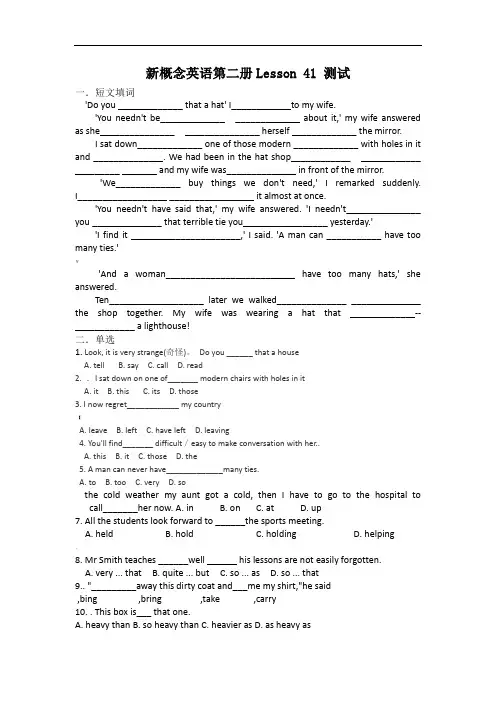
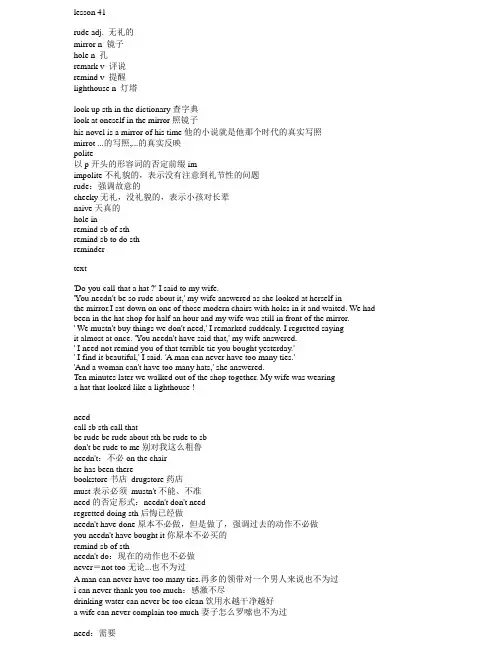
1.Do you call that a hat? (标题)你把那个叫帽子吗?
Do you call that +(冠词)+名词这个结构可以表达一种轻视的含义:
Do you call that a house/a dog?
你把那个叫房子/狗吗?
2.I sat down on one of those modern chairs with holes in it…我坐在一个新式的满是网眼儿的椅子上……
those在此处表示一种看不惯、不满的意味,假如换成the,则没有这种意味。
3.I regretted saying it almost at once. 我立刻又懊悔说了这话。
regret +动名词/名词/that从句通常表示为做过的某件事感到懊悔、后悔:
I now regret leaving my country/ that I have left my country.
我现在懊悔离开了自己的祖国。
He regretted having been rude to her.
他懊悔自己对她无礼。
Did he regret his mistake?
他为自己的错误感到懊悔了吗?
regret +不定式表示对现在或将来要做的事感到对不起、圆满,比 be sorry +不定式要正式:
We regret to tell you that you are not welcome.
我们很圆满地告知您,您不受欢迎。
4.I find it beautiful. 我觉得它好看。
动词find常常用于动词+宾语+宾语补足语这种结构:
Youll find it difficult/easy to make conversation with her.
你将会发觉与她谈天很困难/简单。( it代指后面的不定式短语)
I find this book very interesting.
我觉得这本书很好玩。
5.A man can never have too many ties. 男人有多少领带也不会嫌多。
cannot/can never…too…(固定结构)表示“无论怎么……也不会过分”:
A woman cant have too many hats.
女人有多少帽子也不嫌多。
You cant be too careful in doing your work.
你工作越当心越好。
新概念英语其次册Lesson42课文解释
1.…we stopped at a square to have a rest.……我们在一个广场上停下来休息。
stop 后面跟不定式时,表示停下其他活动去做不定式表示的动作:
On the way to the station, I stopped to buy a paper.
在去车站的路上,我停下来买了张报纸。
stop后面假如跟动名词形式,则表示停止该动作:
Ive stopped buying newspapers
我已不再买报纸了。
How can we stop him complaining? 我们如何才能让他不埋怨呢?
2.after a time, 过了一会儿,不久以后。
time在这里表示“(一段)时间”:
He lived abroad for a long time.
他在国外生活了很长时间。
I saw him a short time ago.
我刚才还观察他了。
After a time, the dog stopped following me.
过了一会儿,那条狗便不再跟着我了。
3.…we had our first glimpse of the snake. ……我们才第一次看到了那条蛇。
glimpse表示“一瞥”、“一看”,是可数名词,常用于下列短语中:
have/ get a glimpse of, catch a glimpse of, take a glimpse at:
He took a glimpse at the‘No Parking’signs outside Jaspers gate and parked his car there.
他瞥了一眼贾斯珀家大门外边的那些“禁止停车”的牌子,
然后把车停在了那里。(有意识的、短暂的动作)
This afternoon I caught/got/had a glimpse of Debbie and Dan walking together in the park.
今日下午我瞥见黛比和丹一起在公园里漫步 。(无意的、短暂的动作)
4.It obviously could not tell the difference between Indian music and jazz! 明显,它辨别不出印度音乐和爵士乐!
(1)tell表示“辨别”、“辨别”、“识别”时常与 can,could,be able to连用。表达这些意义时,tell可以单独使用,也可以与from构成词组:
My son can already tell the difference between beer and wine.
My son can already tell beer from wine.
我儿子已经能辨别出啤酒和葡萄酒了。
(2)表示两者之间的“差别”、“差异”时常用 difference between:
Whats the difference between them?
他/它们之间有何区分?
Theres a lot of difference between Englishmen and Frenchmen.
英国人和法国人之间有很多差别。
在有些状况下也可以不跟 between:
It makes no difference whether you believe me or not.
你信不信我区分不大/都无所谓。
新概念英语其次册Lesson46课文解释
1.…workers began to unload a number of wooden boxes which contained clothing.……工人们开头卸下装有服装的一批木箱。
(1)unload的含义为“卸(货)”,它的反义词为load(装货)。与形容词 uncomfortable, unsmiling等相像,有些动词加前缀un可以表示做相反的动作。
(2)a number of为固定词组,表示“若干”、“很多”:
Youve made a number of mistakes in typing this letter.
你打这封信时出了不少错误。
(3)clothing是服装的总称,为不行数名词,其含义比clothes更为广泛。clothes一般指衣服,clothing则可以包括鞋、帽等。
2.No one could account for the fact that one of the boxes was extremely heavy. 其中有只箱子特殊重,可谁也弄不清是怎么回事。 (1)短语动词 account for的含义为“说明理由”、“作出说明(或解释)”:
The bad weather in England accounts for Harrisons decision to leave the country.
英国糟糕的气候是哈里森打算离开这个国家的缘由。
How do you account for the battered car?
你如何解释这撞坏的车?
(2)that后面的从句为fact的同位语从句,说明fact的详细内容:
He couldnt explain the fact that Marys wallet was found in his room.
他无法解释玛丽的钱包是在他房间里找到的这一事实。
3.It suddenly occurred to one of the workers to open up the box. 突然一个工人想到打开箱子看看。
(1)表示某人想起某事时,要用 sth. occurred to sb. 这个结构,主语为事,而不是人。
(2)it在句中为先行主语,代替不定式 to open up the box。
(3)open up的含义之一是“打开”:
open up boxes/gifts 打开箱子/礼物
When he received the gifts, he opened them up at once.
他收到礼物后立即就打开了。
4.He was astonished at what he found. 看到的情景使他惊讶。
表示某事使/让某人惊讶通常用sb. is/ are/ was/ were…astonished at sth.:
Sam appears astonished at the news/ the sound.
这消息/声音好像使萨姆吃了一惊。
5.on top of, 在……上面。
She put the bread on top of a pile of other goods.
她把面包放在一堆其他货物上面。
6.…he had been confined to the wooden box for over eighteen hours. ……他在那木箱里闷了十八个多小时。
confine表示“把……限制起来”,通常与介词to连用:
Last weekend, Toms mother confined him to his room.
上个周末,汤姆的妈妈把汤姆关在了房间里。
7.The man was ordered to pay £3,500 for the cost of the trip. 此人被责令交付旅费3,500英镑。
pay for表示“为……支付货款”、“为……付出代价”:
She paid £ 50 for that dress.