
英语国家概况(名词解释)
- 格式:pdf
- 大小:688.01 KB
- 文档页数:5


⾃考英语国家概况名词解释
英语国家概况名词解释1 The British Empire ⼤英帝国
About a hundred years ago, as result of its imperialist expansion, Britain ruled and empire that had one fourth of the world’speople and one fourth of the world’s land area. The two world wars greatly weakened Britain. The British Empire graduallydisappeared and it was replaced by the British Commonwealth or the Commonwealth of Nation in 1931.
2.Stonehenge-
It is a group of huge monuments of grant rock Slabs on salisbury plain in Southwest England built as long ago as the NewStone Age. It is generally believed that stonehenge served some sort of religious purposes. The Celts----The Celts came toBritain in three main waves. The first wave were the Gales, the second wave were the Brythons and the Belgae came about150BC. The Celts were practised farmers. The Celtic tribes are ancestors of the Highland Scots, the Irish and the Welsh, Andtheir languages are the basis of both Welsh and Gaelic. They religion was Druidism.

weddings
Weddings don't always take place in churches. If a woman is getting
married for a second time, she will usually get married in a registry office.
These are much smaller than churches and the services are less religious.
Weddings are usually organized by the bride‟s parents. They send out
invitations to the members of their families, and to the couple‟s friends.
The best man is usually the groom‟s best friend. He makes a speech at the
reception. The bride‟s parents also have a cake made. This usually has
three times, or levels.
The guests usually drink champagne(香槟酒) at the beginning of the
reception. Cake is eaten at the end of the meal.
For the wedding the groom will wear a special jacket, which is longer
at the back than the front. We call this a morning coat. The bride will
often wear a diamond necklace.
名词解释
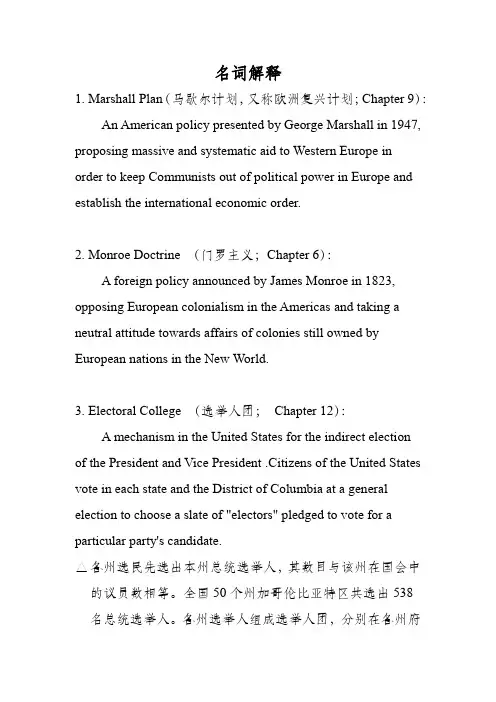
1. Marshall Plan(马歇尔计划,又称欧洲复兴计划;Chapter 9):
An American policy presented by George Marshall in 1947,
proposing massive and systematic aid to Western Europe in
order to keep Communists out of political power in Europe and
establish the international economic order.
2. Monroe Doctrine (门罗主义;Chapter 6):
A foreign policy announced by James Monroe in 1823,
opposing European colonialism in the Americas and taking a
neutral attitude towards affairs of colonies still owned by
European nations in the New World.
3. Electoral College (选举人团; Chapter 12):
A mechanism in the United States for the indirect election
of the President and Vice President .Citizens of the United States
vote in each state and the District of Columbia at a general
election to choose a slate of "electors" pledged to vote for a
particular party's candidate.
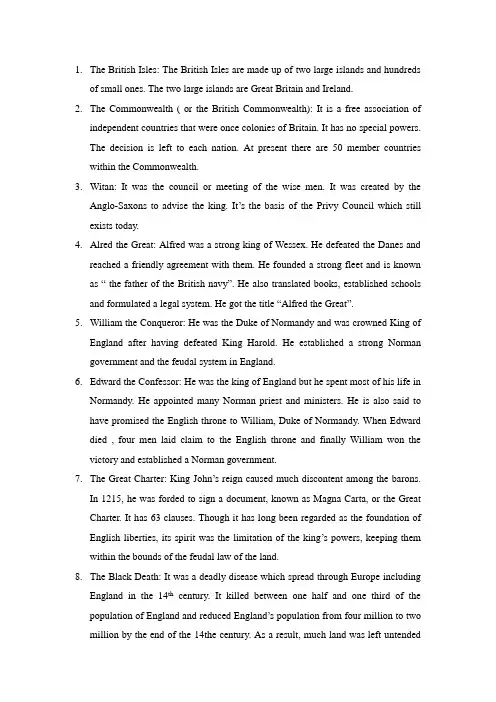
1. The British Isles: The British Isles are made up of two large islands and hundreds
of small ones. The two large islands are Great Britain and Ireland.
2. The Commonwealth ( or the British Commonwealth): It is a free association of
independent countries that were once colonies of Britain. It has no special powers.
The decision is left to each nation. At present there are 50 member countries
within the Commonwealth.
3. Witan: It was the council or meeting of the wise men. It was created by the
Anglo-Saxons to advise the king. It’s the basis of the Privy Council which still
exists today.
4. Alred the Great: Alfred was a strong king of Wessex. He defeated the Danes and
reached a friendly agreement with them. He founded a strong fleet and is known
as “ the father of the British navy”. He also translated books, established schools