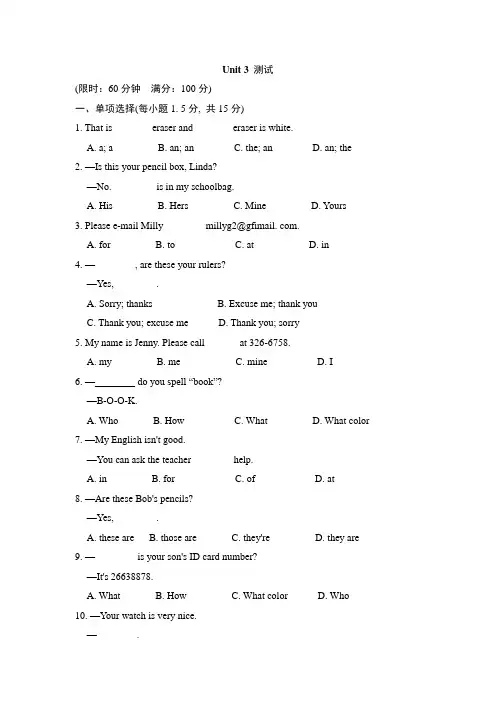
七年级英语上册Unit3-Is-this-your-pencil教案
- 格式:doc
- 大小:329.50 KB
- 文档页数:28
Unit3 Is this your pencil? 教案
Period1 Section A 1a-1c
Ⅰ.教学准备
1.教师:录音机和录音磁带,多媒体课件,图片图片和物品实物。
2.学生:学习用品实物。
Ⅱ.教学目标
1. 调动学生学英语和说英语的积极性。
2. 使学生了解并掌握一些学习用品的英语表达。
3. 学习本课的知识点。
(1) 词汇:pencil, book, eraser, box, pencil box, schoolbag,
dictionary, his, mine, hers
(2) 句型:–Is this/ that your pencil?
– Yes, it is. It’s mine.
No, it isn’t. It’s his/ hers.
4. 训练学生在听录音时听懂简单英语词汇的能力。
Ⅲ.教学重点
1. 词汇:pencil, book, eraser, box, pencil box, schoolbag, dictionary,
his, mine, hers
2. 句型:–Is this/ that your pencil?
– Yes, it is. It’s mine.
No, it isn’t. It’s his/ hers.
Ⅳ.教学难点
让学生运用所学句型“Is this/ that your pencil? Yes, it is. It’s mine.
/ No, it isn’t. It’s his/ hers.”等内容对物品的所属进行问答,能辨认物品的所有者。
Ⅴ.教学步骤
Step1: Greetings and talking
1.教师向学生表示问候,并复习之前所学的问候语。
2.师生问答:教师向学生询问一些已经学过的信息。
For example:
T: What’s this in English?
Ss: It’s a pen.
T: What color is it?
Ss: It’s blue.
…
Step2: Lead-in & Presentation
利用实物直接导入,通过师生问答学习新单词:pencil, book, eraser,
schoolbag, dictionary, pencil box, mine, his, hers。
For example:
T: This is a pencil. Read after me, pencil, pencil, pencil. (利用升降调)
Ss: pencil, pencil, pencil. (利用升降调) T: This is my pencil. It’s mine.
This is his book. It’s his.
This is her eraser. It’s hers. Now read the three words after me.
Ss: Mine, mine, mine. His, his, his. Hers, hers, hers. (利用升降调)
Step3: Practice the new words
1.训练学生拼读单词
全体齐读→分组齐读→单个学生读
2. 让学生完成课本P13 1a, 将单词与图片中物品配对。
Give the students one minute to finish 1a. Then check the answers.
Step4: A game:抢答
Give one picture each time quickly. If students know the thing, hand
up and say its name.
Step5: Present the new sentences
教师提供和收集一些学生的学习用品,放在讲桌上,通过师生问答,找出物品的主人。
For example:
T: Now, look at me. This is her pencil. And this is his book. And that
is her pen. Is this your pencil?
Ss: Yes, it is. It’s mine.
T: Is this your book?
Ss: No, it isn’t. It’s his.
T: Is that your pen?
Ss: No, it isn’t. It’s hers.
Step6: Practice the new sentences
学生四人一组,小组内同学利用自己的学习物品,操练句型“Is this your…?”让学生特别注意“mine, his, hers”的用法。
For example:
S1: Is this your dictionary?
S2: No, it isn’t. It’s hers. Is this your schoolbag?
S3: Yes, it is. Is this your pencil box?
S4: No, it isn’t. It’s his.
Step7: Listening
1. Listen and number the conversations [1-3].
2. Listen again and repeat the conversations.
3. Let the students read the conversations together.
Step8: Summary
1.一般疑问句的归纳。
2.形容词性物主代词和名词性物主代词的关系。
Step9: Homework
1. Read and recite the new words on page13.
2. Read and recite the conversations in 1b.
Step10: Exercise
见课件
Unit 3 – Is this your pencil?
Learning Objectives
In this unit, students will learn to identify ownership of personal belongings.
They will also be able to spell the name of the object for confirmation.
一、Topics(话题):
Things in the classroom
二、Functions (功能)
Identify ownership
三、Structures (结构)
Possessive pronouns mine, yours, his, hers
Yes/no questions and short answers
Lost and found
四、Target Language (目标语言)
Is this your pencil?
Yes, it is. It’s mine.
Are these your books?
No, they aren’t. They’re hers.
五、Vocabulary (词汇)
Pencil, pencil box, schoolbag, book, easer, notebook, dictionary, bag, baseball,
computer game, ID card, watch, ring, mine, your, his, hers
Thank you for..., ask ...for..., a set of
六、Skills (技能)
Listening and read for specific information
七、Recycling (复习巩固)
What’s this? It’s...
How do you spell it?
八、教材分析
本单元以school things为话题,主题是“确认物品的所有权”,物品主要围绕着教室内学生身边的常用物品,在教学时老师能够使用实物进行教学,增强学生的学习效果。事实表明,如果将真实的语言材料引入学习环境,并与社会的语言活动结合起来,学生的学习效果将是事半功倍的。也就是说,作为授课的老师,我们要结合所授内容,努力为学生创造真实的、贴近生活的情境。通过单元教学使学生学会辨认物品的所有者,学会根据场景询问物品的所属,以及学会写寻物启事和招领启事。
与其他单元一样,本单元共六页(6 pages),其中包括Section A,Section B和Self
check。
Section A (Pages13&15) 学会询问物品的所属。提供了本单元教学的基本词汇和语言结构,为本单元的目标句型提供示例和指导性练习,通过简单的语言活动进行操练和巩固;Page13,14有听、说、读。
1a, 1b, 1c 重点学习一些表示学习用具的词,学会询问物品的所属。
2a, 2b, 2c,2d继续学习表示学习用具的词。重点学习运用询问物品所属的句型。
3a, 3b, 3c 学会用英语询问物品的名称,进一步巩固询问物品所属的句型。
Section B (Pages16&17) 学会写招领启事和寻物启事。在已有的基础上开展的,Grammar
focus, Page3是语言运用。许多知识点都是以旧带新,但学习任务的难度在逐渐递升,口头训练也过度到笔头训练,通过这部分的学习,使学生能够对已学过的目标句型运用自如。
1a, 1b, 1c, 1d, 1e学会判断物品的所属。
2a, 2b, 2c学会写招领启事和寻物启事。
Self check 检测本单元所学词汇知识,学会询问物品的所属,学会询问物品的名称。课后自我检测和评价,包括对本单元所学词汇的检测,词汇扩展训练,以及语言运用能力的检测和评价。通过这部分内容的训练,使学生对本单元的语言目标的掌握程度有较为明确的认识。
九、学情分析
1)初一学生心理特点:对中学生活既好奇又担忧;希望在新班集体里得到他人的承认;主要通过他人评价初步形成对自己的评价,所以很在乎他人的评价;自我认识较模糊、片面,但自我意识却不断增强;开始步入青春期生理、心理剧变阶段。
2)初一学生学习英语的特点:初一学生对英语既感到新鲜又有所畏惧,他们希望在新的环境中通过学好英语这门新科目来获得他人的认可。但随着小学英语的实施,很多学生新鲜感减少,畏惧感增加,两极分化从一开学就凸现出来。分层次教学,因材施教迫在眉睫。
3)思维能力: 该年龄段的学生有很强的记忆力和模仿能力,有待培养知识的扩展和运用的能力。