
Lecture 5 Laws7011
- 格式:ppt
- 大小:562.50 KB
- 文档页数:83



劳动法英文讲座Labor Law LectureIntroduction:Labor law plays a crucial role in regulating the relationship between employers and employees, ensuring fair treatment and protection of workers' rights. In this lecture, we will provide an overview of labor law and its significance, discussing key principles, rights, and obligations of both parties involved.1. Definition and Significance of Labor Law:Labor law, also known as employment law or labor relations law, refers to the legal framework that governs the rights, obligations, and protections of workers and employers. Its primary objective is to create a balance of power in the workplace, ensuring fair treatment and preventing exploitation.Labor law is essential to protect workers from unfair practices, such as discrimination, harassment, and wrongful dismissal. It also establishes guidelines for working conditions, minimum wages, maximum working hours, and occupational health and safety.2. Key Principles of Labor Law:a) Freedom of Association: Labor law guarantees workers' right to form and join trade unions or employee associations. It allows employees to collectively bargain with employers to negotiate better working conditions and terms of employment.b) Non-Discrimination: Labor law prohibits discrimination based on race, gender, religion, age, disability, or any other protected characteristic. It ensures equal employment opportunities for all individuals.c) Minimum Wage: Labor laws establish a minimum wage, which is the lowest amount employers can legally pay their employees. This provision aims to prevent exploitation and poverty wages.d) Working Hours: Labor law sets limits on the maximum number of hours employees can work per day or week. It also entitles workers to rest breaks, meal breaks, and overtime pay.e) Health and Safety: Labor law imposes obligations on employers to provide a safe and healthy working environment. It includes provisions for ergonomics, hazard identification, safety training, and protective equipment.3. Rights and Obligations of Employers:a) Employment Contracts: Employers have the right to enter into contracts with employees, defining the terms and conditions of employment. These contracts typically include provisions regarding wages, working hours, leave entitlements, and termination procedures.b) Compliance with Labor Laws: Employers are obligated to comply with all labor laws and regulations applicable to their industry. This includes adherence to minimum wage requirements, proper record-keeping, providing required benefits, and ensuring safe working conditions.c) Non-Discrimination: Employers must not engage in any form of discrimination during the hiring process, promotion, or termination. They should treat all employees fairly and equally, regardless of their protected characteristics.d) Payment of Wages: Employers are responsible for paying employees accurately and on time. They should maintain proper payroll records and provide pay stubs that detail earnings and deductions.e) Health and Safety: Employers have a duty to maintain a safe working environment. This includes regular inspections, risk assessments, proper training, and necessaryprotective measures. They must also provide appropriate compensation and benefits in case of work-related injuries or illnesses.4. Rights and Obligations of Employees:a) Fair Treatment: Employees have the right to be treated fairly and with dignity. They should not face discrimination, harassment, or unfair treatment in the workplace.b) Wages and Benefits: Employees have the right to receive their agreed-upon wages, bonuses, and benefits. They can also expect proper deductions, such as taxes and social security contributions.c) Safe Working Conditions: Employees have the right to work in a safe and healthy environment. They should be provided with necessary protective equipment and receive adequate training on using it.d) Rest and Leave Entitlements: Employees are entitled to rest breaks, meal breaks, and annual leave as per labor laws and their employment contract. They should be given sufficient time off to maintain a healthy work-life balance.e) Grievance and Dispute Resolution: Employees have the right to raise grievancesor complaints regarding their employment. Labor laws often outline procedures for resolving disputes, such as through mediation or arbitration.Conclusion:Labor law serves as a vital mechanism to protect the rights and interests of both employers and employees. It establishes a fair and productive working environment by addressing issues related to wages, working conditions, discrimination, and dispute resolution. By understanding labor law, individuals can ensure their rights are protected and contribute to a more equitable and harmonious workplace.。
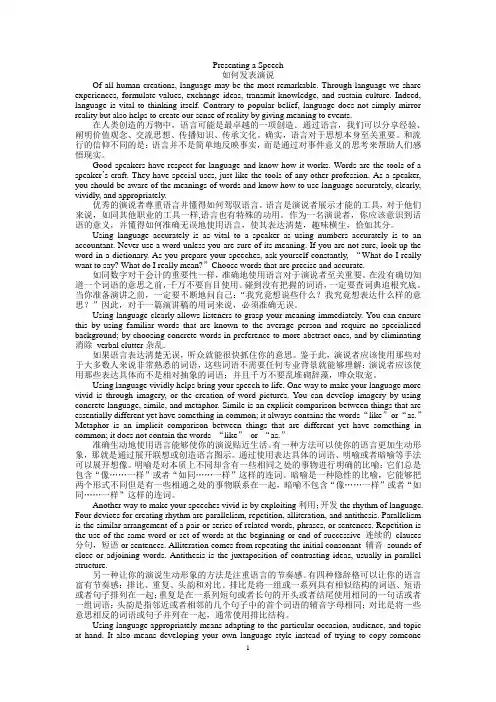
Presenting a Speech如何发表演说Of all human creations, language may be the most remarkable. Through language we share experiences, formulate values, exchange ideas, transmit knowledge, and sustain culture. Indeed, language is vital to thinking itself. Contrary to popular belief, language does not simply mirror reality but also helps to create our sense of reality by giving meaning to events.在人类创造的万物中,语言可能是最卓越的一项创造。
通过语言,我们可以分享经验、阐明价值观念、交流思想、传播知识、传承文化。
确实,语言对于思想本身至关重要。
和流行的信仰不同的是:语言并不是简单地反映事实,而是通过对事件意义的思考来帮助人们感悟现实。
Good speakers have respect for language and know how it works. Words are the tools of a speaker’s craft. They have special uses, just like the tools of any other profession. As a speaker, you should be aware of the meanings of words and know how to use language accurately, clearly, vividly, and appropriately.优秀的演说者尊重语言并懂得如何驾驭语言。