法律与道德英语小作文
- 格式:docx
- 大小:16.32 KB
- 文档页数:4
法律与道德英语小作文
下载温馨提示:该文档是我店铺精心编制而成,希望大家下载以后,能够帮助大家解决实际的问题。文档下载后可定制随意修改,请根据实际需要进行相应的调整和使用,谢谢!
并且,本店铺为大家提供各种各样类型的实用资料,如教育随笔、日记赏析、句子摘抄、古诗大全、经典美文、话题作文、工作总结、词语解析、文案摘录、其他资料等等,如想了解不同资料格式和写法,敬请关注!
Download tips: This document is carefully compiled by
theeditor. I hope that after you download them,they can
help yousolve practical problems. The document can be
customized andmodified after downloading,please adjust and
use it according toactual needs, thank you!
In addition, our shop provides you with various types
ofpractical materials,such as educational essays,
diaryappreciation,sentence excerpts,ancient poems,classic
articles,topic composition,work summary,word parsing,copy excerpts,other materials and so on,want to know different
data formats andwriting methods,please pay attention!
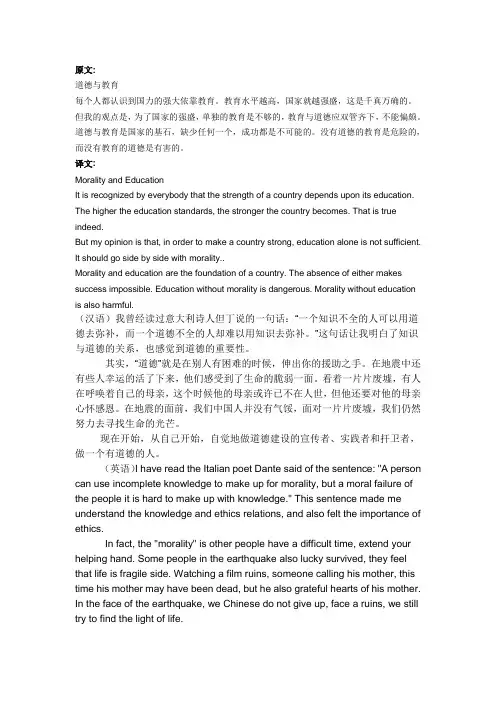
In today's society, law and morality play significant
roles in shaping our behavior and guiding our actions. They
provide a framework for maintaining order and ensuring
fairness. However, it is important to recognize that law
and morality are not always aligned. While laws are
enforceable rules set by the government, morality refers to
personal beliefs about what is right and wrong. This essay
explores the relationship between law and morality,
highlighting their differences and the potential conflicts
that may arise.
Laws serve as a crucial mechanism for maintaining
social order and regulating human behavior. They are
created by the government and enforced through a system of
punishments and rewards. Laws provide a sense of security
and stability in society, as they establish boundaries and
consequences for actions. For example, traffic laws ensure
road safety by regulating speed limits and traffic signals.
While these laws may not always align with personal moral values, they are necessary for maintaining order and
preventing chaos.
On the other hand, morality refers to an individual's
personal beliefs about what is right and wrong. It is
shaped by cultural, religious, and personal values.
Morality guides our behavior and helps us make ethical
decisions. For instance, many people believe that honesty
is a moral virtue and that lying is morally wrong,
regardless of whether it is illegal or not. Morality can
vary among individuals and cultures, leading to different
perspectives on what is considered morally acceptable.
Despite their differences, law and morality often
intersect. Laws are often influenced by moral values and
societal norms. For example, laws against murder and theft
reflect the moral belief that these actions are inherently
wrong. However, there are instances where laws may
contradict personal moral values. This can lead to moral
dilemmas and conflicts. For instance, some individuals may
morally oppose the death penalty, even if it is legally
sanctioned. In such cases, individuals may choose to follow their moral compass rather than the law.
Moreover, laws can also shape morality. When certain
actions are criminalized, they may be perceived as morally
wrong by society. For example, the legalization of same-sex
marriage in many countries has led to a shift in public
opinion and a greater acceptance of homosexuality. The law
has played a role in shaping societal attitudes and
challenging traditional moral beliefs.
In conclusion, law and morality are interconnected but
distinct concepts. While laws provide a framework for
maintaining order and regulating behavior, morality refers
to personal beliefs about what is right and wrong. While
they often align, conflicts can arise when personal moral
values differ from legal requirements. It is important to
recognize the role of both law and morality in shaping our
behavior and society as a whole.