
新概念第一册 Lesson 85-86
- 格式:pptx
- 大小:3.46 MB
- 文档页数:22


1 新概念英语课堂笔记第一册Lesson 85-86 Word Studycinema 【用法】n. 电影院【词组】go to the cinema 去看电影go to a movie 去看电影at the cinema 在电影院【扩展】movie house (美)电影院film【用法】n. 电影;胶卷;一层【词组】see a film 看电影film/movie star 电影明星develop a film 冲洗胶卷a film of oil 一层油【扩展】movie n.(美)电影beautiful 【用法】adj. 漂亮的;出色的;令人愉悦的【词组】beautiful music 优美的音乐【扩展】beauty n. 美丽,美人【同义】按程度从低到高:a plain Jane一个相貌平平的女孩(形容女孩子不漂亮的委婉表达)good-looking好看的smart 时髦的(因会打扮而变得美丽)bright 小巧玲珑(因可人而美丽动人)pretty 漂亮的,引人入迷的beautiful 天生丽质的gentleman-killer 万人迷【例句】She is a girl with a beautiful voice. 她是一位嗓音美妙动听的姑娘。Her French is as beautiful as her English. 她的法文说的和英文一样漂亮。Beautiful weather, isn't it? 天气晴朗宜人,对吗?city 【用法】n. 城市【扩展】town n. 城镇hometown n. 家乡country n. 国家,乡村countryside n. 乡村village n. 村庄homeland n. 祖国Names George /d??:d?/ 乔治(男子名)Text Explanation What’s on? 【译文】上演什么电影?【用法】on后面省略了the cinema。完整形式为:What’s on the cinema?类似用法:What’s on the radio? 广播里在放什么节目?What's on the television? 电视里在放什么节目?be on 意为“放映,上演,播放”。Paris in the spring. 【译文】巴黎之春。【用法】在表示季节的词前应不用冠词,in spring/summer/autumn/winter,在本文中spring前加了定冠词the,表示特指某一年的春天。比如:in the summer of 2000 在2000年的夏It rained all the time.

Lesson 85-86
学习重点:
一、现在完成时和一般过去时的区别
二、have been to 和have gone to 的区别
三、其它主要短语和表达
重点解析:
一、现在完成时和一般过去时的区别
1. 侧重点不同
现在完成时和一般过去时所表示的动作都发生在过去,但它们所强调的重点不同:现在完成时侧重于对现在的影响;而一般过去时只说明过去某一时刻发生的动作或存在的状态,与现在没有关系。即现在完成时侧重于现在的结果,而一般过去时侧重于动作发生的时间。例如:
I have seen the film. 我看过这部电影。(现在我仍记得电影的内容)
I saw the film three days ago.
三天前我看了这部电影。(强调是三天前,而不是别的什么时候看的电影)
Mr. Green has bought a new computer.
格林先生买了一台新电脑。(着重点是格林先生现在有了一台新电脑)
Mr. Green bought a new computer yesterday.
格林先生昨天买了一台新电脑。(强调的是格林先生买新电脑的时间是昨天)
2. 时间状语不同
现在完成时常与already, yet, just, ever, never等副词以及“for+段时间”, “since+过去时间/从句”等时间状语连用;而一般过去时则常与“段时间+ago”, just now, yesterday, last week等表示确定的过去时间的状语连用。例如:
She has lived here since two years ago.
她两年前就住在这里了。(暗含她可能还会在这里住下去)
She lived here two years ago. 两年前她住在这里。(暗含她曾经住过,但现在不在这里了)
He has been in the company for three years.
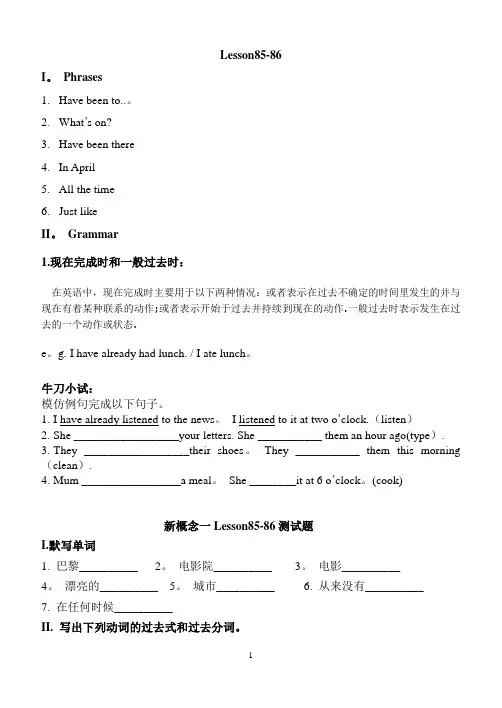
1 Lesson85-86
I。 Phrases
1. Have been to..。
2. What’s on?
3. Have been there
4. In April
5. All the time
6. Just like
II。 Grammar
1.现在完成时和一般过去时:
在英语中,现在完成时主要用于以下两种情况:或者表示在过去不确定的时间里发生的并与现在有着某种联系的动作;或者表示开始于过去并持续到现在的动作.一般过去时表示发生在过去的一个动作或状态.
e。g. I have already had lunch. / I ate lunch。
牛刀小试:
模仿例句完成以下句子。
1. I have already listened to the news。 I listened to it at two o’clock.(listen)
2. She __________________your letters. She ___________ them an hour ago(type).
3. They __________________their shoes。 They ___________ them this morning(clean).
4. Mum _________________a meal。 She ________it at 6 o’clock。(cook)
新概念一Lesson85-86测试题
I.默写单词
1. 巴黎__________ 2。 电影院__________ 3。 电影__________
4。 漂亮的__________ 5。 城市__________ 6. 从来没有__________
7. 在任何时候__________
II. 写出下列动词的过去式和过去分词。 2 1.buy _________ _________

Lesson 85-86Pairs in the springGEORGE: Hello, Ken.KEN: Hi, George.GEORGE: Have you just been to the cinema?KEN: Yes, I have.GEORGE: What’s on?KEN: ‘Paris in the spring’.GEORGE: Oh, I’ve already seen it.I saw it on television last year.It’s an old film, but it’s very good.KEN: Paris is a beautiful city.GEORGE: I’ve never been there.Have you ever been there, Ken?KEN: Yes, I have. I was there in April.GEORGE: Pairs in the spring, eh?KEN: It was spring, but the weather was awful.It rained all the time.GEORGE: Just like London!1. Have you just been to the cinema?1)这是现在完成时的一般疑问句,主语是you,助动词用have.2)just 刚刚,刚才(通常与完成时连用,有时也与过去时连用)--He has just bought a second hand car. --We just arrived.--just “正要…”“刚要….”(常用进行时或be going to do 连用)--I am just making tea for you. --She was just about to fall asleep when the telephone rang.3)have been to a place 表示曾经去过某地,但现在不在那个地方了,去而复归;have gone to a place表示己经去某地了,现在在那个地方或正在去的路上,去而未归。--George has been to Paris. --George has gone to Paris. --Have you ever been to America? --Has he gone go Washington D.C.? --I have been to the library. --H e has gone to the library. 4)have bee to the cinema 表示去过电影院 --have been to the park 去过公园但在名词school, work, church之前不加定冠词,它们所表示的是一种抽象概念而不是具体地点或位置。5) cinema n. 电影院(英)=movie house (美)go to the cinema=see a film2. What’s on? 口语经常使用,上映什么电影--on 表示上映-- What’s on the cinema?-- What’s on the TV?3. I've already seen it. I saw it on television last year.--She has already read this book. 她己经读过这本书了。--It is already past five o'clock. 己经过了五点了。4. I've never been there.1)have been to 后面加名词,若have been后面接副词,介词“to”要省去。--I have been to the park. 我去过那个公园。--He has already been to London. 他己经去过伦敦了。2)I have never been there. 从未去过那。 --never adv. 决不,永不,表示“从来”,这里有强调之意。--never通常置于一般动词之前,be动词,助动词之后。--I never had a chance to meet him. 我始终没有机会与他见面。--I never get up early on Sunday morning.可置于命令句之句首--Never eat too much. 绝不要吃太多。--never mind 不必介意5. Have you ever been there, Ken?ever 1) (用于疑问句)曾经,以前,至今(中文里有时不译出来)-- Do you ever go out late at night? 你平时在深夜外出吗?--Have you ever been to France? 你曾去过法国吗?--No, never. 没有去过。2)(用于否定句)无论何时都(不…); 至今(不曾…)--Nothing new ever happens in this little town. 这个小镇至今不曾发生过新鲜事。--I haven't ever been abroad. 我不曾到国外。3)(用于if从句)曾经--If you ever have any problems, don't hesitate to let me know. 你若有任何问题,请告诉我,别客气。4)(与最高级,比较级连用)至今--This is the best novel that he has ever written. 这是他所写的小说中最好的一部。6. It rained all the time. adv.始终,一直。all the time 总是; 一直--I will be here all the time. 我将一直在这。--I stayed at home all the time. 我一直呆在家里。7. Just like London 省略句Paris was just like London. just 1)just adv. 恰好--just then 正好在那个时候2)like prep. 象…be like...→look like... --What's your father like? 你爸爸是个什么样的人?8. beautiful1) adj. 美丽的--a beautiful flower--a beautiful woman2) 很棒的,完美的--What a beautiful game it is! 多棒的比赛!与同义词的区别: e and All things in their being are go --beautiful表示接近和谐理想的美,--pretty并非表示完美无缺的意思,而是着重表示“可爱”“令人怜爱”之意,--gook-looking 指容貌美,--handsome指容貌端正英俊的(多指男子)9. 复习与现在完成时连用的时间状语:注意下列词与现在完成时常用用于肯定句疑问、否定句介词alreadyjustneveronceyetjust eversince+过去某时间点for+时间段before...till/until...注意下列词不使用现在完成时态:1. 表示过去时态的时间状语:in 1998,yesterday,three years ago,last week2. When... 不用于现在完成时3. still adv.还,仍然,一般不用于完成时态。强调:现在完成时不与表过去的时间状语连用,如yesterday, ago, last...选择最恰当的答案。1.--I have seen the film already. --when__you__? --the day before yesterday.A. have; seen B. will; see C. did; see D. did; seen2. Mr. Black__in China since five years agoA. lived B. has lived C. lives D. is going to live3. We__trees last Sunday. So far we __over 3.000 trees there.A. planted; planted B. planted; have plantedC.have planted; planted D. have planted; have planted4. Jim__the Great Wall many times.A. went to B. goes to C. has gone to D. has been to5. Miss Wu has taught in this school__.A. for ten years B. ten years ago C. since ten years D. for ten years ago6.I __today's homework already. What about you?A. have finished B. finish C. to finish D. finishing用所给动词的适当形式填空1. Jim__(make)many friends since he __(come)to China.2. He __already__(write )a letter to the factory to ask them to stop making noise.3. -- When__he__ (leave)?--Two hours ago.4.--__you__(see)the film before?--Yes. I __. --Where__you__(see )it?--At The Queens Cinema5. How long__she__(be)ill?句型转换。1. John went to see his grandmother once a week.(对划线部分提问)__ __ __Jonn__to see his grandmother?2. He has already finished his homewor.(改为否定句)He__ finished his homework__.3. He has emptied the basket.(对划线部分提问)________________?1.I __ __(not be) to the park for months.2.Jack__(buy)a books yesterday. He __ __(buy) 10 books.3.__you__(see) their poster?4.She__ __(take) my math book. I can't do my homework.5.My brother __ __(eat) four apples. He can't __(eat)anything.6.He __ already __(come) here.7.I __ __(not do) my housework yet.8.Mom__ never __(be) to Beijing.9.__you __(speak) to him yet?10.George __ __(go) to Paris.