投资学第2章
- 格式:ppt
- 大小:1.13 MB
- 文档页数:125

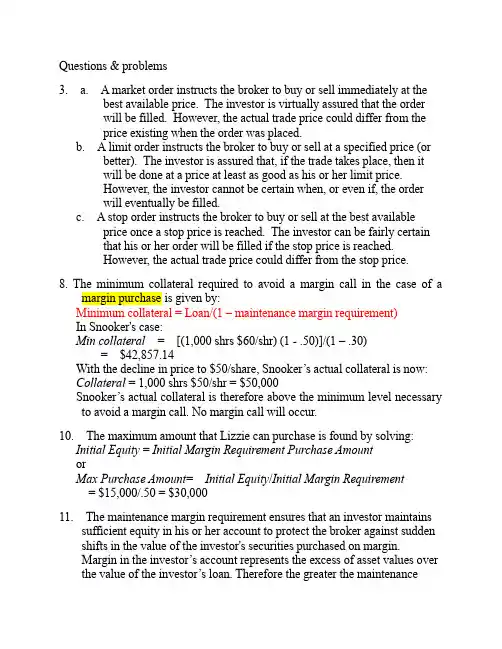
Questions & problems3. a. A market order instructs the broker to buy or sell immediately at thebest available price. The investor is virtually assured that the orderwill be filled. However, the actual trade price could differ from theprice existing when the order was placed.b. A limit order instructs the broker to buy or sell at a specified price (orbetter). The investor is assured that, if the trade takes place, then itwill be done at a price at least as good as his or her limit price.However, the investor cannot be certain when, or even if, the orderwill eventually be filled.c. A stop order instructs the broker to buy or sell at the best availableprice once a stop price is reached. The investor can be fairly certainthat his or her order will be filled if the stop price is reached.However, the actual trade price could differ from the stop price.8. The minimum collateral required to avoid a margin call in the case of amargin purchase is given by:Minimum collateral = Loan/(1 – maintenance margin requirement)In Snooker's case:Min collateral = [(1,000 shrs $60/shr) (1 - .50)]/(1 – .30)= $42,857.14With the decline in price to $50/share, Snooker’s actual collateral is now: Collateral = 1,000 shrs $50/shr = $50,000Snooker’s actual collateral is therefore above the minimum level necessary to avoid a margin call. No margin call will occur.10. The maximum amount that Lizzie can purchase is found by solving:Initial Equity = Initial Margin Requirement Purchase AmountorMax Purchase Amount= Initial Equity/Initial Margin Requirement= $15,000/.50 = $30,00011. The maintenance margin requirement ensures that an investor maintainssufficient equity in his or her account to protect the broker against sudden shifts in the value of the investor's securities purchased on margin.Margin in the investor’s account represents the excess of asset values over the value of the investor’s loan. Therefore the greater the maintenancemargin requirement, the greater is the broker's "cushion" against declines in the value of the investor's portfolio.12. Penny's initial investment in South Beloit is $17,500 ($35 500) of whichPenny put down $7,875 (.45 $17,500). Over the course of the year Penny must pay interest of $1,155 (.12 $9,625). At year-end Penny's investment is worth $20,000 ($40 500). Thus Penny's return on investment for theyear is:ROR = [($20,000 - $17,500) - $1,155]/$7,875= .171 = 17.1%14. Note that the return on an investor's margin purchase can be expressed ona total dollar basis or on a per share basis. In the latter case:In Ed Delahanty's case:a. ROR = {($40 - $30 + $1) - [.13 (1 - .55) $30]}/(.55 $30)= ($11 - $1.755)/$16.50 = .560 = 56.0%b. ROR = {($20 - $30 + $1) - [.13 (1 - .55) $30]}/(.55 $30)= ($-9 - $1.755)/$16.50 = -.652 = -65.2%c. ROR = ($40 - $30 + $1)/$30= $11/$30 = .367 = 36.7%ROR = ($20 - $30 + $1)/$30= $-9/$30 = -.300 = -30.0%16. Beauty's balance sheet at the time of the short sale would appear asfollows:Assets Liabilities & Net WorthCash Proceeds of Sale Liabilities$25/shr 500 shrs = $12,500Market V alue of Short Sold StockInitial Margin$25/shr 500 shrs = $12,500.50 $12,500 = $6,250Total Assets Net Worth$12,500 + $6,250 = $18,750$18,750 - $12,500 = $6,25017. The equity (or net worth) in an investor’s account who engages in shortselling is given by:Equity = (short sale proceeds + initial margin) - loanThus for Candy:a. [(200 shrs $50/shr) (1 + .45)] – (200 shrs $58/shr)= $14,500 - $11,600 = $2,900b. [(200 shrs $50/shr) (1 + .45)] – (200 shrs $42/shr)= $14,500 - $8,400 = $6,10018.The collateral required to avoid a margin call in the case of a short sale isgiven by:collateral =(short sale proceeds+initial margin) / (1 + maintenance margin requirement)In Dinty’s case, the minimum collateral is:collateral = (500 shrs $45/shr) (1+ .55) /(1+.35)= $25,833Dinty’s actual loan equals:500 shrs $50/shr = $25000Because the collateral exceeds the actual loan, Dinty will not receive a margin call at this time.21.Calculated on a total dollar basis, Deerfoot's initial investment in the shortsale of DeForest stock is $35,000 (.50 $70 1,000). At year-end, Deerfoot had to reimburse the owner of the DeForest stock with $2,000 ($2 1,000) for dividends paid on the stock. Further, at year-end, if Deerfoot purchased the stock and repaid the owner, then the excess proceeds over the amountwhich Deerfoot originally received when the stock was sold short would equal -$5,000 ($70 - $75 1000). Thus Deerfoot's return on investment during the year was:ROR = [($70,000 - $75,000) - $2,000]/$35,000= -.200 = -20.0%22.Expressing the return on a short sold security on a per share basis (including interest on the initial margin deposit) given:a. If the Madison stock, which was originally sold short at $50 per share,rises to $58 then:ROR = [($50 - $58 - $0) + (.45 $50 .08)]/(.45 $50)= -.276 = -27.6%b. If the Madison stock, which was originally sold short at $50 per share,falls to $42 then:ROR = [($50 - $42 - $0)] + (.45 $50 .08)]/(.45 50)= .436 = 43.6。

金德环《投资学》课后习题答案习题答案第一章习题答案第二章习题答案练习题1:答案:(1),公司股票的预期收益率与标准差为:Er,,,,,,,0.570.350.2206,,,,,,,,A1/2222,, ,0.5760.3560.22068.72,,,,,,,,,,,,,,A,,(2),公司和,公司股票的收益之间的协方差为:Covrr,0.5762510.50.3561010.5,,,,,,,,,,,,,,,,,AB ,,,,,,0.22062510.590.5,,,,(3),公司和,公司股票的收益之间的相关系数为:Covrr,,,,90.5AB ,,,,,0.55AB,8.7218.90,,AB练习题2:答案:如果,,,的投资投资于,公司,余下,,,投资于,公司的股票,这样得出的资产组合的概率分布如下:钢生产正常年份钢生产异常年份股市为牛市股市为熊市概率 0.5 0.3 0.2 资产组合收益率(,) ,, ,., -2.5 得出资产组合均值和标准差为:Er=0.516+0.32.5+0.2-2.5=8.25,,,,,,,,,,组合1/22222,, ,=0.516-8.25+0.32.5-8.25+0.2-2.5-8.25+0.2-2.5-8.25=7.94,,,,,,,,组合,,1/22222,=0.518.9+0.58.72+20.50.5-90.5=7.94,,,,,,,,,,,,,,,组合,,练习题3:答案:尽管黄金投资独立看来似有股市控制,黄金仍然可以在一个分散化的资产组合中起作用。
因为黄金与股市收益的相关性很小,股票投资者可以通过将其部分资金投资于黄金来分散其资产组合的风险。
练习题4:答案:通过计算两个项目的变异系数来进行比较:0.075 CV==1.88A0.040.09 CV==0.9B0.1考虑到相对离散程度,投资项目B更有利。
练习题5:答案:R(1)回归方程解释能力到底如何的一种测度方法式看的总方差中可被方程解释的方差所it2,占的比例。