动词的时态
- 格式:doc
- 大小:43.00 KB
- 文档页数:3
动词的时态
一、动词的时态
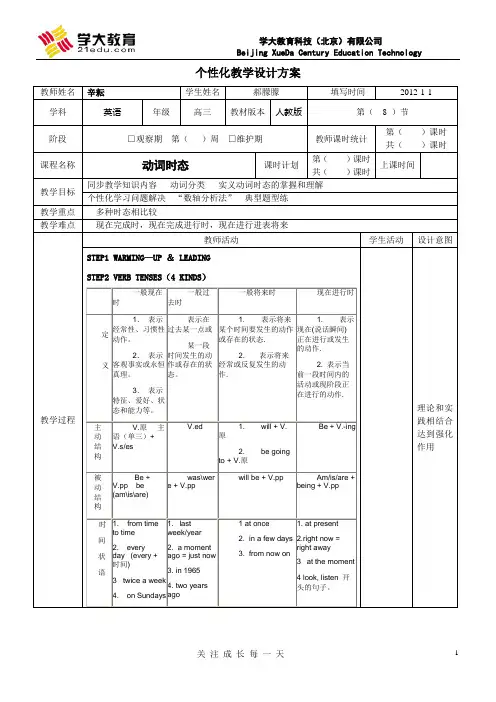
“时间”可分为:现在、过去、将来、过去将来4种。
“状态”可分为:一般、进行、完成、完成进行4种。
“时”与“态”交叉配合构成16种。
主要掌握9种即可:
时 态 一 般 进 行 完 成
现在 一般现在时 现在进行时 现在完成时
过去 一般过去时 过去进行时 过去完成时
将来 一般将来时 将来进行时 将来完成时
动词可分为5类:
情态动词
助动词
系动词
及物动词 实义动词 (可以单独作谓语)
不及物动词
时态中的“态”,即“状态”,表示一个动词的动作完成的程度。
一般态:表示动作的习惯性
进行态:表示动作正在进行
完成态:表示动作已经完成,并有结果
时 态 一般(V原) 进行(be+V-ing) 完成(have+P.P.)
现在 V原/ +es am/is/are+V-ing have/has+P.P.
过去 V-ed was/were+V-ing had+P.P.
将来 shall/will+ V原 shall/will+be+V-ing shall/will+have+P.P.
二、注意:
1. 一般态:V原
进行态:be + V-ing 根据不同时间及主语变化be.
完成态:have + P.P.根据不同时间及主语变化have.
2. 一般将来时的表示方法:
shall/will+ V原 “准备做,而且一定去做”
be going to+ V原 “打算做,做的可能性很大” be to + V原 “要做且一定做,表示命令、建议等”
be about to + V原 “不仅要做而且马上做”
3. 完成时的概念:
完成时表示持续存在及累积后果,它们都有一段时间为背景。起点都在过去,终点可以不同。
如图:
A B C D
起点 过去 现在 将来
终点在“现在”——— 称现在完成时 (have/has+P.P.) A C
终点在“过去”——— 称过去完成时 (had+P.P.) A B
终点在“将来”——— 称将来完成时 (shall/will have+P.P.) A D
4. 现在完成时,时间状语的表示方法:
(1)for + 一段时间 (for three years)
(2)since + 过去某一时间 (since 1998)
Since + 名词 ( since his arrival)
Since + 一段时间(since two years ago )
Since + 主语 + 一般过去时V ( since he left here)
注意:a. since 前面的句子中的谓语动词一般是表示延续动作的动词。
后面则是表示短暂的动作的名词或动词。
b. 主句中谓语用完成时态,since 从句谓语用过去时。
5. 现在完成进行时:have /has + been + do-ing
表示“从过去开始,一直做某事,而且此动作还将一直持续下去”。
Susan has cooked the dinner. 苏珊把饭做好了。
Susan has been cooking the dinner. 苏珊一直在做饭。(饭还没做好)
过去完成进行时:had + been + do-ing
表示过去一段时间内 “一直做某事”
He said he had been sitting there all morning and didn’t move a bit.
练 习
1. By the end of this month, the generating set ____ for a whole year.
A. will run B. has run C. runs D. will have run
2. Your daughter has two children, doesn’t she?
That’s right. She ____ in 1970.
A. did marriage B. was married C. had married D. got married
3. -- _____ my glasses?
-- Yes, I saw them on your bed a minute ago. A. Do you see B. Had you seen C. Would you see D. Have you seen 4. The new secretary is supposed to report the manager as soon as she ____.
A. will arrive B. arrives C. is arriving D. is going to arrive
5. The volleyball match will be put off if it _____ .
A. will rain B. rains C. rained D. is raining
6. Mary ____ a dress when she cut her finger.
A. made B. is making C. was making D. makes
7. Since the computers are used on assembly line, the production cost ___ greatly.
A. has been reduced B. is reducing
C. is reduced D. reduces
8. I hope they ____ this building by the time we come back next autumn.
A. have built B. will build C. are to build D. will have built
9. –We haven’t heard from Jane for a long time.
-What do you suppose _____ to her?
A. was happening B. to happen C. has happened D. having happened
10. –Do you know our town at all?
-No, this is the first time I ____ here.
A. was B. have been C. came D. am coming
11. –Do you like the material?
-Yes, it ____ very soft.
A. is feeling B. felt C. feels D. is felt
12. The pen I ____ I ____ is on my desk, right under my nose.
A. think; lost B. thought; had lost C. think; had lost D. thought; have lost
13. –Who is Jerry Cooper?
-_____ ? I saw you shake hands with him at the meeting.
A. Don’t you meet him yet B. Hadn’t you met him yet
C. Didn’t you meet him yet D. Haven’t you met him yet
14. He didn’t look well, for he ____ for sixteen hours.
A. had worked B. was working C. had been working D. would have worked
15. I first met Lisa three years ago. She _____ at a radio shop at that time.
A. has worked B. was working C. had been working D. had worked
16. Shirley _____ a book about China last year but I don’t know whether she has
finished it.
A. has written B. wrote C. had written D. was writing
动词的时态:
DDDBB CADCC CBDCB D