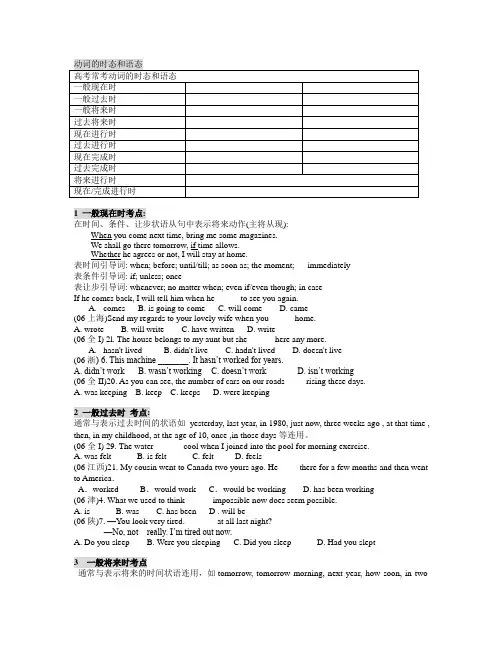
动词的时态语态
- 格式:docx
- 大小:26.04 KB
- 文档页数:20
第 1 页 动词的时态语态
依据学校英语教学新课标的要求,同学主要把握五种动词基本时态〔一般如今时、一般过去时、如今进行时、如今完成时、一般讲来时〕,理解三种时态〔过去进行时、过去完成时、过去讲来时〕,共计八种时态:
一:如今范畴的时态:
1. 一般如今时:
标志词语:always, often, usually, sometimes, never,
every day/week/month/year, on Sundays,once a day/week/month
year…,in the morning …,how often 等 考点:
1〕表如今、过去的常常性或习惯性动作或状态
We have meals three times a day.
He is always ready to help others.
2〕表达永久的真理。
The teacher told us the earth __________ (travel) around
the sun.
★温馨提示:1) 在以here, there开头的句子中用一般如今时替代如今进行时
Here _________(come) the bus.
Listen! There _______(go) the bell.
2) 肯定要把握三单动词改变规律
2. 如今进行时:如今进行时是由助动词be (am, is, are)+ 第 2 页 动词-ing 形式构成的,用来表示如今或现阶段正在进行的动作。
标志词语:Look! Listen! while, now,these days, at this
moment等时间状语 He ____________ (read) a newspaper, while he
______________(wait) for buses. My hometown
__________________ (become/get) richer and richer.
--What are you doing these days? ----I ____________
(write) a novel.
-- Where’s Tom? -- He _______(help) his dad wash the car
over there under the tree. ★温馨提示
1) always 用于将来时含有情感颜色。
He __________ always __________(complain) to me. (埋怨)
He _______always _____________(think )of others first.
(欣赏)
2) 表感觉、情感、心理活动的动词,如:see, hear, smell,
taste, notice, seem, hate, like, love, want, wish 等不用进行时
I ___________(want) to visit the Great Wall.
I __________(live) in Jinan now.
This kind of fruit _____________(smell) terrible but
_____________( taste) sweet. He ________(not, like) the
teacher at all.
3〕表理解、记忆、 拥有、确定的动词,如forget, remember, 第 3 页 understand, believe, know, decide,have, has, own, belong等,不用进行时
Now I still __________(remember) what he said.
3. 如今完成时:构成have/has+过去分词;其疑问句是把have/has提至句首,否认式是在have/has后面加not。
标志状词语: already, yet, ever, never, before, since…,in/during the past/last…, so far=up to now=by now, just,
recently, all one’s life, ever since,since then 考点:
The old man __________(live) in this village since he
_______(be) 3 years old. By now, we _____________(learn)
thousands of words.
So far, he _________________(visit) the island 5 times.
In the last 2 years, many people ________________(buy)
personal cars.
He’s already put the rubbish into the dustbin. (一般疑问句) (否认句)
→__________ he __________ the rubbish into the
dustbin_________?
→He _______ _________ the rubbish into the dustbin
_________.
He left his hometown 3 years ago. He hasn’t come back
yet. (同义句) 第 4 页 A〕He ___________ _____________ _____________ from his
hometown for 3 years.
B〕3 years __________ ___________ ___________ he
___________ his hometown. Mr Smith died 35 years ago. (同义句)
A〕Mr Smith __________ ___________ _____________ for 35
years.
B〕___________ ___________ 35 years ____________ Mr Smith
___________. ★温馨提示:1) 连续性动词与非连续性动词在如今完成时中的使用
连续性动词:be, have, know, live, work, study, learn,
teach, speak, talk, draw,wait,wear,walk, sleep等,这些动词可以和表示一段时间的状语连用。
例如:Uncle Wang has worked here for 10 years.
非连续性动词:come ,go, arrive, reach, see, hear, close,
leave, begin, start, lose, buy, fall, join, die等,这些动词可用于完成时态,说明某个动作的结果还存在,但不能和表示一段时间的状语连用。
常见的非连续性动词与连续性动词转换如下:
come--- be;leave---be away;come to---be in/at;go
out---be out;begin/start ---be on; buy---have;borrow---keep;die—be dead;join --- be a member of/be a…member;catch a 第 5 页 cold---have a cold;get/fall ill/sick --- be ill/sick;become
a teacher---be a teacher;fall asleep---be asleep;go/get to
sleep---sleep;marry --- be married;end/finish---be over
2) have/has been to,have/has gone to与have/has been in的区分
have/has been to意思是―去过某地‖ eg. He has been to
America many times.
have/has gone to意思是―去了某地‖ eg. ---Where is your
mother? –She has gone to the shop.
have/has been in +地点+表示段的时间状语,意思是“在某地已经停留了〔多长时间〕”。
eg. She went to Shanghai last week. She has been there
for mort than a week.
3) 几组易混淆的词
1) already与yet : already通常用于确定句中 , yet用于疑问句, 否认句中
2) ever与never: ever意为“曾经”,用于疑问句或否认句中多用于完成时态。 --- Have you ever traveled around the world?
--- No, not ever.
never意为“从来没有,从未”,常与before连用。
I have never been late for school before.
3) before与ago: before在完成时中常与ever,never连用, 第 6 页 I have never been there before.
ago常用于一般过去时,但在与since引导的词组或句子中,主句用完成时。 eg. He has lived here since he was born.
4) for与since:“for+一段时间”;since与表示过去的某一时间点词组或句子连用, 考点:
I _____________(teach) here since I came to Jinan.
His father _____________(work) in the factory for 20
years.
The old man ________________(live) in the village all his
life.
__________ you ___________ (pack) your suitcase yet?
We’ll leave in a minute. --- Have the guests arrived? --- Yes.