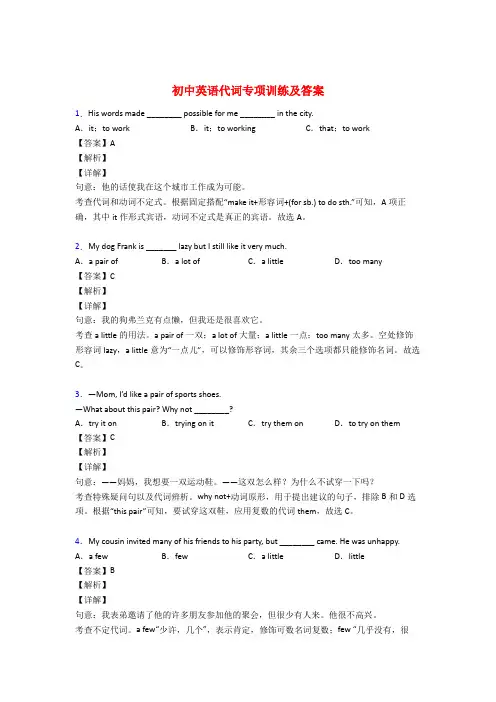
初中英语代词讲解及习题(附答案)
- 格式:doc
- 大小:138.50 KB
- 文档页数:24
word格式-可编辑-感谢下载支持
第三章 代词:
代词的分类:英语中代词分为:人称代词、物主代词、反身代词、指示代词、关系代词、疑问代词、连接代词和不定代词等等。
第一节 人称代词、物主代词、反身代词
1、人称代词:人称代词代替人和事物的名称,分为主格和宾格两种形式。
第一人
称单数 第二人
称单数 第三人称单数 第一人称复数 第二人称复数 第三人称复数 阳性 阴性
中性
主
格 I
(我) you
(你) he
(他) she
(她) it
(它) we
(我们) you
(你们) they
(他们,她们,它们)
宾
格 me
(我) you
(你) him
(他) her
(她) it
(她) us
(我们) you
(你们) them
(他们,她们,它们)
(1)、主格用来作句子的主语、表语。如: I often go shopping on Sundays.(星期天我常去购物) / Are they from Brazil?(他们是巴西人吗?) / Where have they gone?(他们上哪儿去了?) / That’s it.(就那么回事) / It’s he!(是他!)
(2)、宾格用来作及物动词或者介词的宾语。如:Who teaches you English this year?(今年谁教你们的英语?) / Help me!(救救我!) / We often write letters to her.(我们常给他写信)
(3)、人称代词作表语或者放在比较状语从句连词than或as之后时,可以用主格形式,也可以用宾格形式,口语中大多用宾格。如:--Who is it?(是谁?) –It’s I/me.(是我。)
(4)、三个不同人称同时出现,或者主语中包含“我”时,按照“you→he→I”的顺序表达。如:
Both he and I are working at that computer company.(我和他都在那家电脑公司上班)
–Who will go there?(谁要去那儿?) –You and me.(你和我)
(5)、人称代词it除了可以指人指物之外,还可以表示“时间、天气、温度、距离、情况”等含word格式-可编辑-感谢下载支持
义,此外还可以作“非人称代词”使用,替代作主语或者宾语的不定式、动名词或者名词性从句。如:--What’s the weather like today?(今天天气怎样?)—It’s fine.(天气晴好) / --What’s the time?(几点啦?) –It’s 12:00.(12点) / It’s a long way to go.(那可要走好长的路) / It took him three days to clean his house.(打扫屋子花了他三天的时间) / It is
very clear that the public want to know when these men can go into space.(很显然,公众想知道这些人什么时候能进入太空) / We found it very difficult to learn a foreign
language well.(我们发觉要学好一门外语是非常困难的)
2、物主代词:说明事物所属关系的代词,分为形容词性和名词性两种。
第一人
称单数
第二人
称单数 第三人称单数 第一人称复
数 第二人称复数 第三人称复数 阳性 阴性 中性
形容
词性 my
(我的) your
(你的) his
(他的) her
(她的) its
(它的) our
(我们的) your
(你们的) their (他们的,她们的,它们的)
名词
性 mine
(我的) Yours
(你的) his
(他的) hers
(她的) its
(她的) ours
(我们的) yours
(你们的) theirs(他们的,她们的,它们的)
(1)、形容词性物主代词只能作句子中名词的修饰语,后面要跟名词。如:
Is that your umbrella?(那是你的伞吗?) / I often go to see my aunt on Sundays.(我经常在星期天去看望阿姨) / They are their books.(是他们的书)
(2)、名词性物主代词相当于名词,既代替事物又表明所属关系,在句子中往往独立地作主语、宾语或者表语,后面千万不可以跟名词。如:
This is your cup,but where is mine?(这是你的杯子,可我的在哪儿?) / Your classroom
is very big, but ours is rather small.(你们的教室很大,我们的相当小)
(3)、“of + 名词性物主代词”称为双重所有格,作定语时放在名词的后面。如:
A friend of mine came to see me yesterday.(我的一个朋友昨天来看我了) (指若干朋友中有一个来看我。)
[试比较] My friend came to see me yesterday.(我的朋友昨天来看我了)(指我的那个特定的朋友来看我。) word格式-可编辑-感谢下载支持
3、反身代词:表示谓语的动作与主语有关或者宾语补足语的动作与宾语有关。
第一人
称单数 第二人
称单数 第三人称单数 第一人称复数 第二人称复数 第三人称复数 阳性 阴性 中性
myself
(我自己) yourself
(你自己) himself
(他自己) herself
(她自己) itself
(它自己) ourselves
(我们自己) yourselves
(你们自己) themselves
(他们/她们/它们自己)
(1)、反身代词在句子中作宾语表示反射(指一个动作回到该动作执行者本身)。如:
Don’t play with the knife, you might hurt yourself.(不要玩刀子,那会割伤你的)
(2)、在句子中作同位语表示强调(即用来强调名词或代词的语气)。如:
The story itself is good. Only he didn’t tell it well.(故事本身是好的,只是他没有讲好)
4.指示代词: 指示说明近处或者远处、上文或者下文、以前或者现在的人或事物。
单数 复数 含义
this(这个) these(这些) 指较近的人和物
that(那个) those(那些) 指较远的人和物
such (这样的人/物) 指上文提过的人和物
same (同样的人/物) 指和上文提过的相同的人和物
it (这人/这物) 指不太清楚是谁或者是什么时
指示代词既可以单独使用做句子的主语、宾语或表语,也可以作定语修饰名词。如: word格式-可编辑-感谢下载支持
What’s this?(这是什么?) / That model plane is made of plastic.(那只模型飞机是塑料做的)(被动句) / Remember never to do such things.(记得永远不要做这样的事情)
/ Do the same as the teacher tells you. (按老师说的做)/ ---Who is it?(是谁?) ---It’s me!(是我!)
一、用适当的人称代词填空:
1. __________ is my aunt. We often visit __________. ( she )
2. China is a developing country. _________is in the east of Asia.
( its )
3. What day is __________ today? — __________ is Thursday. (its)
5. I own a blue bike. The red one isn’t __________. ( I )
6. These new houses are so nice. __________are very expensive.(them )
7. The fishermen caught a lot of fish, didn’t __________? ( them )
8. Ling Ling is a girl.____studies in a primary school.______ brother
lives with ____ and helps ____ with______ lessons. ( she )
9. Mike is my classmate. ____ is good at Engliush . ( his )
10. Kate wants a glass of milk. Will you pass it to ____ ? ( she )
11. What’s the weather like today ? ____ is cloudy. ( its )
二、用形容词性物主代词和名词性物主代词填空
1. I ate all ____ sandwiches yesterday.( I ) Can I have one of ____ ?
( you )
2. George has lost ____ ( his ) pen. Ask Mary if(是否)she will lend him ____ . ( she )
3..Jack has a dog and so have I.____(he)dog and ____( I ) had a fight (打架).
4. The teacher wants you to return that book of ____ ( he )
5. Mr. and Mrs. Green and a friend of ____ are coming to see us.
( they )
6. We are going to Paris to stay with a French friend of ____ .
(we )
7. This isn’t________knife. _________ is green. ( she )
8. These are your books Kate.Put ________in the desk,please.(they )
9. _______ must look after ________ things. ( you )
10. Wei Fang,is that ________ ruler? Yes,it’s.( you )
11. They want a football. Give __________the green one,please. ( they)
12. It’s Lin Tao’s bag. Give it to __________. ( he )