
词汇学- 词的意义
- 格式:ppt
- 大小:48.00 KB
- 文档页数:23


先看例句:
①我国最大马力拖拉机开
始量产。(人民网一《人民日报》
2005年10月24日第16版)
②台三个月后量产流感疫
苗。(人民网一《人民日报・海外 8 ̄t}2009年5月5日第3版)
③“空中小轿车”开始量产。
(人民网一《人民日报・海外版》
2006年12月9日) ④在刚刚闭幕的上海车展
上,几乎所有国内厂家都推出了电
动汽车,几乎所有厂家都高调宣
布,它们的量产电动车将在明后年
投放市场。(王政:电动车热的冷思
考。人民网2009年5月6日) ⑤大众最疯狂的计划:布加
迪威龙今年9月量产。(人民网一
《人民日报))2005年2月24日)
⑥据《重庆晚报》报道:EI
前。位于重庆市西彭的西南铝业 公司传出喜讯——制罐材料研发
取得突破,已具备量产能力,铝制 易拉罐从此实现中国造。(人民网
2009年4月30日)
⑦我首款最新混合动力系统
的油电混合动力轿车量产。(人民 网一《人民日报・海P]" ̄/gt))2007年
l2月14日)
以上实例告诉我们,人们以
前的习惯说法“批量生产”由于词
语紧缩而迅速词汇化。尽管“量
产”与“批量生产”的理性意义完
全相同,“量产”就是“批量生产” 的意思,语法上也大同小异,二者
的语法位置基本相同,只是“量
产”可以直接作定语,如例④⑥, 说词论句i 2010・4
而“批量生产”作定语时后面需加
“的”;但是,语用的求简原则使得
人们更易接受“量产”。我们相信,
用不了多久,“量产”便会被现代
汉语类词典收录,从而取得词的
正式户口。
“量产”是词汇化的结果,除 了有词汇化的意义外,更给我们
一个词汇学上的启发,那就是词
语紧缩是词(或语素)的意义增多
的重要途径之一。查《古代汉语词 典》(商务印书馆1998年12月第
1版),“量liOng”的义项有:①量
器,如升、斗、斛等;②容量,限量;
③度量,气量;④估量,衡量;⑤量
词,双。查《现代汉语词典》(商务
On Context and Meaning
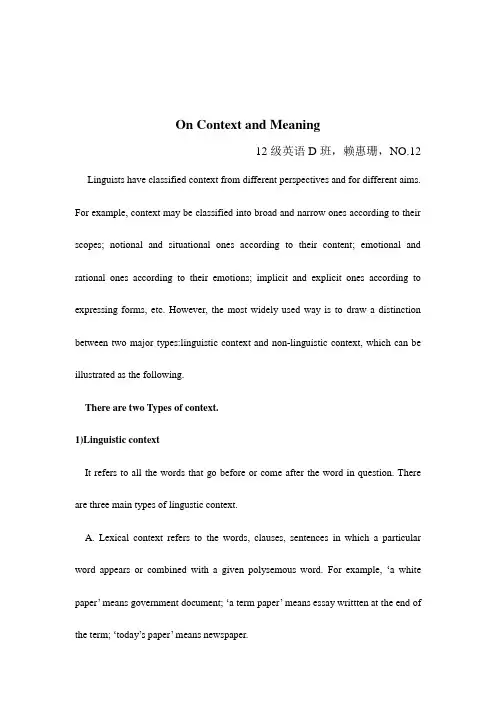
12级英语D班,赖惠珊,NO.12
Linguists have classified context from different perspectives and for different aims.
For example, context may be classified into broad and narrow ones according to their
scopes; notional and situational ones according to their content; emotional and
rational ones according to their emotions; implicit and explicit ones according to
expressing forms, etc. However, the most widely used way is to draw a distinction
between two major types:linguistic context and non-linguistic context, which can be
illustrated as the following.
There are two Types of context.
1)Linguistic context
It refers to all the words that go before or come after the word in question. There
are three main types of lingustic context.
A. Lexical context refers to the words, clauses, sentences in which a particular
Journal of Ningbo Institution of Education, Vol.11, No.5, Oct.2009
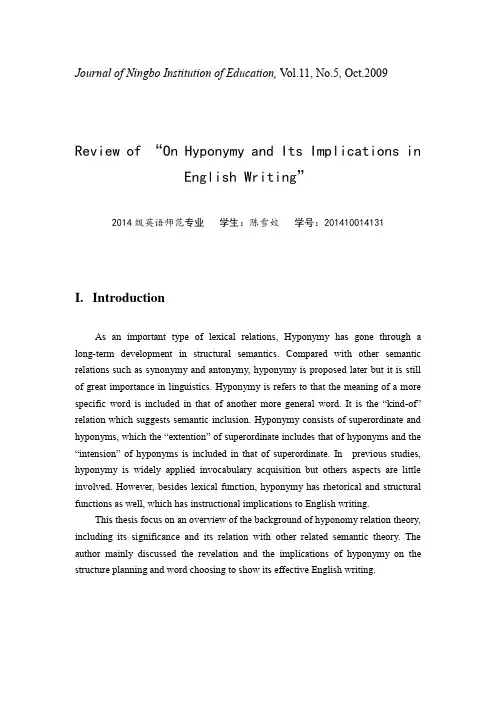
Review of “On Hyponymy and Its Implications in
English Writing”
2014级英语师范专业学生:陈雪姣学号:201410014131
I. Introduction
As an important type of lexical relations, Hyponymy has gone through a
long-term development in structural semantics. Compared with other semantic
relations such as synonymy and antonymy, hyponymy is proposed later but it is still
of great importance in linguistics. Hyponymy is refers to that the meaning of a more
specific word is included in that of another more general word. It is the “kind-of”
relation which suggests semantic inclusion. Hyponymy consists of superordinate and
hyponyms, which the “extention” of superordinate includes that of hyponyms and the
“intension” of hyponyms is included in that of superordinate.In previous studies,
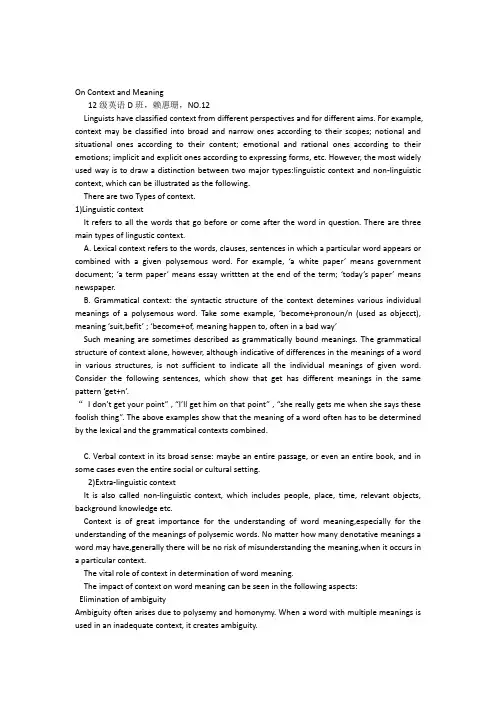
On Context and Meaning
12级英语D班,赖惠珊,NO.12
Linguists have classified context from different perspectives and for different aims. For example,
context may be classified into broad and narrow ones according to their scopes; notional and
situational ones according to their content; emotional and rational ones according to their
emotions; implicit and explicit ones according to expressing forms, etc. However, the most widely
used way is to draw a distinction between two major types:linguistic context and non-linguistic
context, which can be illustrated as the following.
There are two Types of context.
1)Linguistic context
It refers to all the words that go before or come after the word in question. There are three
main types of lingustic context.
A. Lexical context refers to the words, clauses, sentences in which a particular word appears or