
skills for listening
- 格式:ppt
- 大小:323.50 KB
- 文档页数:15


大学英语A级考试听力材料Section 1You will hear a conversation between a student and a professor. The student is seeking advice on how to improve her listening skills for the upcoming A-level English exam. Listen carefully and answer the questions below.Student: Hello, Professor Smith. I hope you can help me. I'm really struggling with my listening skills for the A-level English exam. Do you have any tips or strategies that might help me improve?Professor: Of course, I'd be happy to help. Improving your listening skills requires regular practice and exposure to a variety of English accents. One effective strategy is to listen to authentic English materials, such as podcasts, radio shows, or movies. This will help you become familiar with different accents and improve your overall comprehension.Student: That sounds like a great idea. But sometimes I find it difficult to understand the fast-paced conversations in these materials. Any suggestions on how to overcome this?Professor: Good question. When listening to fast-paced conversations, it's important to focus on the main ideas and key points. Try not to get caught up in understanding every single word. Pay attention to context and use your prior knowledge to fill in the gaps. With practice, your listening speed and comprehension will improve.Student: Thank you, Professor. I'll definitely give that a try. Are there any other strategies that I can use to enhance my listening skills?Professor: Absolutely. Another useful strategy is to engage in active listening. This means taking notes while you listen, jotting down important keywords or phrases, and summarizing the main ideas after each listening session. This will help you retain information and reinforce your understanding of the material.Student: That makes sense. I'll make sure to take notes and review them later. Do you have any recommendations for specific resources or materials that I can use?Professor: There are various online platforms and apps that provide authentic listening materials with accompanying transcripts. These resources allow you to listen, read, and compare your understanding with the transcript. Additionally, you can practice listening torecordings of English conversations and then try to reproduce them by speaking aloud. This will help improve your pronunciation and speaking skills as well.Student: Thank you so much, Professor Smith. I really appreciate your guidance. I'll put these tips into practice and give it my best shot in the upcoming exam.Professor: You're welcome, and good luck with your preparation. Remember, consistent practice and exposure are the keys to success. Keep practicing, and I'm confident you'll see significant improvement in your listening skills.Section 2You will hear a monologue from a student who recently took the A-level English exam. Listen carefully and answer the questions below.Student: Hey everyone, I just wanted to share my experience of taking the A-level English exam. The listening section was definitely challenging, but with some preparation, I managed to do well.Firstly, I made it a habit to listen to English podcasts and radio shows regularly. This helped me get used to different accents and improved my overall listening comprehension. I also practiced watching English movies without subtitles, which forced me to rely solely on my listening skills.During the actual exam, I focused on understanding the main ideas and key points of each listening passage. I didn't stress about understanding every single word. If there were difficult parts, I used my prior knowledge and context to guess the meaning. This approach helped me maintain my confidence and allowed me to answer the questions effectively.In terms of resources, I found online platforms and apps extremely helpful. They provided a wide range of listening materials with transcripts and practice exercises. I would listen to the recordings, read the transcripts, and compare them to see where I went wrong. This helped me identify my weaknesses and areas for improvement.Additionally, I engaged in active listening by taking notes during practice sessions. I would jot down keywords, phrases, and important details. After each session, I would review my notes and summarize themain ideas. This not only reinforced my understanding but also helped me retain the information for longer.Overall, preparing for the listening section of the A-level English exam requires dedication, practice, and exposure to authentic materials. By incorporating these strategies into my study routine, I was able to improve my listening skills and perform well in the exam. Good luck to all of you who are preparing for it!Section 3You will hear a conversation between two students discussing their strategies for the A-level English listening exam. Listen carefully and answer the questions below.Student 1: Hey, have you started preparing for the A-level English listening exam?Student 2: Yes, I have. It's quite challenging, but I'm determined to do well. What about you?Student 1: I've been practicing by listening to English podcasts and watching movies in English without subtitles. It has helped me getaccustomed to different accents and improved my overall comprehension.Student 2: That's a good strategy. I've also been using online platforms that provide listening materials and transcripts. I listen to the recordings, read along with the transcripts, and then try to answer the questions without looking at the text.Student 1: Oh, that's an interesting approach. I should try that too. Do you have any other tips?Student 2: Yes, I find it helpful to create flashcards with keywords or phrases related to the listening passages. I shuffle them and listen to a recording, trying to match the information from the passage with the corresponding flashcard.Student 1: That's a clever idea. It seems like an effective way to reinforce vocabulary and improve memory. I’ll definitely give that a try.Student 2: Another technique I use is shadowing. I listen to a short recording, and as I listen, I try to imitate the speaker's pronunciation,intonation, and rhythm. It helps improve my listening and speaking skills at the same time.Student 1: That sounds like a fun exercise. I'll incorporate that into my practice sessions as well. Thanks for sharing these tips!Student 2: No problem. We're all in this together. With consistent practice and different strategies, I'm sure we'll all succeed. Good luck!。
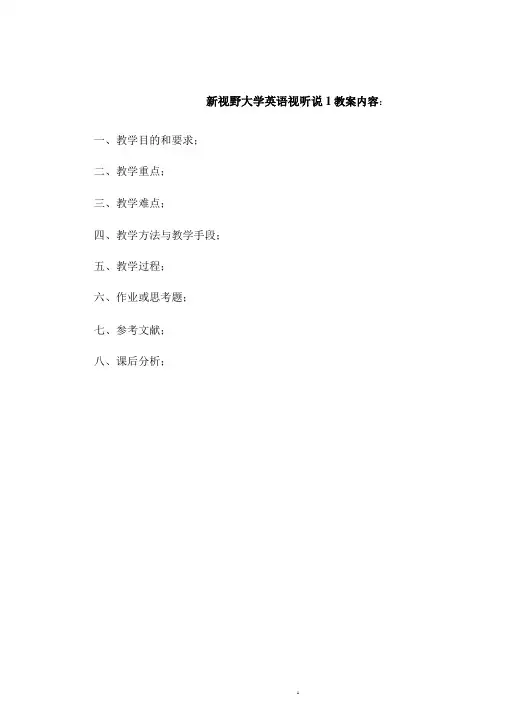
新视野大学英语视听说1教案内容:一、教学目的和要求;二、教学重点;三、教学难点;四、教学方法与教学手段;五、教学过程;六、作业或思考题;七、参考文献;八、课后分析;课程基本信息□公共必修课□公共选修课课程类别√专业必修课□专业选修课□学分学时 1.5 学分26 学时使用教材郑树棠,《新视野大学英语视听说教程1》,外语教学与研究出版社,2015 年参考1.郑树棠,《新视野大学英语视听说教程 1 教师用书》,外语教学与研究出版社,2015 年书目2.张明伦,《英语听力入门 I-IV 》,华东师范大学出版社,2009年.3.潘培忠,《VOA 新闻听力教程》,青岛出版社, 2001年.通过对英语(师范)专业大一学生进行初步的专业听力技能训练使其能听懂教师的课堂用语以及对课文内容所作的解释;听懂他人以较慢的语速谈课论日常生活;听懂基本没有生词、题材熟悉、难度略低于高三所学课文的程语段,理解正确率达到 70%。
通过一学期的学习,能够听懂英语语言国家人教士所作的难度不超过所学语言知识的讲座,掌握中心大意,理解主要内容,并能辨别说话人的态度和语气。
听懂VOA慢速新闻广播和文化节目,抓住学主要内容。
能在15分钟内听写根据已学知识编写而成或选用的录音材料(词目数120个左右,念四遍,语速为每分钟80个单词),错误率不超过 10%。
的能熟练地就课文内容进行问答,并进行简单的讨论;经过准备,能简及单而连贯地复述听过的或读过的语段;能就日常生活的话题进行初步交际;能清楚而连贯地讲述学生熟悉的题材和课文内容,长度不少于八句。
通过要一学期的学习,口语水平应逐步在初级基础上有所提高:能就所听到的语求段进行问答和复述;能就日常生活话题进行交谈;做到正确表达思想,语音、语调自然,无重大语法错误,语言基本得体。
UNIT 1 Traces of the past(3periods)I.Teaching Objectivesand Requirements1. Topic:Traces of the past2. Language Skills:1) Listening skills: Listening for specific information2) Speaking skills: Keeping a conversation going3. Learning Objectives:1) talk about past events and their impacts on the present2) listen for specific information3) keep a conversation going4) conduct an interview4. Vocabulary, and Expression:social, clubbing, disco, cute, fish and chips, Johannesburg,orphanage, Cuban, FIFA ⋯5. Language Notes and Culture Notes:Tower Bridge, Harry Potter, Mamma Mia, Havana, Covent Garden, Cuban National Ballet, Grammy Awards ⋯II. Teaching Focusesanize a series of listening and speaking activities related to the topic of the unit.2.Help Ss master the related listening and speaking skills by conducting listening and speaking training in class.3.Give students some background information about each part.4.Focus on the listening materials on Pages 15---18.III. Teaching Difficulties1.Encourage the freshmen to speak in English in class by helping them eliminate some negative affective factors, and some language/cultural barriers.2.Try to reduce Ss’a nxiety and create more chances for them toengage in classroom activities.IV. Teaching Methods and Teaching AidsTeaching Methods: presentation, discussion, self-learning, instruction, interactionTeaching Aids: multi-media, physical objects, models, pictures, CDV. Teaching Procedures1.Opening UpGuide Ss to think of the activities he/she sometimes does at weekends, and then ask his/her partner whether he/she likes doing any of the activities mentioned in the word webs on Page 2 and whether he/she did any of them last weekend.4. Skills Training1) Lead-in: Watch a podcast from the beginning to the end for its generalidea, and then finish the related exercises on pages 3---4. 2) ListeningListening skills:Listening for specific informationListening for specific information is a common and useful listening skill. It means listening for the important details you need. For example, if you listen to a weather forecast, you should expect to information about the temperatures,descriptions of the weather, such as clear, sunny, cloudy, overcast, rainy, hot, cold, windy, snow, storm, and chances of rain / snow. Training at 3 steps:BEFORE you listen; WHILE you listen; AFTER you listen3)ViewingTraining at 3 steps:BEFORE you view; WHILE you view; AFTER you view4) SpeakingSpeaking skills:Keeping a conversation goingKeeping a conversation going is an important speaking skill for exchanging information with or showing politeness to other people. There are several ways to keep a conversation going.Firstly, ask questions. Questions are useful not only for starting a conversation, but also for keeping the conversation going. After your first question, ask follow-up questions, especially open-ended questions, to encourage the person you are talking with to go on with the conversation. Secondly, give extra information.When answering questions, try to give extra information such as whom you did something with, when and where you did it, how it was.Thirdly, make comments. Encourage your conversation partner to go on talking by making comments on what he / she says. You may use expressions such asThat sounds good,!Really?, or I don ’t believe y.ou! Speaking skills training:Imitation; Role-play; Group discussion 3. Further practice in listening1) Understanding ten short conversations.2) Understanding a long conversation followed by five questions.3) Understanding a passage following by five questions.5. Introduction to English News (Unit 1 ofListen to News):1) Definitions ofNews“新闻”2) English News 英“语新闻”two types of English newsdifferent carriers of English news2) The Importance and Necessity of Learning English NewsVI. Assignments1.Ask Ss to finish Task 3, Ex.5 on Page 5. and Task 2, Ex.4 on Page 9. 2.Assign Ss to prepare a three-minute oral report on one of the above topics or any one related to what he/she has learned in this unit andpresent it in the next class.VII. References5.郑树棠,《新视野大学英语视听说教程1教师用书》,外语教学与研究出版社,2015年6.张明伦,《英语听力入门 I-IV 》,华东师范大学出版社,2009年.7.潘培忠,《VOA 新闻听力教程》,青岛出版社, 2001年.VIII. ReflectionUnit TwoA Break for Fun(3 periods)I.Teaching Objectives and Requirements8. Topic:Talk about various leisure activities.9. Skills:1) Listening: able to identify words and expressions for describingpeople’s appearance.2) Speaking: able to ask for and give recommendations; able to describean event.10. Vocabulary, Expressions and GrammarSlumdog Millionaire , Terminator, The Proposal, Sweeney T odd, The Graduate,Bestival, masculine, blonde, coming of age, survey, personality, presenter, live, surf.II. Teaching Focuses6.Topic understanding and improving the students ’l istening and speaking ability about talking about the various leisure activities.7. Listen and learn by heart some useful expressions about the relevant films and leisure activities.8. Practice talking about one’s appearance, describing an event.III. Teaching Difficulties3. How to improve the students’listening and speaking ability about topics in this unit.4. How to understand the movie names in the dialogs.IV. Teaching Methods and Teaching AidsTeaching Methods: presentation, discussion, self-learning, instruction, interactionTeaching Aids: Multi-media, physical objects, models, pictures, CDV. Teaching ProceduresStep One: Lead inTeaching tips: Ask Students to work in pairs discussing the following questions and then compare their answers with their partners.What is your favorite activity in your spare time?How often do you go to the cinema?Step Two: Listening SkillsTask 1:Understanding short conversationsNow you will hear five short conversations. Listen carefully and choose the best answer from the four possible choices.Task 2: Understanding a long conversationNow you will hear a long conversation followed by four questions. Listen carefully and choose the best answer from the four possible choices.Task 3: Understanding the two passagesNow you will hear two passages, in which the first passage is followedby four questions and the second passage is with word blanks for you to fill in. Listen carefully and choose the best answer from the listening materials.Task 4: Listening to the worldSharing: Watch the podcast which includes three video materials before doing the exercises.Practice the topics:1) How often do they go to the cinema?2) What kinds of films do they like?3) Who are their favorite actors?Listening:Watch the radio program before filling in the blanks of the table about the actors’appearance, and let the students practice the description of people’s appearances.Viewing: Watch the video before working in pairs and discussing the questions:1)What do you think about Bestival? Would you like to go to a festival like Bestival? Why or why not?2)Of all the festivals held on your campus or in your city, which one do you like most? Why?Task 5: Additional listening materials大( 学英语新闻听力教程)Listen to the news: now listen to the news report and choose the best answer to each question you hear.Step Three: Speaking outTask 1: Listen to conversation 1 and fill in the blanks.Task 2: Listen to Conversation 2 and check the ones you hear.Step Four: VocabularySlumdog Millionaire《贫民窟的百万富翁》, Australia《澳大利亚》,Terminator《终结者》, The Proposa《l假结婚》, Sweeney Tod《d理发师陶德,》The Graduate《毕业生》,Bestival 英国音乐节名 , masculine男性e头发)金黄色的, coming of age成年, survey调查, personality 的, blond(个性, presenter主持人, live 现场直播的, surf 冲浪.VI. Assignments1. Further listening and speaking2. Finish the after-class exercises.VII.References9.郑树棠,《新视野大学英语视听说教程 1 教师用书》,外语教学与研究出版社, 2015年10.张明伦,《英语听力入门 I-IV 》,华东师范大学出版社,2009年.11.潘培忠,《VOA 新闻听力教程》,青岛出版社, 2001年.VIII.ReflectionUnit Three Life moments(3periods)I.Teaching Objectives and Requirements11. Topic:Talk about various leisure activities.12. Skills:1) Listening: able to identify words and expressions for describingpeople’s appearance.2) Speaking: able to ask for and give recommendations; able to describean event.13. Vocabulary, Expressions and GrammarDiversity, multiculturalism, absolutely, and stuff, tremendous architecture, Oasis, pass, boundary, absurdist, traditionalII. Teaching Focuses12.Topic understanding and improving the students ’l istening and speaking ability about talking about the various leisure activities.2. Listen and learn by heart some useful expressions about the relevant films and leisure activities.5. Practice talking about one’s appearance, describing an event.III. Teaching Difficulties2. How to improve the students’listening and speaking ability about topics in this unit.3. How to understand the movie names in the dialogs.IV. Teaching Methods and Teaching AidsTeaching Methods: presentation, discussion, self-learning, instruction,interactionTeaching Aids: Multi-media, physical objects, models, pictures, CDV. Teaching ProceduresStep One: Lead inTeaching tips: Ask Students to work in pairs discussing the following questions and then compare their answers with their partners.Have you ever traveled aboard?Have you ever slept in a tent in the woods ?Step Two: Listening SkillsTask 1:Understanding short conversationsNow you will hear five short conversations. Listen carefully and choose the best answer from the four possible choices.Task 2: Understanding a long conversationNow you will hear a long conversation followed by four questions. Listen carefully and choose the best answer from the four possible choices.Task 3: Understanding the two passagesNow you will hear two passages, in which the first passage is followedby four questions and the second passage is with word blanks for you to fill in. Listen carefully and choose the best answer from the listening materials.Task 4: Listening to the worldSharing: Watch the podcast which includes three video materials before doing the exercises.Practice the topics:1) why dose Finn love living in London?2) What specific reasons dose he give?3) What question does he ask people to answer?Listening:Watch the radio program before filling in the blanks of the table about the actors’appearance, and let the students practice the description of people’s appearances.Viewing: Watch the video before working in pairs and discussing the questions:1) How do they feel about London?2)Task 5: Additional listening materials大(学英语新闻听力教程) Listen to the news: now listen to the news report and choose the best answer to each question you hear.Step Three: Speaking outTask 1: Listen to conversation 1 and fill in the blanks.Task 2: Listen to Conversation 2 and check the ones you hear.Step Four: VocabularyGuatemala, the Nail, Egypt, anniversary, Iecland, thermal, spa, Mayan civilizationVI. Assignments1. Further listening and speaking2. Finish the after-class exercises.VII.References13.郑树棠,《新视野大学英语视听说教程 1 教师用书》,外语教学与研究出版社, 2015年14.张明伦,《英语听力入门 I-IV 》,华东师范大学出版社,2009年.14.潘培忠,《VOA 新闻听力教程》,青岛出版社, 2001年. VIII.ReflectionUnit FourGetting from A to B(3 periods)I.Teaching Objectives and Requirements15. Topic:Talk about different types of transportation.16. Skills:1) Listening: to ask yourself information questions before listening.2) Speaking: to make and respond to apologies.17. Vocabulary, Expressions and GrammarWaterloo Station, World Fair, Seattle, Heathrow, Berlin, Zen, Amsterdam, iPod, landscape, sweaty, water, monorail, definitely, vegetarian, commute, improvisation.II. Teaching Focuses15.Topic understanding and improving the students ’l istening and speaking ability about talking about the different types of transportation.16. Listen and learn by heart some useful expressions about the relevant films and apologies.17. Ask yourself information questionsIII. Teaching Difficulties6. How to improve the students’listening and speaking ability about topics in this unit.7. How to deal with problems when traveling.IV. Teaching Methods and Teaching AidsTeaching Methods: presentation, discussion, self-learning, instruction, interactionTeaching Aids: Multi-media, physical objects, models, pictures, CDV. Teaching ProceduresStep One: Lead inTeaching tips: Think of two types of transportation. Then work in pairs and ask each other as few yes/no questions as possible to find out the types of transportation in your partner’s mind. Here are some examples: Does it go on the road?Is it big?Is it for lots of people?Step Two: Listening SkillsTask 1:Understanding short conversationsNow you will hear five short conversations. Listen carefully and choosethe best answer from the four possible choices.Task 2: Understanding a long conversationNow you will hear a long conversation followed by four questions. Listen carefully and choose the best answer from the four possible choices. Task 3: Understanding the two passagesNow you will hear two passages, in which the first passage is followedby four questions and the second passage is with word blanks for you to fill in. Listen carefully and choose the best answer from the listening materials. Task 4: Listening to the world ---- ViewingBefore Watching: Read the program information on the textbook and answer the questions:1) Why are the planes late at Heathrow Airport?2) What is the program mainly talk about?While Watching18. Read the statements. Then watch the video clip and underline the activities you see people doing.2. Watch Part 1 of the video clip and listen to four people talk about the situation. Match the phrases 1-6 to the people A-D. Sometimes there is one more answer.After Watching: Suppose you were one of the passengers at Heathrow Airport that day. Write an email to a friend to tell him about the problemyou had at the airport after you have finally arrived home.Task 5: Additional listening materials大(学英语新闻听力教程) Listen to the news: now listen to the news report and choose the best answer to each question you hear.Step Three: Speaking outTask 1: Imitation.Listen to the statement and read them out.Task 2: Speaking skillsMaking and responding to apologiesStep Four: VocabularyWaterloo Station 滑铁卢车站(伦敦), World Fair 世界博览会 , Seattle 西雅图, Heathrow希斯罗机场(伦敦) , Berlin 柏林, Zen 禅宗(佛教的宗派之一) , Amsterdam 阿姆斯特丹 , iPod 苹果随身播放器 , landscape风景, sweaty 闷热的使人出汗 , water(风等使眼睛)流泪, monorail 单轨铁路 , definitely 确切的,肯定的, vegetarian 蔬菜的,没有肉的, commute上下班往返 .VI. Assignments1. Further listening and speaking2. Finish the after-class exercises.VII.References18.郑树棠,《新视野大学英语视听说教程 1 教师用书》,外语教学与研究出版社, 2015年19.张明伦,《英语听力入门 I-IV 》,华东师范大学出版社,2009年.20.潘培忠,《VOA 新闻听力教程》,青岛出版社, 2001年.VIII.ReflectionUnit Five Relax and explore(3 periods)I.Teaching Objectives and Requirements19. Topic:Talk about various holidays and interesting places.20. Skills:1) Listening: able to identify words and expressions for describingpeople’s preferences2) Speaking: able to make and take orders; able to introduce a town orcity in China.21. Vocabulary, Expressions and GrammarGreece landmark the Cook Island kayak Bali avenue legend tango Lane metropolis passionate cathedral pasta costumeII. Teaching Focuses21.Topic understanding and improving the students ’l istening and speaking ability about talking about the various holidays and interesting places .22. Listen and learn by heart some useful words & expressions about the relevant topics.23. Practice talking about one’s preferences, describing an event.III. Teaching Difficulties8. How to improve the students’listening and speaking ability about topics in this unit.9. How to understand the orders in a restaurant.IV. Teaching Methods and Teaching AidsTeaching Methods: presentation, discussion, self-learning, instruction, interactionTeaching Aids: Multi-media, physical objects, models, pictures, CDV. Teaching ProceduresStep One: Lead inTeaching tips: Ask Students to work in pairs discussing the following questions and then compare their answers with their partners.Which kind of holidays do you like most?What kind of special holidays have you ever had?Step Two: Listening SkillsTask 1:Understanding short conversationsNow you will hear five short conversations. Listen carefully and choosethe best answer from the four possible choices.Task 2: Understanding a long conversationNow you will hear a long conversation followed by four questions. Listen carefully and choose the best answer from the four possible choices. Task 3: Understanding the two passagesNow you will hear two passages, in which the first passage is followedby four questions and the second passage is with word blanks for you to fillin. Listen carefully and choose the best answer from the listening materials. Task 4: Listening to the worldSharing: Watch the podcast which includes three video materials before doing the exercises.Practice the topics:1) What kind of holidays do they like?2) Where did they go on their last holiday?3) How do they feel about their last holiday?Listening:Watch the radio program before filling in the blanks of thetable about their holidays and the places, and let the students practice the description of weather.Viewing: Watch the video before working in pairs and discussing the places they wentTask 5: Additional listening materials大(学英语新闻听力教程) Listen to the news: now listen to the news report and choose the best answer to each question you hear.Step Three: Speaking outTask 1: Listen to conversation 1 and fill in the blanks.Task 2: Listen to Conversation 2 and check the ones you hear.Step Four: VocabularyVI. Assignments1. Further listening and speaking2. Finish the after-class exercises.VII.References24.郑树棠,《新视野大学英语视听说教程 1 教师用书》,外语教学与研究出版社, 2015年25.何高达,《大学英语新闻听力教程》,外语教学与研究出版社,2016 年VIII.Reflection。
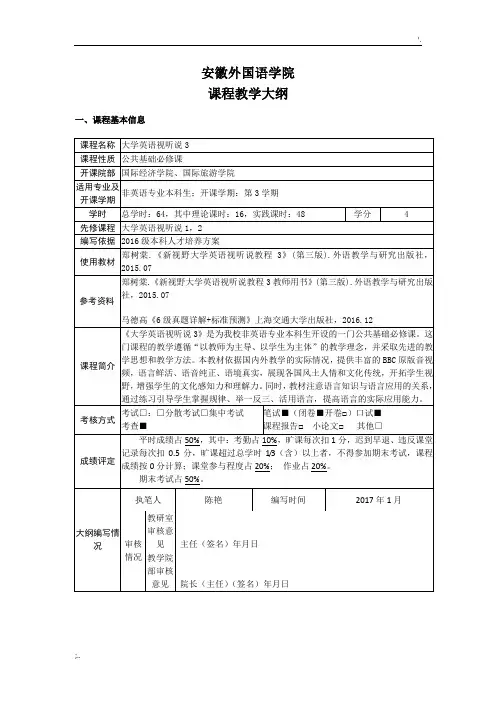
安徽外国语学院课程教学大纲一、课程基本信息二、课程教学目的英语视听说课程的教学目的是培养学生扎实的语言基本功和听说专业技能,即加强学生英语听力能力的同时着重发展学生的英语听说能力。
使学生在今后的工作和社会交往中能用英语有效地进行口头信息交流,同时培养和训练学生自主学习能力,提高综合文化素养,以适应我国社会发展和国际交流的需要,使学生能够真正具有良好的国际交流能力。
三、课程教学要求本课程教学大纲在教学要求上分为一般要求阶段(一年级)和较高要求阶段(二年级),本课程属于较高要求阶段。
现将本课程的教学要求规定如下:1、词汇:通过本课程的学习,学生的词汇量应应达到4500个单词和700个词组,其中2000个单词和500个词组为积极词汇,即要求学生能够在认知的基础上学会熟练运用,包括口头表达以及书面表达两个方面。
2、语法:巩固和加深基本语法知识,提高在语篇水平上运用句法结构的能力。
3、听的能力:能听懂英语讲课内容,能听懂一般性英语谈话和一般性题材讲座。
能基本听懂英语国家慢速英语教学节目,语速为每分钟130词左右,能掌握其中大意,抓住要点和有关细节。
能运用基本的听力技巧帮助领会讲话者的观点和态度。
4、说的能力:能在学习过程中与老师、同学进行交流,并能就某一主题进行讨论。
能就日常话题和来自英语国家的人士进行交谈。
能就所熟悉的话题经准备后作简短发言,表达比较清楚,语音、语调基本正确。
能在交谈中使用基本的会话策略。
四、课程教学内容和学时安排五、教学内容Unit 1 Access to Success1. Teaching ObjectivesTalk about SuccessTake notes by using a keyword outlineRefer to what you said earlierTalk about a challenge / an achievementHave a basic understanding of public speaking2. Key PointsHow to grasp the listening skill: note-taking by using a keyword outlineHow to grasp the speaking skill: refer to what you said earlierImportant and useful words and expressions3. Difficult PointsMastering the listening skill: note-taking by using a keyword outlineMastering the speaking skill: refer to what you said earlierContent1.Opening up2. Listening to the world1) Sharing: How do they feel about trying new things?What stops them from trying new things?What have they achieved in their life that makes them feel proud?Who do they admire in terms of achievements and why?2) Listening: before listening; while listening; after listening3) Viewing: before viewing; while viewing; after viewing3. Speaking for 3communication1).Role-play2).Speaking skills: Referring to what you said earlier3).Group discussion: The most impressive challengea.Get ideasb.Discuss and organize ideasc.Present ideas4. Further practice in listening1) Short conversations2) Long conversation3) Two passages5. Wrapping upUse the following self-assessment checklist to check what you have learned in this unit.6. CET-6 Training: Vocabulary1) The importance of enlarging one’s vocabulary2) Skills for memorizing vocabulary3) Analysis with examples4) CET-6 model listening trainingUnit 2 Emotions speak louder than words1. Teaching ObjectivesTalk about different emotionsGet familiar with the usage of problem-solution pattern.Know some signal words2. Key PointsHow to grasp the listening skill:Predict the theme and relevant vocabulary before you listenGrasp some signal words3. Difficult PointsThe usage of the problem-solution patternThe understanding of the organization of a speechThe usage of organizing ideasContent1.Opening up2. Listening to the world1) Sharing: How are they feeling today? Why?Would you describe yourself as an optimist or a pessimist? Why?What’s the best thing that’s happened to you this year?2) Listening: before listening; while listening; after listening3) Viewing: before viewing; while viewing; after viewing3. Speaking for communication1).Role-play2).Speaking skills: Overall organization of a speech3).Group discussion: The most impressive experiencea.Get ideasb.Discuss and organize ideasc.Present ideas4. Further practice in listening1) Short conversations2) Long conversation3) Two passages5. Wrapping upUse the following self-assessment checklist to check what you have learned in this unit.6. CET-6 Training: Listening for Conversations1) Skills for listening to conversations2) Analysis with examples3) CET-6 model listening trainingUnit 3 Love your neighbor1. Teaching ObjectivesTalk about neighbors and communitiesDistinguish fact from opinion in listeningLearn how to tell a story2. Key PointsTalk about planning a communityKnow the rules of about language use in public speakingUseful expressions3. Difficult PointsHow to grasp the specific informationHow to distinguish fact from opinion in listeningHow to learn public speaking skillsContent1. Opening up2. Listening to the world1) Sharing: Do you know your neighbors? How well do you know them?What do you think makes a good/bad neighbor?2) Listening: before listening; while listening; after listening3) Viewing: before viewing; while viewing; after viewing3. Speaking for communication1).Role-play2).Speaking skills: language in public speaking3).Group discussion: Way of planning a new communitya.Get ideasb.Discuss and organize ideasc.Present ideas4. Further practice in listening1) Short conversations2) Long conversation3) Two passages5. Wrapping upUse the following self-assessment checklist to check what you have learned in this unit.6. CET-6 Training: Listening for Long Conversations1) Skills for listening to long conversations2) Analysis with examples3) CET-6 model listening trainingUnit 4 What’ s the Big Idea?1.Teaching ObjectivesTalk about inventions and creative ideasPredict the theme and relevant vocabulary before you listenPropose ideas and comment on ideas while brainstorming2.Key PointsHow to grasp the listening skill:Predict the theme and relevant vocabulary before you listenHow to grasp the speaking skill: brainstorming3.Difficult PointsLearn to use voice, body language and visual aids in speech deliveryThe understanding of the organization of a speechThe usage of organizing ideasContent1. Opening up2. Listening to the world1) Sharing: What items do they enjoy buying most?What sorts of things do they buy on impulse?What recent product or service do they think is impressive?2) Listening: before listening; while listening; after listening3) Viewing: before viewing; while viewing; after viewing3. Speaking for communication1).Role - play2).Speaking skills: Making guesses3).Group discussion: Your business ideasa.Get ideasb.Discuss and organize ideasc.Present ideas4. Further practice in listening1) Short conversations2) Long conversation3) Two passages5. Wrapping upUse the following self-assessment checklist to check what you have learned in this unit.6. CET-6 Training: Listening for Passages1) Skills for listening to passages2) Analysis with examples3) CET-6 model listening trainingUnit 5 More than a paycheck1.Teaching ObjectivesTalk about different jobsListen for contrastManage a meeting/discussion2.Key PointsHow to master different kinds of jobsHow to get familiar with the topic of managing a meeting3.Difficult PointsHow to grasp the specific informationHow to listen for contrastHow to learn public speaking skillsContent1. Opening up2. Listening to the world1)Sharing: Have you ever considered the potential disadvantages of your dream job? Are you prepared to accept them when you take the job?Suppose you see your dream job advertised. Unfortunately, it asks for several specific skills and you’ve only got some of them. What would you probably?2) Listening: before listening; while listening; after listening3) Viewing: before viewing; while viewing; after viewing3. Speaking for communication1).Role-play2).Speaking skills: Managing a meeting3).Group discussion: Talk about a typical day in lifea.Get ideasb.Discuss and organize ideasc.Present ideas4. Further practice in listening1) Short conversations2) Long conversation3) Two passages5. Wrapping upUse the following self-assessment checklist to check what you have learned in this unit.6. CET-6 Training: Listening for Recordings of Lectures or Talks1) Skills for listening to recordings of lectures and or talks2) Analysis with examples3) CET-6 model listening trainingUnit 6 Histories make men wise1. Teaching ObjectivesTalk about important events and people in historyMake inferencesExpress uncertaintyTalk about an imaginary historyMake an informative speech in chronological or spatial order2. Key PointsHow to master the history of different periodsHow to get familiar making inferencesUseful expressions3. Difficult PointsHow to grasp the specific informationHow to express uncertaintyHow to make an informative speech in chronological or spatial orderContent1. Opening up2. Listening to the world1)Sharing: Do you think life better know than in the past?If you could have lived through a different age or decade, which would you choose and why?2) Listening: before listening; while listening; after listening3) Viewing: before viewing; while viewing; after viewing3. Speaking for communication1)Role-play2)Speaking skills: Expressing uncertainty3)Group discussion:What would have happened if Zheng He had reached the Americas first?a.Get ideasb.Discuss and organize ideasc.Present ideas4. Further practice in listening1) Short conversations2) Long conversation3) Two passages5. Wrapping upUse the following self-assessment checklist to check what you have learned in this unit.6. CET-6 Training: Listening for News Reports1) Skills for listening to news reports2) Analysis with examples3) CET-6 model listening training。
