
人教版初中英语八年级下册Unit3 Section B(2a-selfcheck)
- 格式:pptx
- 大小:145.16 KB
- 文档页数:32


Section B (2a-2e)
【学习目标】
1.学习P22页单词。
2.学习新的阅读技巧:浏览。
【重点、难点】
1. 阅读技巧。
2. 探讨学生应不应当帮助做家务的话题。
【自主学习】翻译下列短语:
1.浪费时间 2.对……来说没有必要做某事
3.不介意 4.花费时间做某事
5. 为了 6.不足以做某事
7.越早……越好……
【合作探究】
Step 1 Reading
1. Warming up
2a. Discuss the questions with your partner
1) What do you often do to help your parents at home?
2) Do you think kids should help out with chores at home?
2. Skimming
2b. The Sunday Mail magazine invited parents to write about whether they think
young people should do chores at home. Skim the following letters. Which
one agrees and which one disagrees?
了解阅读策略:
Skimming 意为“快速掠过,从中提取最容易取得的精华”。这种读法包含有原词的所有意思——快速读过去,取出读物中关键性的东西。因此,我们可以把这种读法理解为快速浏览课文,领会文章大意。一般而言,通过标题可知道文章的主题。对文章的首段和末段要多加注意,以便发现作者的观点。
Answer the questions.
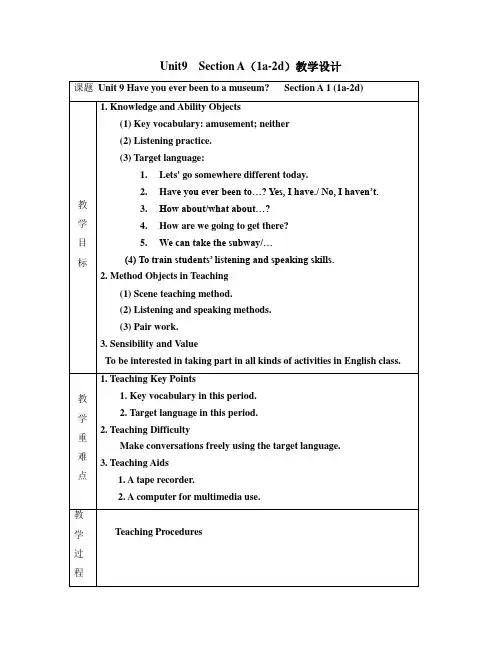
Unit9 Section A(1a-2d)教学设计
课题 Unit 9 Have you ever been to a museum? Section A 1 (1a-2d)
教
学
目
标 1. Knowledge and Ability Objects
(1) Key vocabulary: amusement; neither
(2) Listening practice.
(3) Target language:
1. Lets' go somewhere different today.
2. Have you ever been to…? Yes, I have./ No, I haven’t.
3. How about/what about…?
4. How are we going to get there?
5. We can take the subway/…
(4) To train students’ listening and speaking skills.
2. Method Objects in Teaching
(1) Scene teaching method.
(2) Listening and speaking methods.
(3) Pair work.
3. Sensibility and Value
To be interested in taking part in all kinds of activities in English class.
教学重难点 1. Teaching Key Points
1. Key vocabulary in this period.
2. Target language in this period.
2. Teaching Difficulty
Make conversations freely using the target language.
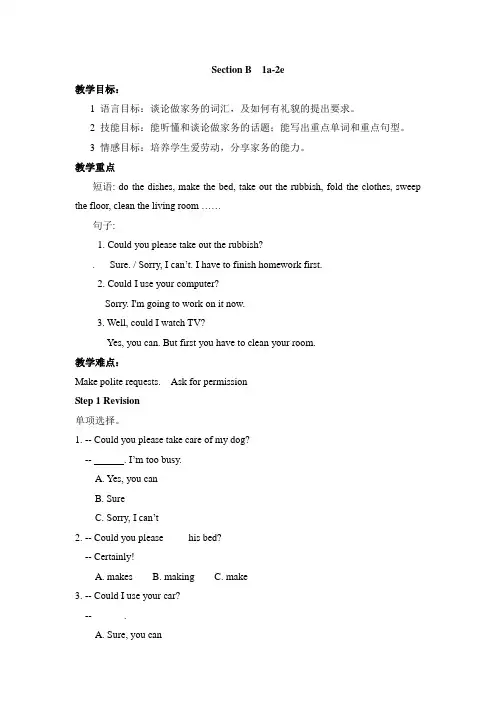
Section B 1a-2e
教学目标:
1 语言目标:谈论做家务的词汇,及如何有礼貌的提出要求。
2 技能目标:能听懂和谈论做家务的话题;能写出重点单词和重点句型。
3 情感目标:培养学生爱劳动,分享家务的能力。
教学重点
短语: do the dishes, make the bed, take out the rubbish, fold the clothes, sweep
the floor, clean the living room ……
句子:
1. Could you please take out the rubbish?
. Sure. / Sorry, I can’t. I have to finish homework first.
2. Could I use your computer?
Sorry. I'm going to work on it now.
3. Well, could I watch TV?
Yes, you can. But first you have to clean your room.
教学难点:
Make polite requests. Ask for permission
Step 1 Revision
单项选择。
1. -- Could you please take care of my dog?
-- ______. I’m too busy.
A. Yes, you can
B. Sure
C. Sorry, I can’t
2. -- Could you please ____ his bed?
-- Certainly!
A. makes B. making C. make
3. -- Could I use your car?

Teaching design
Knowledge goal
Students will be able to use the expression about whether young
children should do chores freely.
Language skill
Students will be able to express opinions about whether they
should do chores.
Learning strategies
Students will learn to skim the first or last sentence to find the main
idea.
Feelings and attitude
Students will learn to be independent and help with housework.
Students will learn to practice their critical thinking.
Difficulties and importance
Students will talk about whether young people should do chores
under the stress of schoolwork.
Students will find the main idea of the passage through skimming.
Students will learn to make up new sentences in new situations
based on the understanding of the phrases and sentences patterns.
Students will be able to retell the letters by using the phrases and