
21世纪大学实用英语综合教程第二册第2单元
- 格式:ppt
- 大小:538.01 KB
- 文档页数:37

文档
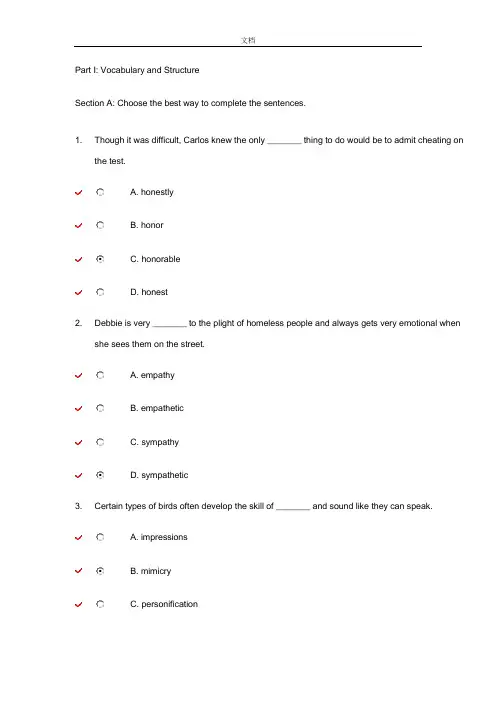
Part I: Vocabulary and Structure
Section A: Choose the best way to complete the sentences.
1.
Though it was difficult, Carlos knew the only _______ thing to do would be to admit cheating on
the test.
A. honestly
B. honor
C. honorable
D. honest
2. Debbie is very _______ to the plight of homeless people and always gets very emotional when
she sees them on the street.
A. empathy
B. empathetic
C. sympathy
D. sympathetic
3. Certain types of birds often develop the skill of _______ and sound like they can speak.
A. impressions
B. mimicry
C. personification 文档
D. imitating
4.
As babies develop, they need to learn to _______ before they can walk.
A. run
B. climb
C. swim
D. crawl
5. When he was a child, Tony lost all vision in his right eye, so he feels _______ for the difficulties

教 案授课单元21世纪大学实用英语综合教程 第二册 Unit 1本(章)节授课方式课堂讲授(√ ) 实践课( )教学时数6本 (章) 节 教 学 目 标After studying this unit, the students are expected to 1.master the basic language and skills necessary to ask for and give clarification;2.understand the main ideas of Text A, Text B and Text C, and master the useful sentence structures and words and expressions found in the exercises relevant to the first two texts;3.know how to write a letter of invitation;4.know how to use V+V-ing;5.guess the meaning of unknown words in context.授课要点教 学 重 点 和 难 点Teaching focus: 1. Master the basic language and skills necessary to make requests2. Explain some language points to the Ss.3. Explain some grammar points to the Ss.Teaching difficulties: 1. How to improve Ss’ speaking ability.2. How to improve Ss’ listening ability.
思考题或作 业1.Review the key expressions from the previous lesson. 2.Read Text B of this unit, and deepen the understanding of the theme in this unit. -Share reflections on this theme in class. 3.Review the new words and phrases of this text. Try to use them in daily life. 4.Finish the reading and listening tasks of this unit.教学内容与组织安排1st periodText A (Global Reading)2nd periodText A (Detailed Reading)3rd periodGrammar Review 4 th periodPractical Writing 5th periodText B6th periodImprove Your Reading Skills 1st period Text A (Global Reading)1 Background InformationEnglish Language The English language is the most widely spoken language in the world. It is used as either a primary or secondary language in many countries. During the 1500s, fewer than 2 million people spoke English. All of them lived in what is now Great Britain. Through the centuries, as the result of various historical events, English spread throughout the world. Today, about 400 million people speak English as their native language. Most of them live in Australia, Canada, Great Britain, Ireland, New Zealand, South Africa, and the United States.Another 100 million people living chiefly in Bangladesh, India, Pakistan, and in many African countries speak English in addition to their own language. An additional 200 million people probably know at least some English. (From the 1998 World Book Multimedia Encyclopedia)Characteristics of EnglishVocabulary. English has a larger vocabulary than any other language. There are more than 600,000 words in the largest dictionaries of the English language. Some English words have been passed on from generation to generation as far back as scholars can trace. These words, such as woman, man, sun, hand, love, go, and eat, express basic ideas and feelings. Later, many words were borrowed from other languages, including Arabic, French, German, Greek, Italian, Latin, Russian, and Spanish. For example, algebra is from Arabic, fashion from French, piano from Italian, and canyon from Spanish.A number of words, such as doghouse and splashdown, were formed by combining other words. New words were also created by blending words. For example, motor and hotel were blended into motel. Words can be shortened to form new words, as was done with history to form story. Words called acronyms are formed by using the first letter or letters of several words. The word radar is an acronym for radio detection and ranging. Pronunciation and spelling in English sometimes seem illogical or inconsistent. Many words are spelled similarly though pronounced differently. Examples include cough, though, and through. Other words, such as blue, crew, to, too, and shoe, have similar pronunciations but are spelled differently. Many of these variations show changes that occurred during the development of English. The spelling of some words remained the same through the centuries, though their pronunciation changed.Grammar is the set of principles used to create sentences. These principles define the elements used to assemble sentences and the relationships between the elements. The elements include parts of speech and inflections. Parts of speech are the word categories of the English language. Scholars do not all agree on how to describe the parts of speech. The traditional description lists eight classes: nouns, pronouns, verbs, adjectives, adverbs, prepositions, conjunctions, and interjections. The most important relationships of the parts of speech include subject and verb, verb and predicate, and modifier and the word modified.English has fewer inflections than most other European languages. An English noun has only two inflections, the plural and the possessive. Inflections are used to change the tense and number of a verb or the case of a pronoun. Inflections can change adjectives to the comparative or the superlative — for example, big, bigger, biggest. American EnglishAmerican English is a variety of the English language spoken in the United States. Although all Americans do not speak the same way, their speech has enough in common that American English can be recognized as a variety of English distinct from British English, Australian English, and other national varieties. American English has grown up with the country. It began to diverge from British English during its colonial beginnings and acquired regional differences and ethnic flavor during the settlement of the continent.Today it influences other languages and other varieties of English because it is the medium by which the attractions of American culture — its literature, motion pictures, and television programs — are transmitted to the world. Characteristics of American English A. Pronunciation In broad terms, Canadian and American speakers tend to sound like one another. They also tend to sound different from a large group of English speakers who sound more British, such as those in Australia, New Zealand, and South Africa. For example, most Canadians and Americans pronounce an r sound after the vowel in words like barn, car, and farther, while speakers from the British English group do not. Also, some British English speakers drop h sounds at the beginning of words, so that he and his are pronounced as if they were spelled ee and is. The English spoken in Australia, New Zealand, and South Africa sounds more like British English than American English does because these varieties have had less time to diverge from British English. The process of separate development began later in these countries than in North America.In some cases there are differences between American English and British English in the rhythm of words. British speakers seem to leave out a syllable in words like secretary, as if it were spelled secretry, while Americans keep all the syllables. The opposite is true of other words, such as specialty, which Americans pronounce with three syllables (spe-cial-ty) while British speakers pronounce it with five syllables (spe-ci-al-i-ty). Vowels and consonants may also have different pronunciations. British speakers pronounce zebra to rhyme with Debra, while American speakers make zebra rhyme with Libra. Canadian and British speakers pronounce the word schedule as if it began with an sh sound, while Americans pronounce it as if it began with an sk sound.B. Words
.
. 第五课
The Treasure in the Orchard
An old gardener who was dying sent for his two sons to come to his bedside, as
he wished to speak to them. When they came in answer to his request, the old
man, raising himself on his pillows, pointed through the window towards his
orchard.
"You see that orchard?" said he.
"Yes, Father, we see the orchard."
"For years it has given the best of fruit - golden oranges, red apples, and
cherries bigger and brighter than rubies!"
"To be sure, Father. It has always been a good orchard!"
The old gardener nodded his head, time and time again. He looked at his
hands - they were worn from the spade that he had used all his life. Then he
looked at the hands of his sons and saw that their nails were polished and their
fingers as white as those of any fine lady's.

1 教 案
授课单元 21世纪大学实用英语第二册第二单元
本(章)节
授课方式 课堂讲授(√ ) 实践课( ) 教学时数 6
授
课
要
点 本
(章)
节
教
学
目
标 1。 master the basic language and skills necessary to make
and respond to an apology;
2. understand the main ideas of Text A, Text B and Text C;
3。 master the useful sentence structures and words and
expressions found in the exercises relevant to the first
two texts;
教
学
重
点
和
难
点 1。 know how to use the structure of V + V—ing or +
infinitive;
2。 know how to reply to an invitation;
3. guess the meaning of unknown words in context。
思考题
或
作 业 1。 Have you ever been mistaken for someone else? Or do
you know someone who has been mistaken for another
person? Please share your story with your classmates。
2。 Now imagine you have the same name as the mayor of your
city and look like him too. What might happen when you go