2019外研版高中英语选择性必修一Unit1 Developing ideas教学设计
- 格式:docx
- 大小:18.07 KB
- 文档页数:5
Unit1 Developing ideas教学设计
Developing ideas板块教学设计
(建议时长80–90分钟,教师可根据教学实际酌情调整。)
课型 Reading + Writing
主题语境 人与自我——积极的生活态度
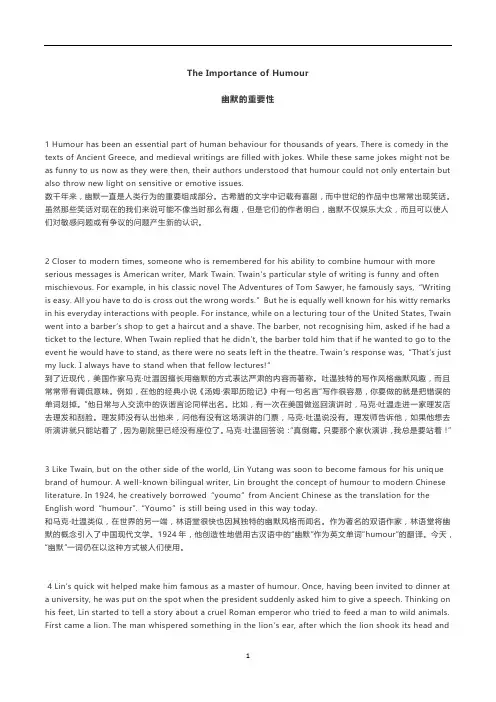
内容分析 本板块呈现了从另一角度反映单元主题的课文,语篇类型为论说文。课文标题是《幽默的重要性》,幽默是人类行为的重要组成部分,它不仅是一种生活方式,还是一种用来阐明世界的工具。课文通过阐述Mark
Twain和林语堂先生的幽默故事,论说了幽默的重要性,读写部分对
Charlie Chaplin 及其作品进行了简要介绍和评价。
教学目标 在本板块学习结束时,学生能够:
1. 通过提取课文大意,梳理课文结构,更好地了解幽默的重要性;
2. 通过分析、概括、整合Mark Twain和林语堂在作品和生活中的幽默方式,领悟他们的生活智慧,学习他们豁达的人生观,树立积极健康的世界观、人生观和价值观;
3. 通过观察语篇,发现人物介绍的基本内容、文体特征和写作手法,并能运用所学知识介绍一位熟悉和喜爱的喜剧人。
教学重点 1. 引导学生通过阅读来全面了解两位大师,深入理解语篇;
2. 培养学生发现人物介绍的基本内容、文体特征和写作手法,并能运用所学知识介绍一位熟悉和喜爱的喜剧人。
教学难点 1. 引导学生进行人物介绍的写作;
2. 学习Mark Twain和林语堂在作品和生活中的幽默方式,领悟他们的生活智慧,豁达的人生观,树立积极健康的世界观、人生观和价值观;
教学策略 P-W-P模式
Teaching
contents Procedures
Purposes
Teacher’s activity Students’ activity
Activity 1 1. Teacher asks two
students to read the
short introductions
to Mark Twain and
Lin Yutang
respectively and
helps students clear
the obstacles in
reading.
2. Teacher asks
students to read the
short introductions
and get the main 1. Students read the
short introductions
to Mark Twain and
Lin Yutang
respectively and
clear the obstacles
in reading.
2. Students read the
short introductions
and get the main
ideas of them.
3. Students share
what else they To activate students’
theme-related
background
knowledge and
prepare for the
following reading
activities. ideas of them.
3. Teacher asks some
students to share
what else they
know about Mark
Twain and Lin
Yutang with the
class. know about Mark
Twain and Lin
Yutang with the
class.
Activity 2 1. Teacher asks
students to read the
activity instruction
and make sure they
understand the
reading task.
2. Teacher asks
students to read the
passage to find out
Mark Twain and
Lin’s attitude
towards humour,
and refer to
dictionary when
necessary.
3. Teacher invites
some students to
present their
answers and other
students to make
supplements. 1. Students read the
activity instruction
and make sure they
understand the
reading task.
2. Students read the
text to find out
Mark Twain and
Lin’s attitude
towards humour,
and refer to
dictionary when
necessary.
3. Students present
their answers and
other students
make supplements. To train students to
read a passage with
tasks and find out the
key information.
Activity 3 1. Teacher asks
students to read
the passage
individually,
organise the
information from
the passage and
complete the
diagram.
2. Teacher asks
students to check
their answers and
learn from each
other in groups.
3. Teacher invites 1. Students read the
passage individually,
organise the
information from the
passage and complete
the diagram.
2. Students check their
answers and learn
from each other in
groups.
3. Some students retell
the passage and other
students make
supplements. To test students’
abilities to sort out the
structure and specific
information of a
passage
some students to
retell the passage
and other students
to make
supplements.
Think &
Share 1. Teacher asks students
to work in pairs to
discuss the four
questions.
2. Teacher asks students
to answer the
questions and other
students to make
supplements or free
discussion.
1. Students work in
groups to discuss
the four questions.
2. Some students
answer the
questions and other
students make
supplements or
free discussion.
1. To help students
further explore
the topic.
2. To improve
students’ critical
thinking ability.
3. To help students
apply what
they’ve learnt in
a real-life
context.
Activity 4 1. Teacher asks
students to read the
equation from the
passage, think of it
and try answering
the questions
individually.
2. Teacher asks
students to work in
groups to fully
express their own
opinions and give
reasons.
3. Teacher asks some
groups to share
their opinions of
the equation and
others make
comments.
4. Teacher asks
students to pay
close attention to
self-evaluation and
think about their
performances in
this activity.
Teacher makes
advice to improve 1. Students read the
equation from the
passage, think of it
and try answering
the questions
individually.
2. Students work in
groups to fully
express their own
opinions and give
reasons.
3. Some groups share
their opinions of
the equation and
others make
comments.
4. Students think
about their
performances in
this activity. To inspire students to
think the author’s
attitude and the value
of the passage and
cultivate students’
ability to think
creatively.