
高考英语状语从句2
- 格式:ppt
- 大小:2.69 MB
- 文档页数:28

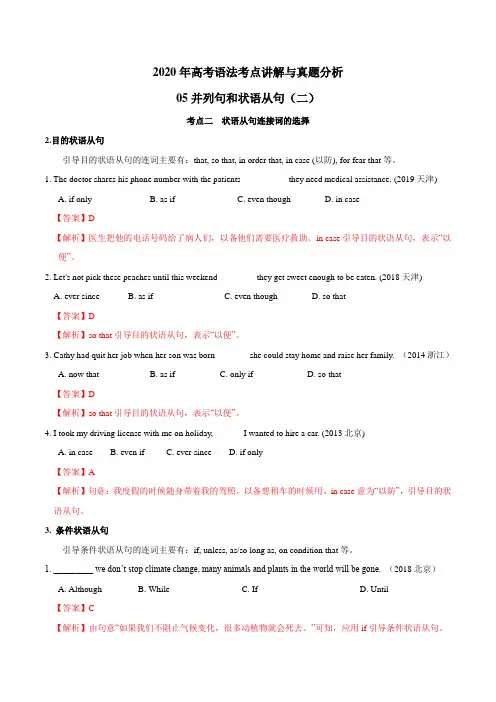
2020年高考语法考点讲解与真题分析05并列句和状语从句(二)考点二状语从句连接词的选择2.目的状语从句引导目的状语从句的连词主要有:that, so that, in order that, in case (以防), for fear that等。
1. The doctor shares his phone number with the patients __________ they need medical assistance. (2019天津)A. if onlyB. as ifC. even thoughD. in case【答案】D【解析】医生把他的电话号码给了病人们,以备他们需要医疗救助。
in case引导目的状语从句,表示“以便”。
2. Let's not pick these peaches until this weekend ________ they get sweet enough to be eaten. (2018天津)A. ever sinceB. as ifC. even thoughD. so that【答案】D【解析】so that引导目的状语从句,表示“以便”。
3. Cathy had quit her job when her son was born _______ she could stay home and raise her family. (2014浙江)A. now thatB. as ifC. only ifD. so that【答案】D【解析】so that引导目的状语从句,表示“以便”。
4. I took my driving license with me on holiday, ______ I wanted to hire a car. (2013北京)A. in caseB. even ifC. ever sinceD. if only【答案】A【解析】句意:我度假的时候随身带着我的驾照,以备想租车的时候用。

状语从句状语从句在高考试题中由于其他从句的干扰,以及倒装句,强调句的介入,使得状语从句更为复杂状语从句是一种副词性从句,通常由一个从属连词或一个起连词作用的词组引导状语从句1 时间状语从句常见的连词(组):when, while, as, befre, after, nce, till, until, as sn as, nw that, hardly when, scarcely when, n sner than等可以引导时间状语从句的副(介)词(短语)或名词短语:directly, instantly, iediately, by the tie, the ent, the secnd, the inute, the instant, every tie, each tie, net tie, the last tie等注意点如下:(1) when, while, as引导的时间状语从句as表示“当……的时候”,往往和when/ while通用,但它着重强调主句与从句的动作或事情同时或几乎同时发生when(at r during the tie)既可以表示在某一点的时候,又可以表示在某一段时间内,主句与从句的动作或事情可以同时发生也可以先后发生while强调一段时间,仅表示从句和主句的动作同时发生,并且有延续意义,该从句中的动词一般要用延续性动词,从句中常用过去进行时态或一般过去时态;当when表示a perid f tie时,两者可以互换She cae up as I was cing(同时)在我做饭时,她走了过When we were at schl, we went t the library every day(在一段时间内)当我们在学校时,每天都去图书馆While they were watching TV, I was preparing yself fr the cing eainatin他们在看电视,而我在为即将到的考试做准备Strie while the irn is ht 趁热打铁( 不可用as或when,这里的while意思是“趁……”)一、when可以和延续性动词连用,也可以和短暂性动词连用;而while和as只能和延续性动词连用① Why d yu want a new jb when yu've gt such a gd ne already?(get为短暂性动词)你已经找到如此好的工作,为何还想再找新的?②Srry,I was ut when yu called e.(call为短暂性动词)对不起,你打电话时我刚好外出了③Strie while the irn is ht.(is为延续性动词,表示一种持续的状态)趁热打铁④ The students t ntes as they listened.(listen为延续性动词)学生们边听课边做笔记二、when从句的谓语动词可以在主句谓语动作之前、之后或同时发生;while和as从句的谓语动作必须是和主句谓语动作同时发生1.从句动作在主句动作前发生,只用 when①When he had finished his hewr,he t a shrt rest.(finished先发生)当他完成作业后,他休息了一会儿②When I gt t the airprt,the guests had left.(gt t后发生)当我赶到飞机场时,客人们已经离开了2.从句动作和主句动作同时发生,且从句动作为延续性动词时,when,while,as都可使用①When /While /As we were dancing,a stranger cae in.(dance为延续性动词)当我们跳舞时,一位陌生人走了进②When /While /As she was aing a phnecall,I was writing a letter.(ae为延续性动词)当她在打电话时,我正在写信3.当主句、从句动作同时进行,从句动作的时间概念淡化,而主要表示主句动作发生的背景或条件时,只能用 as这时,as常表示“随着……”;“一边……,一边……”之意① As the tie went n,the weather gt wrse.(as表示“随着……”之意)② The atsphere gets thinner and thinner as the height increases.随着高度的增加,大气越越稀薄③As years g by,hina is getting strnger and richer.随着时间一年一年过去,中国变得越越富强了④The little girls sang as they went.小姑娘们一边走,一边唱⑤The sad ther sat n the radside,shuting as she was crying.伤心的妈妈坐在路边,边哭边叫4.在将时从句中,常用when,且从句须用一般时代替将时①Yu shall brrw the b when I have finished reading it.在我读完这本书后,你可以借阅②When the anager ces here fr a visit net wee,I'll tal with hi abut this.下周,经理这参观时,我会和他谈谈此事三、when用于表示“一……就……”的句型中(指过去的事情)sb.had hardly(=scarcely) dne sth.when...=Hardly / Scarcely had sb.dne sth.when...①I had hardly /scarcely clsed y eyes when sene nced at the dr.=Hardly / Scarcely had I clsed y eyes when sene nced at the dr.我刚一闭上眼,就有人在敲门了②I had hardly /scarcely entered y r when the telephne rang.=Hardly /Scarcely had I entered y r when the telephne rang.我刚一走进房门,电话就响了(2) befre引导状语从句时的常见重点句型①It will (nt) be befre还要……才,要不了多久就……It was (nt) befre 过了……才(没多久就……)It was a lng tie befre I gt t sleep过了好长时间我才睡着了It wasn t lng befre he tld e abut the news没多久他就告诉了我那条新闻②不等……就……;在……之前就……The telephne rang ff befre I culd answer it我还没得及接电话,电话就挂断了③刚……就……He hardly entered the r befre he heard the telephne ring他刚进屋电话铃就响了④先……再……Yu can have a few days t thin abut it befre yu ae yur decisin做决定之前你还有几天时间考虑(3)since 引导的从句用延续性动词的过去式(包括过去完成时)时,则从句的动作已经结束,从句意思是否定的如果从句的动词是延续性动词的现在完成时态,则从句意思是肯定的He has never been t see e since I was ill我病愈后,他一直未看我(不再生病了)He has never been t see e since I have been ill我病了,他一直未看我I haven t heard fr hi since he lived here自他从这里搬走,我就没有收到他的信(不住在这儿了)(4) till, until如果till与until用在肯定句中时,则主句中谓语动词部分所表示的动作或状态一直延续到某时或某个动作发生时才结束注意它的倒装句和强调句I didn t recgnize she was y classate until she t ff her dar glasses=Nt until she t ff her dar glasses did I recgnise she was y classate=It was nt until she t ff her dar glasses that I recgnised she was y classate直到她摘下墨镜,我才认出她是我的同学2 原因状语从句引导原因状语从句的常见连词或短语:as, because, since, nw that, cnsidering that, seeing that(鉴于……)注意以下几点:(1) because, since, as, fr, nw thatbecause语气最强,用于回答why的提问,可与强调词nly, just 以及否定词nt 连用但不可以与s连用since 引导的从句语气次于because引导的从句,常表示稍加分析后而推断出的原因,或指人们已知的事实,比as正式一些,常置于句首as 语气最弱,其原因只是对结果的附带说明,一般放在句首fr虽然解释为“因为”但只是一个并列连词,它也常引导句子表示原因,但不是原因状语从句,它是一个并列句fr所提供的理由是一种补充性的说明,表示推测的理由nw that意为“既然,由于”表示由于人们已知的事实或正在发生的事而产生某个结果He failed because he was careless他因粗心而失败了Since everyne has ce, let s begin ur eeting既然大家都了,我们开会吧As all the seats were full, he std there所有的座位都满了,他只好站那儿It ight have rained last night fr the grund is wet昨晚可能下雨了,因为地面是湿的Nw that the ids have left he we have a lt f etra space由于孩子们离开了家,所以我们有了额外的空间3 地点状语从句地点状语从句常由下列连词引导:where, wherever等Yu ay find hi where his brther lives你可能会在他哥哥居住的地方找到他Yu are free t g wherever yu lie你可以去你想要去的任何地方Anywhere he went, he gt war welce无论他走到哪儿,都受到热烈欢迎The girl taes the dll with her everywhere she ges这个女孩无论去哪都带着她的布娃娃Where there is a will, there is a way 有志者事竟成4 结果状语从句结果状语从句常由下列连词引导:s that,such that,s that等要注意以下几个问题(1) 五种结构:①s+adj/adv+that②such (a/an+adj)+n+that③s+adj+a/an+n+that=such a/an+adj+n+that④s any/uch/few/little(少)+n+that⑤such+(adj) +n (u/pl)+ thatHe spe s fast that I culdn t fllw hi他说的如此的快,我跟不上他It was such a lvely day / s lvely a day that we all went swiing今天天气如此的好,我们大家都去游泳了(2) s或such置于句首时,主句常用倒装It was such a lvely day / s lvely a day that we all went swiing=Such a lvely day was it that we all went swiing今天天气如此的好,我们大家都去游泳了(3)注意以上结构与定语从句s/such as的区别This is such an interesting/s interesting a fil that everyne wants t see it这是一部很有趣的电影以至于每个人都想去看5 目的状语从句目的状语从句由下列连词引导:s that, in rder that, fr fear that, in case等(注:s that也可用引导结果状语从句)s that, in rder that引导的目的状语从句中常需用情态动词s that引导的目的状语从句只能放在主句之后in rder that 引导的目的状语从句可以放在主句之前或之后We set ut early s that we culd see the sunrise我们很早出发以便能看到日出He sent the letter by air ail s that it ight reach the in tie他空邮这封信以便他们能及时收到6 条件状语从句条件状语从句分为真实条件句和非真实条件句(用在虚拟语气中)注意:在真实条件句中,常用一般时态代替将时常由下列连词引导条件状语从句:if, unless, suppse, suppsing, prviding (that), prvided (that), given (that), in case, n cnditin that, as lng as, s lng as, s far as等(1) unless=if ntYu will fail unless yu study hard除非你努力,否则你就要失败(2) suppse, suppsing, prviding(that), prvided(that), given(that)= ifGiven that he supprts us, we ll win the electin如果他支持我们,我们就会赢得选举(3)n cnditin that, as lng as, s lng as = nly ifAs lng as yu dn t lse heart, yu will succeed只要你不灰心,你就会成功(4) as(s) far asS far as I a cncerned, I in favur f “ercy illing”就我个人而言,我支持安乐死7 让步状语从句引导让步状语从句的连词:althugh, thugh, as, even if, even thugh,while, whether r, whever, whatever, hwever, n atter+疑问词等注意以下几点:(1) althugh, thugh引导让步状语从句时,主句前不能用but,但可以加yet, stillThugh it was raining hard, yet they didn t stp wring尽管下着大雨,他们仍然在工作(2) as引导让步状语从句时,必须用前置结构,通常是从句中的表语、状语或动词原形放在句首,放在句首的名词前的冠词要去掉Thugh he is a child, he nws a lt=hild as(thugh)he is, he nws a lt尽管他是个孩子,但他仍知道的很多(注意在child前不要用冠词)Thugh I lie it very uch, I wn t buy it=Much as I lie it, I wn t buy it尽管我非常喜欢它,但我也不会买它(3)whether r (nt ) 引导的从句,提供两个对比的¡°尽管¡±情况,含有条件意味(Whether yu)Believe it r nt, it is trueWhether yu ce here r we g there, the tpic f discussin will reain unchanged不管是你这儿还是我们去那儿,讨论的主题保持不变(4) 疑问词+ever=n atter +疑问词Whever yu are, yu ust shw yur pass无论你是谁,你都必须出示你的通行证Whenever yu ce, yu are welce8 方式状语从句引导方式状语从句的连词或短语:as, as if, as thugh,the way等注意以下几点:(1) as引导方式状语从句时意为¡°按照¡±,¡°如同¡±,前面常用加强语气I did it just as yu tld e = I did it just as tld t我是按照你的吩咐做的He didn t win the atch as epected(2) as if和as thugh 引导的从句中,谓语常用虚拟语气,有时也用陈述语气It sees as if it were ging t rain(3)连词while 和whereas 可以表示对比Whereas he is rather lazy, she is quite energetic注意状语从句中的省略现象(1) 连接词+过去分词Unless repaired, the washing achine is n use(2) 连词+现在分词L ut while crssing the street(3)连词+形容词/其他常见的有if necessary,if pssible,when necessary,if any等(4) 比较状语从句中的省略He arrived he half an hur earlier than (he had been) epected例1My parents dn’t ind what jb I d I a happy(2009•陕西)A even thughB as sn as as lng as D as thugh解析:选考查状语从句根据题干意思可知,此处是条件状语从句as lng as只要;even thugh引导让步状语从句,意为“即使”;as sn as引导时间状语从句,意为“一……就……”;as thugh引导方式状语从句,意为“仿佛,好象”例2—Shall we have ur picnic trrw?—it desn’t rain (2009•山东)A UntilB While Once D If解析:选D考查交际用语答句句意为:如果明天不下雨的话例3She had just finished her hewr her ther ased her t practise playing the pian yesterday(2009•福建)A whenB while after D since解析:选A考查状语从句由句意可知,此处when用作并列连词,意为“这时”例4Yu d better nt leave the edicine ids can get at it(2008•山东)Aeven if Bwhich where Ds that解析:选句意为:你最好不要把药放在小孩子够得着的地方where引导地点状语从句even if 即使;which 不引导状语从句;s that 为了;以至于;引导目的或结果状语从句例5There were se chairs left ver everyne had sat dwn(2008•四川)A whenB until that D where解析:选A句意为:大家都坐下之后,还有一些椅子空着when 当……时候,引导时间状语从句,符合题意until 直到,引导时间状语从句,但与题意不符;that不引导状语从句;where引导地点状语从句例6Occasins are quite rare I have the tie t spend a day with y ids(2008•山东)Awh Bwhich why Dwhen解析:选D句意为:我很少有机会和孩子在一起待上一天的时间when在此处引导定语从句,修饰先行词ccasins(机会),并在从句中作时间状语wh和which是关系代词,定语从句中不缺少主语、宾语、表语,故排除;why引导定语从句时表示原因,与题意不符例7Trrw is T’s birthdayHave yu gt any idea the party is t be held?(2008•陕西)A what Bwhich that Dwhere解析:选D句意为:明天就是汤姆的生日了,你知道生日聚会在什么地方进行吗?idea后的部分是同位语从句,说明idea的内容;根据题意判断用where引导例8The last tie we had great fun was we were visiting the Wat er Par(2008•天津)A Where Bhw when Dwhy解析:选句意为:我们最后一次玩得很痛快是在游览水上公园时was后的部分是一个表语从句,从句中缺少状语,根据题意判断用when引导例9Dn’t prise anything yu are ne hundred percent sure(2008•浙江)A whetherB after hw D unless解析:选D句意为:不要承诺什么,除非你有百分之百的把握unless 如果不,除非;符合题意whether 是否;after ……之后;hw 如何例10 well prepared yu are, yu still need a lt f luc in untain clibing(2008·上海)A HweverB Whatever N atter D Althugh解析:选A考查hwever 的用法hwever相当于n atter hw, 但n atter不能单独使用;句中的well是副词,所以用hwever而不用whatever修饰;althugh引导的让步状语从句不倒装1 I’ll let yu nw ____ he ces bacA befreB because as sn as D althugh2 She will sing a sng ____ she is asedA ifB unless fr D since3 We will wr ____ we are neededA wheneverB because since D wherever4 Read it alud _____ the class can hear yuA s thatB if when D althugh5_____ yu g, dn't frget yur pepleA WheneverB Hwever Wherever D Whichever6 It is abut ten years _____ I et yu lastA sinceB fr when D as7 They will never succeed, _____ hard they tryA becauseB hwever when D since8 _____ still half drun, he ade his way heA WhenB Because Thugh D As9 _____ she was very tired, she went n wringA AsB Althugh Even D In spite f10 Busy _____ he was, he tried his best t help yuA asB when since D fr11 I learned a little Russian _____ I was at iddle schlA thughB althugh as if D when12 _____ we gt t the statin, the train had left alreadyA IfB Unless Since D When13 _____ the rain stps, we' 11 set ff fr the statinA BefreB Unless As sn as D Thugh14 She was _____ tired _____ she culd nt ve an inchA s, thatB such, that very, that D s, as15 We didn’t g he _____ we finished the wrA sinceB until because D thugh16 I'll stay here _____ everyne else ces bacA even ifB as thugh because D until17 Althugh it's raining, _____ are still wring in the fieldA theyB but they and they D s they18 Spea t hi slwly _____ he ay understand yu betterA sinceB s that fr D because19 Yu'll iss the train ______ yu hurry upA unlessB as if D until20 When yu read the b, yu' d better ae a ar _____ yu have any questinsA at whichB at where the place D where21 We'd better hurry ______ it is getting darA andB but as D unless22 I didn' t anage t d it _____ yu had eplained hwA untilB unless when D befre23_____ he ces, we wn't be able t gA WithutB Unless Ecept D Even24 I hurried _____ I wuldn't be late fr classA sinceB s that as if D unless25 _____ I catch a cld, I have pain in y bacA Every tieB Thugh Even D Where26 What's the atter _____ they still haven't answered the telegra?A whenB that thugh D hwever27 Bring it nearer _____ I ay see it betterA althughB even thugh s that D since28 Yu ay arrive in Beijing early _____ yu ind taing the night trainA thatB thugh unless D if29 Helen listened carefully _____ she ight discver eactly what she neededA in thatB in rder that in case D even thugh30 Mre peple will eat ut in restaurants _____ they d tdayA thanB when while D as31_____ hard she tries, she can hardly avid aing istaes in her hewrA MuchB Hwever As D Althugh32 Pr _____ it ay be, there is n place lie he, _____ yu ay gA as; whereverB thugh; whenever in spite f; when D that; wherever33 The child was __ iediately after supperA enugh tired t g t bedB t tired t g t beds tired that he went t bed D very tired, he went t bed34 The histry f nursing __ the histry f anA as ld asB is ld than that is as ld as D is as ld as35 _____ brn in hicag, the authr was faus fr his stries abut New YrA SinceB Once WhenD Althugh36_____ we std at the tp f the building, the peple belw were hardly visibleA AsB Althugh Unless D In spite f37 Scarcely was Gerge Washingtn in his teens _____ his father diedA thanB as while D when38 _____ David ges, he is welceA WhicheverB Hwever Wherever D Whatever39 The huse std _____ there had been a rcA whichB at which when D where40 Sall _____ it is, the pen is a st useful tlA becauseB s if D as41 After the new technique was intrduced, the factry prduced _____ tractrs in 1988 as the year befreA as twice anyB as any twice twice as any D twice any as42 The pian in the ther shp will be _____, but _____A cheaper; nt as betterB re cheap; nt as bettercheaper; nt as gd D re cheap; nt as gd43 Jhn plays ftball _____, if nt better than, DavidA as wellB as well as s well D s well as44 Althugh he is cnsidered a great writer,A his wrs are nt widely readB but his wrs are nt widely readhwever his wrs are nt widely read D still his wrs are nt widely read45 ___ the day went n, the weather gt wrseA WithB Since While D As46—What was the party lie?—Wnderful It' s years _____ I enjyed yself s uchA afterB when befre D since47 It was nt _____ she t ff her dar glasses _____ I realized she was a faus fil starA when; thatB until; that until; when D when; then48 If we wr with a strng will, we can verce any difficulty, _____ great it isA whatB hw hwever D whatever49 After the war, a new schl building was put up _____ there had nce been a theatreA thatB where which D when50_____, Mther will wait fr hi t have dinner tgetherA Hwever late is heB Hwever he is lateHwever is he late D Hwever late he is51 He will ce t call n yu the ent he ____ his paintingA will finishB finished has finished D had finished52 ____ difficult the tas ay be, we will try ur best t cplete it in tieA N atterB N wnder Thugh D Hwever53 It was ____ that s he culdn’t finish it by herselfA s difficult a wrB such a difficult wr s difficult wr D such difficult wr1~5 ADA 6~10 ABBA 11~15 DDAB 16~20 DABAD 21~25 ABBA26~30 BBD 31~35 BADD 36~40 ADDD 41~45 BAD 46~50 DBBD51~53 DD。
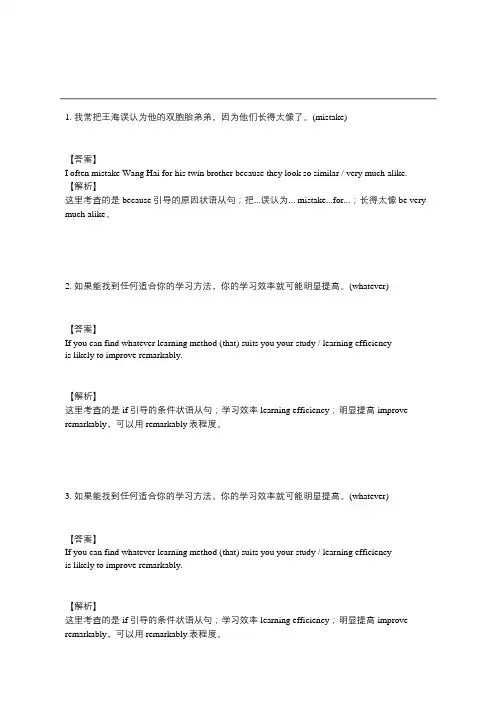
1. 我常把王海误认为他的双胞胎弟弟,因为他们长得太像了。
(mistake)【答案】I often mistake Wang Hai for his twin brother because they look so similar / very much alike.【解析】这里考查的是because引导的原因状语从句;把...误认为... mistake...for...;长得太像 be very much alike。
2. 如果能找到任何适合你的学习方法,你的学习效率就可能明显提高。
(whatever)【答案】If you can find whatever learning method (that) suits you your study / learning efficiencyis likely to improve remarkably.【解析】这里考查的是if引导的条件状语从句;学习效率 learning efficiency;明显提高 improve remarkably,可以用 remarkably表程度。
3. 如果能找到任何适合你的学习方法,你的学习效率就可能明显提高。
(whatever)【答案】If you can find whatever learning method (that) suits you your study / learning efficiencyis likely to improve remarkably.【解析】这里考查的是if引导的条件状语从句;学习效率 learning efficiency;明显提高 improve remarkably,可以用 remarkably表程度。
4. 不在房间的时候别让灯开着。
(when)【答案】Don’t leave the light on when you are not in the room.【解析】这里考查的是祈使句加when引导的时间状语从句;让灯开着 leave the light on。

1. The farmer watered the vegetables in the field _____ they might grow better.A. in caseB. for fear thatC. in orderD. so that2. If they don’t understand it the first time, go over it again _____ they do.A. whenB. afterC. sinceD. until3. I won’t accept their offer, _____ favorable the conditions.A. howB. howeverC. no matterD. no matter however4. _____ it happened to be a nice day, we decided to go to the beach.A. WhenB. Before C If D. Since5. We were just about ready to leave _____ it started to snow.A. whenB. beforeC. afterD. since6. I’ll keep his address _____ I need it.A. so thatB. in order tha tC. in caseD. when7. Will you keep my place in the queue for me _____ I go and make a phone call?A. sinceB. whileC. in caseD. until8. _____ I’m very much mistaken, that’s my watch you’re wearing!A. IfB. UnlessC. SinceD. Because9. The mother don’t let the boy touch the knife _____ he might cut himself.A. in order thatB. so as thatC. for fearD. that10. The modern history of Italy dates from 1860, _____ the country became united.A. whenB. ifC. sinceD. until11. We can’t move into the new flat _____ the other tenants have moved out.A. sinceB. whenC. untilD. as12. When I met him last week, it was the first time we had seen each other _____ we were at school.A. thatB. sinceC. whenD. after13. She made a note of it _____ she might forget.A. so thatB. in order thatC. ifD. in case14. The fire went on for quite some time _____ it was brought under control.A. whenB. sinceC. afterD. before15. They sat down opposite each other, but it was some moments _____ they spoke.A. afterB. beforeC. sinceD. when16. _____ the government agrees to give extra money , the theatre will have to close.A. UntilB. UnlessC. SinceD. While17. ______ I suggest, he always disagrees.A. HoweverB. WhateverC. WhicheverD. Whoever18. Their country has plenty of oil, _____ ours has none.A. whileB. whenC. unlessD. since19. “______when do the pubs stay open?” “About midnight.”A. SinceB. BeforeC. UntilD. After20. ______ I understand what you say, I can’t agree with you.A. SinceB. BecauseC. If D . While21. You should let your children play ______ you can see them.A. whereB. whenC. in whichD. that22. They kept trying _____ they must have known it was hopeless.A. ifB. becauseC. whenD. where23. _____ you are at home alone, please don’t leave the door open.A. WhileB. AsC. BeforeD. How【参考答案】1—5 DDBDA 6—10 CBBCA 11—15 CBDDB 16—20 BBACD 21—23 ACA。