
高中英语必修三教学课件:Unit+1+情态动词
- 格式:ppt
- 大小:234.50 KB
- 文档页数:24


高中英语必修三
考点一 情态动词( unit 1 ,unit 2)
一、情态动词的特点:
1.没有人称和数的变化。
2. 有些情态动词有过去式的变化:
e.g. will → would , can → could , may→ might , dare → dared
二、情态动词的否定式:
情态动词+ not +动词原形can not: can't , must not: mustn't , need not : needn't
三、情态动词的用法及相互区别, 是考试的内容之一
1. can , be able to be able to 表示经过努力后, 能够做到; be able to 有多种形式的变
化。
can
1). 表示体力或脑力方面的能力;
2). 表示允许、可能性。
could 是can的过去式, 表示过去有能力及过去存在的可能性 ; 用于疑问句表示委婉地
提出问题。
1) The fire spread through the hotel very quickly but everyone ____ get out. (NMET 97 )
A. had to B. would C. could D. was able to
2) -Will you stay for lunch?
-Sorry, __. My brother is coming to see me. (NMET99)
A. I mustn't B. I can't C. I needn't D. I won't
2.may 表示询问或说明一件事可不可做; 表示某事有可能发生。might是may的过去
式; 用在疑问中比may委婉、客气。
1) -May I take this book out of the reading-room?
-No, you mustn't. ( Yes, you may.)
2) -Might I make a suggestion? -Yes, you may.

2019年英语新同步浙江专用必修三讲义:Unit 1 Section Ⅲ Grammar—情态动词(Ⅰ) Word版含答案
姓名,年级:
时间:
2019年英语新同步浙江专用必修三讲义:Unit
1 Section Ⅲ Grammar—情态动词(Ⅰ)
Word版含答案(可编辑) 2019年英语新同步浙江专用必修三讲义:Unit 1 Section Ⅲ Grammar—情态动词(Ⅰ) Word版含答案
Section_ⅢGrammar—
情态动词(Ⅰ)
语法图解
探究发现
①Festivals can also be held to honour famous people。
②Some festivals are held to honour the dead or to satisfy the ancestors, who might
return either to help or to do harm.
③Most ancient festival would celebrate the end of cold weather, planting in spring
and harvest in autumn。
④For the Japanese festival Obon, people should go to clean graves and light incense
in memory of their ancestors.
[我的发现]
以上四个句子都使用了情态动词。其中,第①句中的can表示许可,意为“可以”;第②句中的might表示推测,意为“可能会”;第③句中的would表示过去习惯性动作,意为“过去常会”;第④句中的should表示劝告或建议,意为“应该”。
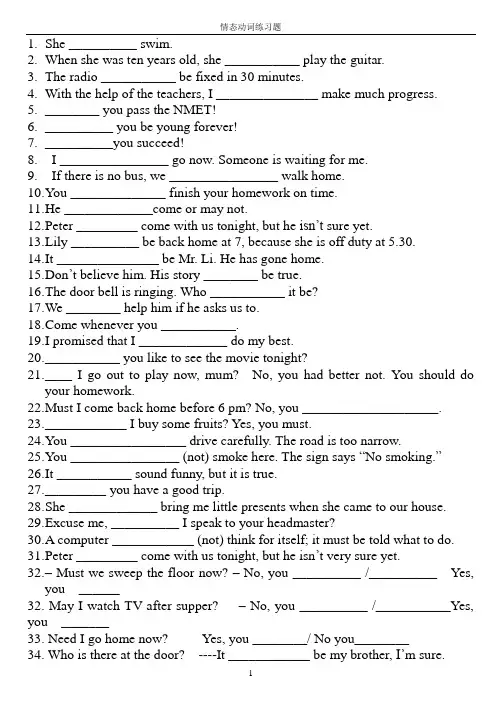
情态动词练习题
1 1. She __________ swim.
2. When she was ten years old, she ___________ play the guitar.
3. The radio ___________ be fixed in 30 minutes.
4. With the help of the teachers, I _______________ make much progress.
5. ________ you pass the NMET!
6. __________ you be young forever!
7. __________you succeed!
8. I ________________ go now. Someone is waiting for me.
9. If there is no bus, we ________________ walk home.
10. You ______________ finish your homework on time.
11. He _____________come or may not.
12. Peter _________ come with us tonight, but he isn’t sure yet.
13. Lily __________ be back home at 7, because she is off duty at 5.30.
14. It _______________ be Mr. Li. He has gone home.
15. Don’t believe him. His story ________ be true.
16. The door bell is ringing. Who ___________ it be?
▁▂▃▄▅▆▇█▉▊▋▌精诚凝聚 =^_^= 成就梦想 ▁▂▃▄▅▆▇█▉▊▋▌
▃ ▄ ▅ ▆ ▇ █ █ ■ ▓点亮心灯 ~~~///(^v^)\\\~~~ 照亮人生 ▃ ▄ ▅ ▆ ▇ █ █ ■ ▓ 情 态 动 词
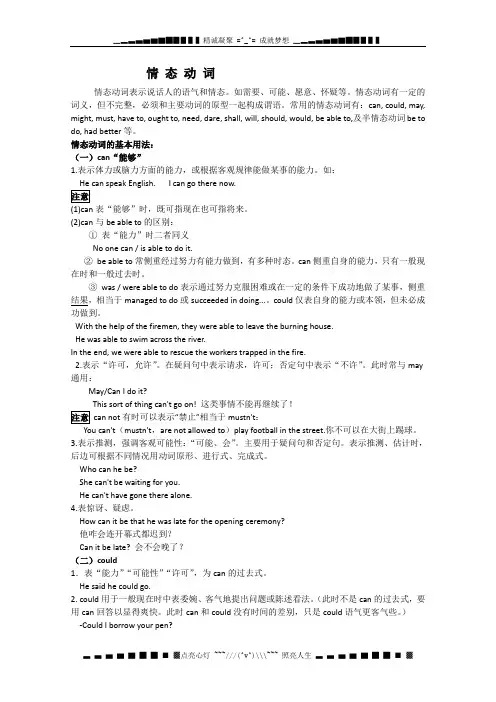
情态动词表示说话人的语气和情态。如需要、可能、愿意、怀疑等。情态动词有一定的词义,但不完整,必须和主要动词的原型一起构成谓语。常用的情态动词有:can, could, may,
might, must, have to, ought to, need, dare, shall, will, should, would, be able to,及半情态动词be to
do, had better等。
情态动词的基本用法:
(一)can“能够”
1.表示体力或脑力方面的能力,或根据客观规律能做某事的能力。如:
He can speak English. I can go there now.
注意
(1)can表“能够”时,既可指现在也可指将来。
(2)can与be able to的区别:
① 表“能力”时二者同义
No one can / is able to do it.
② be able to常侧重经过努力有能力做到,有多种时态。can侧重自身的能力,只有一般现在时和一般过去时。
③ was / were able to do表示通过努力克服困难或在一定的条件下成功地做了某事,侧重结果,相当于managed to do或succeeded in doing...。could仅表自身的能力或本领,但未必成功做到。
With the help of the firemen, they were able to leave the burning house.
He was able to swim across the river.