
新概念英语第二册第28课 No parking 禁止停车
- 格式:ppt
- 大小:224.00 KB
- 文档页数:32


新概念二课第28课练习
一、找出下列句子中的定语
You haven’t kept your promise to write us often.
The injured workers are now being taken good care of in the hospital.
You are the first one here.
Have you read anything interesting lately?
A little child learning to walk often falls.
二、请分析一下定语从句:(请划出定语从句,并标出先行词)
1. The place which he often visits is always full of artists.
2. Another thing that I found very difficult was English grammar.
3. You couldn’t understand people who talked fast.
4. I have some ideas that may help.
5. They said something that you didn’t like.
三、用关系代词填空:that 、which 、who、 whom 、whose
1. This is the man________ wants to see you.
2. The student ________ answered the question is Zhang Hua.
3. The man _______ you went to see has come.
4. The man _______I met yesterday lent me some money.
5. The man _______was passing by saw what happened.
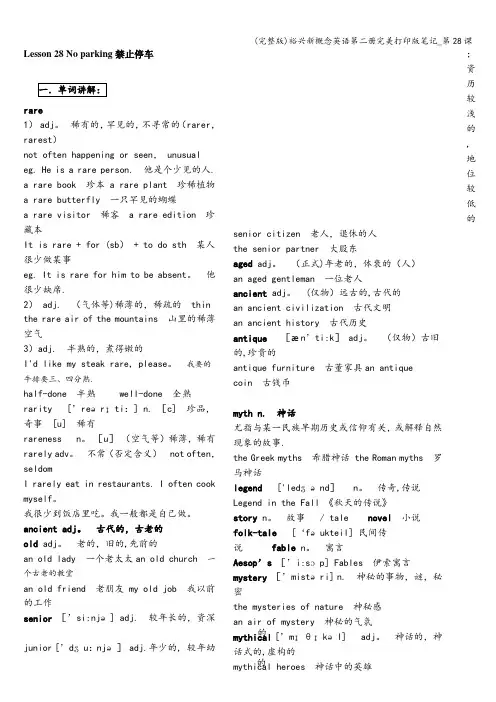
(完整版)裕兴新概念英语第二册完美打印版笔记_第28课
Lesson 28 No parking禁止停车
一.单词讲解:
rare
1) adj。 稀有的,罕见的,不寻常的(rarer,
rarest)
not often happening or seen, unusual
eg. He is a rare person. 他是个少见的人.
a rare book 珍本 a rare plant 珍稀植物
a rare butterfly 一只罕见的蝴蝶
a rare visitor 稀客 a rare edition 珍藏本
It is rare + for (sb) + to do sth 某人很少做某事
eg. It is rare for him to be absent。 他很少缺席.
2) adj. (气体等)稀薄的,稀疏的 thin
the rare air of the mountains 山里的稀薄空气
3)adj. 半熟的,煮得嫩的
I'd like my steak rare, please。 我要的牛排要三、四分熟.
half-done 半熟 well-done 全熟
rarity [’reərɪti:] n. [c] 珍品,奇事 [u] 稀有
rareness n。 [u] (空气等)稀薄,稀有
rarely adv。 不常(否定含义) not often,
seldom
I rarely eat in restaurants. I often cook
myself。
我很少到饭店里吃。我一般都是自己做。
ancient adj。 古代的,古老的
old adj。 老的,旧的,先前的
an old lady 一个老太太an old church 一个古老的教堂
an old friend 老朋友 my old job 我以前的工作
senior [’si:njə] adj. 较年长的,资深的
新东方新概念英语第二册课后习题答案详解 第 1 页 共 99 页 新东方新概念英语第二册课后习题答案详解
/html/2/xiangjie/list_81_2.html
第13课、新东方新概念英语第二册课后习题答案详解
Lesson 13
1. b
根据课文第3-4行They will be coming„and most of the young people in town will„,只有b. mainly the young
people 与课文内容相符合,而其他3个选择都不符合课文内容。
2. d
根据文章第7-8行...the police will have a difficult time, they will be trying to keep order.只有d. to prevent trouble(防止麻烦)最符合文章的意思,它说明警察去那的目的,而其它3个选择都表示原因,不能准确表达文章的含义。
3. b
需要选同前面句子中的most of (大多数)意思相近的词或短语。 a. A lot(许多)后面应该有of, 与most of 意思不同;c. Some(一些)不是most of 的同义词,语法上也讲不通;d. Many(许多)也不是most of 的同义词,且有语法错误;只有b. Nearly all(几乎所有的)同most of 的意思最接近,也最符合语法。
4. c
只有c. long will they be 最符合语法和题目意思。 a. long they will be 不是疑问句形式,不合乎语法规则;b. they will be 不合乎语法,也不合乎题目意思;d. long they be 不合乎语法。
5. a
只有a.in才最接近前面句子中的 during 的含义,而其他3个选择都在意思上讲不通。

Lesson 25 Do the English speak English? 英国人讲的是英语(yīnɡ yǔ)吗?
I arrived in London at last. 我终于到了伦敦。
The railway station was big,
black and dark. 火车站很大,又黑又暗。
I did not know the way to my
hotel, 我不知道去饭店的路该怎么走,
so I asked a porter. 于是向一个搬运工打听。
I not only spoke English very
carefully, 我的英语讲得不但非常认真,
but very clearly as well. 而且咬字也非常清楚。
The porter,however,could not
understand me; 然而搬运工却不明白我的话。
I repeated my question several
times and at last he understood. 我把问话重复了很多遍。他终于听懂了。
He answered me, 他回答了,
but he spoke neither slowly nor
clearly. 但他讲得既不慢也不清楚。
‘I am a foreigner,'I said. “我是个外国人”,我说。
Then he spoke slowly, 于是他说得慢了,
but I could not understand him. 可我还是听不懂。
My teacher never spoke English
like that! 我的老师从来不那样讲英语!
The porter and I looked at each
other and smiled. 我和搬运工相视一笑。
Then he said something and I
understood it. 接着,他说了点什么,这回我听懂了。