
chap5药物的临床研究
- 格式:ppt
- 大小:464.55 KB
- 文档页数:103


外周5-HT与相关疾病的研究进展摘要】5-HT是一类重要的神经递质和信号分子,在中枢神经系统和外周均发挥重大作用。
本文主要综述了与外周5-HT相关的疾病,以及对5-HT作为相关疾病治疗新靶点的展望。
【关键词】5-HT 5-HT受体最新进展靶点【中图分类号】R457.2 【文献标识码】A 【文章编号】1672-5085(2013)49-0057-021.5-HT 及其受体5-HT又名血清素,是体内重要的自体活性物质和中枢神经递质[1]。
在人体内,约90% 5-HT由肠道嗜铬细胞合成。
嗜铬细胞摄取色氨酸,在TPH1的作用下转化为5-羟色氨酸, 然后在芳香族氨基酸脱羧酶的作用下转变为5-HT,储存于囊泡内,与ATP一同储存于嗜铬细胞颗粒内。
在刺激因素作用下,5-HT从颗粒内释放,弥散到血液中,输送到全身各部位发挥作用[2]。
5-HT在中枢神经系统和自发性神经系统中发挥巨大作用。
在中枢神经系统,5-HT作为中枢神经递质,主要分布于松果体和下丘脑,参与心情、痛觉、睡眠和体温等生理功能的调节。
中枢神经系统5-HT含量或功能异常,可能与精神病,偏头痛等多种疾病的发病有关,相关研究较为全面和成熟[3]。
在外周,血清素调节血管收缩和舒张,胃肠运动性,细胞增殖,凋亡和血小板聚集。
5-HT 通过与 5-HT 受体(5-HTR)结合发挥作用。
5-HT受体亚型复杂,现已发现有7大类受体存在,即5-HT1-7受体。
这7类受体又被进一步分为若干个亚型[4]。
目前,对5-HT1受体和5-HT2受体的研究最为广泛。
5-HT1受体又被分为5-HT1A-1F 受体亚型,而5-HT2受体被分为 5-HT2A受体、5-HT2B受体和5-HT2C受体[5]。
5-HT 受体家族的复杂性表明决定了5-HT可通过多种途径产生多种作用。
5-HT 与不同的受体亚型结合,可产生不同的生物活性。
针对 5-HT 而研发的药物也因此产生多种药理作用。
5-HT 在中枢及外周神经系统中都发挥重要的作用。

ChatGPT: five priorities for researchEva A. M. van Dis, Johan Bollen, Robert van Rooij, Willem Zuidema & Claudi L. BocktingConversational AI is agame-changer for science.Here’s how to respond.A chatbot called ChatGPT can help to write text for essays, scientific abstracts and more.Since a chatbot called ChatGPT was released late last year, it has become apparent that this type of artificial intelligence (AI) technology will have huge implications on the way in whichresearchers work.ChatGPT is a large language model (LLM), a machine-learning system that autonomously learns from data and can produce sophisti-cated and seemingly intelligent writing after training on a massive data set of text. It is the latest in a series of such models released by OpenAI, an AI company in San Francisco, California, and by other firms. ChatGPT has perspectives. However, it could also degrade the quality and transparency of research and fundamentally alter our autonomy as human researchers. ChatGPT and other LLMs produce text that is convincing, but often wrong, so their use can distort scientific facts and spread misinformation.We think that the use of this technology is inevitable, therefore, banning it will not work. It is imperative that the research community engage in a debate about the implications of this potentially disruptive technology. Here, we out-line five key issues and suggest where to start.Hold on to human verificationLLMs have been in development for years, but continuous increases in the quality and size of data sets, and sophisticated methods to calibrate these models with human feed-back, have suddenly made them much more powerful than before. LLMs will lead to a new generation of search engines 1 that are able to produce detailed and informative answers to complex user questions.But using conversational AI for specialized research is likely to introduce inaccuracies, bias and plagiarism. We presented ChatGPT with a series of questions and assignments that required an in-depth understanding of the literature and found that it often generated false and misleading text. For example, when we asked ‘how many patients with depression experience relapse after treatment?’, it gen-erated an overly general text arguing that treatment effects are typically long-lasting. However, numerous high-quality studies show that treatment effects wane and that the risk of relapse ranges from 29% to 51% in the first year after treatment completion 2–4. Repeat-ing the same query generated a more detailed and accurate answer (see Supplementary information, Figs S1 and S2).Next, we asked ChatGPT to summarize a systematic review that two of us authored in JAMA Psychiatry 5 on the effectiveness of cognitive behavioural therapy (CBT) for anxiety-related disorders. ChatGPT fabricated a convincing response that contained several factual errors, misrepresentations and wrong data (see Supplementary information, Fig. S3). For example, it said the review was based on 46 studies (it was actually based on 69) and, more worryingly, it exaggerated the effective-ness of CBT.Such errors could be due to an absence of the relevant articles in ChatGPT’s training set, a failure to distil the relevant information or being unable to distinguish between credible and less-credible sources. It seems that the same biases that often lead humans astray, such as availability, selection and confirma-tion biases, are reproduced and often even amplified in conversational AI 6.Researchers who use ChatGPT risk being misled by false or biased information, andcaused excitement and controversy because itis one of the first models that can convincingly converse with its users in English and other languages on a wide range of topics. It is free, easy to use and continues to learn.This technology has far-reaching conse-quences for science and society. Researchers and others have already used ChatGPT and other large language models to write essays and talks, summarize literature, draft and improve papers, as well as identify research gaps and write computer code, including sta-tistical analyses. Soon this technology will evolve to the point that it can design exper-iments, write and complete manuscripts, conduct peer review and support editorial decisions to accept or reject manuscripts.Conversational AI is likely to revolutionize research practices and publishing, creating both opportunities and concerns. It might accelerate the innovation process, shorten time-to-publication and, by helping people to write fluently, make science more equi-table and increase the diversity of scientificV I T O R M I R A N D A /A L A M Y224 | Nature | Vol 614 | 9 2023Comment2023incorporating it into their thinking and papers. Inattentive reviewers might be hoodwinked into accepting an AI-written paper by its beautiful, authoritative prose owing to the halo effect, a tendency to over-generalize from a few salient positive impressions7. And, because this technology typically reproduces text without reliably citing the original sources or authors, researchers using it are at risk of not giving credit to earlier work, unwittingly plagiarizing a multitude of unknown texts and perhaps even giving away their own ideas. Information that researchers reveal to ChatGPT and other LLMs might be incorpo-rated into the model, which the chatbot could serve up to others with no acknowledgement of the original source.Assuming that researchers use LLMs in their work, scholars need to remain vigilant. Expert-driven fact-checking and verification processes will be indispensable. Even when LLMs are able to accurately expedite summaries, evaluations and reviews, high-quality journals might decide to include a human verification step or even ban certain applications that use this technol-ogy. To prevent human automation bias — an over-reliance on automated systems — it will become even more crucial to emphasize the importance of accountability8. We think that humans should always remain accountable for scientific practice.Develop rules for accountability Tools are already available to predict the likelihood that a text originates from machines or humans. Such tools could be useful for detecting the inevitable use of LLMs to man-ufacture content by paper mills and predatory journals, but such detection methods are likely to be circumvented by evolved AI technolo-gies and clever prompts. Rather than engage in a futile arms race between AI chatbots and AI-chatbot-detectors, we think the research community and publishers should work out how to use LLMs with integrity, transparency and honesty.Author-contribution statements and acknowledgements in research papers should state clearly and specifically whether, and to what extent, the authors used AI technolo-gies such as ChatGPT in the preparation of their manuscript and analysis. They should also indicate which LLMs were used. This will alert editors and reviewers to scrutinize man-uscripts more carefully for potential biases, inaccuracies and improper source crediting. Likewise, scientific journals should be trans-parent about their use of LLMs, for example when selecting submitted manuscripts. Research institutions, publishers and funders should adopt explicit policies that raise awareness of, and demand transpar-ency about, the use of conversational AI in the preparation of all materials that might become part of the published record. Publishers could request author certificationthat such policies were followed.For now, LLMs should not be authors ofmanuscripts because they cannot be heldaccountable for their work. But, it might beincreasingly difficult for researchers to pin-point the exact role of LLMs in their studies.In some cases, technologies such as ChatGPTmight generate significant portions of amanuscript in response to an author’s prompts.In others, the authors might have gone throughmany cycles of revisions and improvementsusing the AI as a grammar- or spellchecker, butnot have used it to author the text. In the future,LLMs are likely to be incorporated into textprocessing and editing tools, search enginesand programming tools. Therefore they mightcontribute to scientific work without authorsnecessarily being aware of the nature or mag-nitude of the contributions. This defies today’sbinary definitions of authorship, plagiarismand sources, in which someone is either anauthor, or not, and a source has either beenused, or not. Policies will have to adapt, butfull transparency will always be key.Inventions devised by AI are already causinga fundamental rethink of patent law9, andof code and images that are used to train AI,as well as those generated by AI(see go.nature.com/3y4aery). In the case of AI-written or-assisted manuscripts, the research and legalcommunity will also need to work out whoholds the rights to the texts. Is it the individ-ual who wrote the text that the AI system wastrained with, the corporations who producedthe AI or the scientists who used the systemto guide their writing? Again, definitions ofauthorship must be considered and defined.Invest in truly open LLMsCurrently, nearly all state-of-the-art conver-sational AI technologies are proprietaryproducts of a small number of big technologycompanies that have the resources for AIdevelopment. OpenAI is funded largely byMicrosoft, and other major tech firms areracing to release similar tools. Given thenear-monopolies in search, word processingand information access of a few tech compa-nies, this raises considerable ethical concerns.One of the most immediate issues for theresearch community is the lack of trans-parency. The underlying training sets andLLMs for ChatGPT and its predecessors arenot publicly available, and tech companiesmight conceal the inner workings of theirconversational AIs. This goes against themove towards transparency and open science,and makes it hard to uncover the origin of, orgaps in, chatbots’ knowledge10. For example,we prompted ChatGPT to explain the workof several researchers. In some instances, itproduced detailed accounts of scientists whocould be considered less influential on thebasis of their h-index (a way of measuring theimpact of their work). Although it succeededfor a group of researchers with an h-index ofaround 20, it failed to generate any informa-tion at all on the work of several highly citedand renowned scientists — even those with anh-index of more than 80.To counter this opacity, the developmentand implementation of open-source AI tech-nology should be prioritized. Non-commercialorganizations such as universities typically lackthe computational and financial resourcesneeded to keep up with the rapid pace of LLMdevelopment. We therefore advocate thatscientific-funding organizations, universities,non-governmental organizations (NGOs), gov-ernment research facilities and organizationssuch as the United Nations — as well tech giants— make considerable investments in inde-pendent non-profit projects. This will help todevelop advanced open-source, transparentand democratically controlled AI technologies.Critics might say that such collaborationswill be unable to rival big tech, but at least onemainly academic collaboration, BigScience, hasalready built an open-source language model,called BLOOM. Tech companies might benefitfrom such a program by open sourcing relevantparts of their models and corpora in the hopeof creating greater community involvement,facilitating innovation and reliability. Academicpublishers should ensure LLMs have access totheir full archives so that the models produceresults that are accurate and comprehensive.Embrace the benefits of AIAs the workload and competition in academiaincreases, so does the pressure to use conver-sational AI. Chatbots provide opportunitiesto complete tasks quickly, from PhD stu-dents striving to finalize their dissertation toresearchers needing a quick literature reviewfor their grant proposal, or peer-reviewersunder time pressure to submit their analysis.If AI chatbots can help with these tasks,results can be published faster, freeing aca-demics up to focus on new experimentaldesigns. This could significantly accelerateinnovation and potentially lead to break-throughs across many disciplines. We thinkthis technology has enormous potential,provided that the current teething problemsrelated to bias, provenance and inaccuraciesare ironed out. It is important to examine andadvance the validity and reliability of LLMs sothat researchers know how to use the technol-ogy judiciously for specific research practices.Nature | Vol 614 | 9 2023 | 225 2023Some argue that because chatbots merely learn statistical associations between words in their training set, rather than understand their meanings, LLMs will only ever be able to recall and synthesize what people have already done and not exhibit human aspects of the scientific process, such as creative and conceptual thought. We argue that this is a pre-mature assumption, and that future AI-tools might be able to master aspects of the scien-tific process that seem out of reach today. In a 1991 seminal paper, researchers wrote that “intelligent partnerships” between people and intelligent technology can outperform the intellectual ability of people alone11. These intelligent partnerships could exceed human abilities and accelerate innovation to previ-ously unthinkable levels. The question is how far can and should automation go?AI technology might rebalance the academic skill set. On the one hand, AI could optimize academic training — for example, by provid-ing feedback to improve student writing and reasoning skills. On the other hand, it might reduce the need for certain skills, such as the ability to perform a literature search. It might also introduce new skills, such as prompt engi-neering (the process of designing and crafting the text that is used to prompt conversational AI models). The loss of certain skills might not necessarily be problematic (for example, most researchers do not perform statistical analyses by hand any more), but as a community we need to carefully consider which academic skills and characteristics remain essential to researchers. If we care only about performance, people’s contributions might become more limited and obscure as AI technology advances. In the future, AI chatbots might generate hypotheses, develop methodology, create experiments12, analyse and interpret data and write manu-scripts. In place of human editors and reviewers, AI chatbots could evaluate and review the arti-cles, too. Although we are still some way from this scenario, there is no doubt that conversa-tional AI technology will increasingly affect all stages of the scientific publishing process. Therefore, it is imperative that scholars, including ethicists, debate the trade-off between the use of AI creating a potential acceleration in knowledge generation and the loss of human potential and autonomy in the research process. People’s creativity and originality, education, training and productive interactions with other people will probably remain essential for conducting relevant and innovative research.Widen the debateGiven the disruptive potential of LLM s, the research community needs to organize an urgent and wide-ranging debate. First, we recommend that every research group immediately has a meeting to discuss and try ChatGPT for themselves (if they haven’talready). And educators should talk about itsuse and ethics with undergraduate students.During this early phase, in the absence of anyexternal rules, it is important for responsiblegroup leaders and teachers to determine howto use it with honesty, integrity and transpar-ency, and agree on some rules of engagement.All contributors to research should bereminded that they will be held accounta-ble for their work, whether it was generatedwith ChatGPT or not. Every author should beresponsible for carefully fact-checking theirtext, results, data, code and references.Second, we call for an immediate, contin-uing international forum on developmentand responsible use of LLMs for research.As an initial step, we suggest a summit forrelevant stakeholders, including scientistsof different disciplines, technology compa-nies, big research funders, science academies,publishers, NGOs and privacy and legal special-ists. Similar summits have been organized todiscuss and develop guidelines in response toother disruptive technologies, such as humangene editing. Ideally, this discussion shouldresult in quick, concrete recommendationsand policies for all relevant parties. We presenta non-exhaustive list of questions that couldbe discussed at this forum (see ‘Questions fordebate’).One key issue to address is the implicationsfor diversity and inequalities in research. LLMscould be a double-edged sword. They could helpto level the playing field, for example by remov-ing language barriers and enabling more peopleto write high-quality text. But the likelihood isthat, as with most innovations, high-incomecountries and privileged researchers will quicklyfind ways to exploit LLMs in ways that acceleratetheir own research and widen inequalities.Therefore, it is important that debates includepeople from under-represented groups inresearch and from communities affected bythe research, to use people’s lived experiencesas an important resource.Science, similar to many other domains ofsociety, now faces a reckoning induced by AItechnology infringing on its most dearly heldvalues, practices and standards. The focusshould be on embracing the opportunity andmanaging the risks. We are confident thatscience will find a way to benefit from conver-sational AI without losing the many importantaspects that render scientific work one of themost profound and gratifying enterprises:curiosity, imagination and discovery.The authorsClaudi L. Bockting is a professor of clinicalpsychology in the Department of Psychiatryat Amsterdam UMC, University of Amsterdam,the Netherlands, and co-director of the Centrefor Urban Mental Health at the Institute forAdvanced Study, University of Amsterdam.Eva A. M. van Dis, Johan Bollen,Robert van Rooij, Willem Zuidema.A full list of author affiliations andSupplementary information accompaniesthis Comment online (see go.nature.com/3ww5fyz).e-mail:****************************1. Grant, N. & Metz, C. The New York Times (21 December2022).2. Jelovac, A., Kolshus, E. & McLoughlin, D. M.Neuropsychopharmacol. 38, 2467–2474 (2013).3. Kato, M. et al. Mol. Psychiatry26, 118–133 (2021).4. Vittengl, J. R., Clark, L. A., Dunn, T. W. & Jarrett, R. B.J. Consult. Clin. Psychol. 75, 475–488 (2007).5. van Dis, E. A. M. et al. JAMA Psychiatry 77, 265–273 (2020).6. Rich, A. S. & Gureckis, T. M. Nature Mach. Intell.1, 174–180 (2019).7. Thorndike, E. L. J. Appl. Psychol. 4, 25–29 (1920).8. Skitka, L. J., Mosier, K. & Burdick, M. D. Int. J. Human-Comp. Stud. 52, 701–717 (2000).9. George, A. & Walsh, T. Nature 605, 616–618 (2022).10. Rudin, C. Nature Mach. Intell. 1, 206–215 (2019).11. Salomon, G., Perkins, D. N. & Globerson, T. Edu. Res.20, 2–9 (1991).12. Melnikov, A. A. et al. Proc. Natl Acad. Sci. USA 115,1221–1226 (2018).The authors declare no competing interests.226 | Nature | Vol 614 | 9 2023 Comment2023。

ChatGPT技术在在线医药咨询中的应用效果评估与药物安全性分析近年来,人工智能技术的迅猛发展极大地改变了我们的生活方式,其中包括医疗行业。
随着ChatGPT技术的兴起,越来越多的在线医药咨询平台开始使用该技术进行自动化回答和建议。
本文将评估ChatGPT技术在在线医药咨询中的应用效果,并探讨其在药物安全性方面的分析能力。
ChatGPT技术是一种基于深度学习的自然语言处理模型,能够生成逼真的自然语言回答。
在在线医药咨询中,用户可以通过这种技术与机器人智能助手进行交流,提出自己的健康问题,并获得相应的回答和建议。
它可以帮助用户了解病情、预防保健、诊断和治疗等方面的知识。
首先,我们来评估ChatGPT技术在在线医药咨询中的应用效果。
通过对一系列医疗问题进行测试,我们发现ChatGPT能够准确回答用户提出的健康问题。
它能够理解用户的问题并给出相关的建议,有助于帮助用户解决健康问题。
然而,也存在一些问题。
由于ChatGPT是通过预训练模型进行训练的,它的回答结果受到训练数据的限制,可能会出现一些误导性的回答。
此外,由于它是通过生成模型生成回答的,有时会产生一些语法不通顺或模棱两可的回答,给用户带来困惑。
接下来,我们将探讨ChatGPT技术在药物安全性分析方面的能力。
在日常生活中,我们可能会遇到一些关于药物使用和安全性的问题。
通过ChatGPT技术,用户可以向机器人智能助手咨询与药物有关的问题,并获得相关的安全性分析。
然而,这种能力仍存在一定的局限性。
由于ChatGPT是基于已有数据进行训练的,它对于新兴药物或医学研究中的最新发现可能不够敏感。
因此,在使用ChatGPT技术进行药物安全性分析时,用户仍需要保持谨慎,并考虑与专业医生的进一步咨询。
除了应用效果和药物安全性分析,ChatGPT技术还有其他一些潜在的应用领域。
例如,它可以应用于医疗资源调度和分配中,为患者提供更加个性化的诊疗方案。
此外,它还可以用于药物研发过程中的数据分析和模型优化,加速新药的研究和开发。
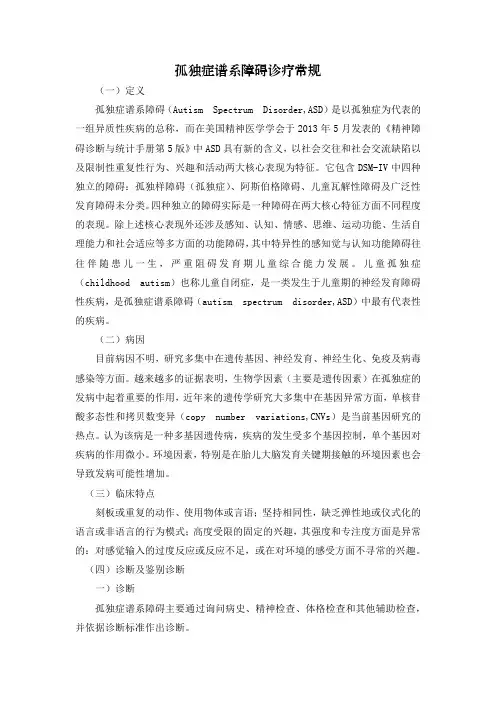
孤独症谱系障碍诊疗常规(一)定义孤独症谱系障碍(Autism Spectrum Disorder,ASD)是以孤独症为代表的一组异质性疾病的总称,而在美国精神医学学会于2013年5月发表的《精神障碍诊断与统计手册第5版》中ASD具有新的含义,以社会交往和社会交流缺陷以及限制性重复性行为、兴趣和活动两大核心表现为特征。
它包含DSM-IV中四种独立的障碍:孤独样障碍(孤独症)、阿斯伯格障碍、儿童瓦解性障碍及广泛性发育障碍未分类。
四种独立的障碍实际是一种障碍在两大核心特征方面不同程度的表现。
除上述核心表现外还涉及感知、认知、情感、思维、运动功能、生活自理能力和社会适应等多方面的功能障碍,其中特异性的感知觉与认知功能障碍往往伴随患儿一生,严重阻碍发育期儿童综合能力发展。
儿童孤独症(childhood autism)也称儿童自闭症,是一类发生于儿童期的神经发育障碍性疾病,是孤独症谱系障碍(autism spectrum disorder,ASD)中最有代表性的疾病。
(二)病因目前病因不明,研究多集中在遗传基因、神经发育、神经生化、免疫及病毒感染等方面。
越来越多的证据表明,生物学因素(主要是遗传因素)在孤独症的发病中起着重要的作用,近年来的遗传学研究大多集中在基因异常方面,单核苷酸多态性和拷贝数变异(copy number variations,CNVs)是当前基因研究的热点。
认为该病是一种多基因遗传病,疾病的发生受多个基因控制,单个基因对疾病的作用微小。
环境因素,特别是在胎儿大脑发育关键期接触的环境因素也会导致发病可能性增加。
(三)临床特点刻板或重复的动作、使用物体或言语;坚持相同性,缺乏弹性地或仪式化的语言或非语言的行为模式;高度受限的固定的兴趣,其强度和专注度方面是异常的:对感觉输入的过度反应或反应不足,或在对环境的感受方面不寻常的兴趣。
(四)诊断及鉴别诊断一)诊断孤独症谱系障碍主要通过询问病史、精神检查、体格检查和其他辅助检查,并依据诊断标准作出诊断。