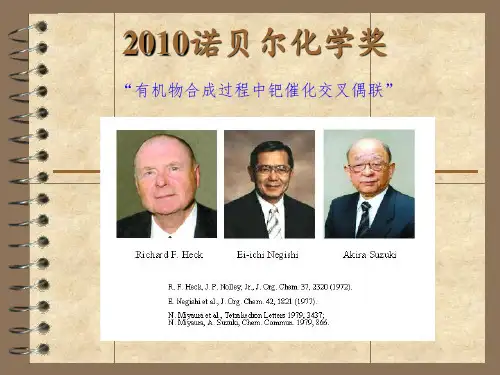
Suzuki 偶联 2010 诺贝尔奖
- 格式:doc
- 大小:135.50 KB
- 文档页数:9
Suzuki CouplingThe scheme above shows the first published Suzuki Coupling, which is thepalladium-catalysed cross coupling between organoboronic acid and halides. Recent catalyst and methods developments have broadened the possible applications enormously, so that the scope of the reaction partners is not restricted to aryls, but includes alkyls, alkenyls and alkynyls. Potassium trifluoroborates and organoboranes or boronate esters may be used in place of boronic acids. Some pseudohalides (for example triflates) may also be used as coupling partners.Mechanism of the Suzuki CouplingOne difference between the Suzuki mechanism and that of the Stille Coupling is that the boronic acid must be activated, for example with base. This activation of the boron atom enhances the polarisation of the organic ligand, and facilitates transmetallation. If starting materials are substituted with base labile groups (for example esters), powdered KF effects this activation while leaving base labile groups unaffected.In part due to the stability, ease of preparation and low toxicity of the boronic acid compounds, there is currently widespread interest in applications of the Suzuki Coupling, with new developments and refinements being reported constantly.Recent LiteratureAlkyl-Alkyl Suzuki Cross-Couplings of Unactivated Secondary Alkyl Halides at Room TemperatureB. Saito, G.C. Fu, J. Am. Chem. Soc., 2007, 129, 9602-9603.Boronic Acids: New Coupling Partners in Room-Temperature Suzuki Reactions of Alkyl Bromides. Crystallographic Characterization of an Oxidative-Addition Adduct Generated under Remarkably Mild ConditionsJ. H. Kirchhoff, M. R. Netherton, I. D. Hill, G. C. Fu, J. Am. Chem. Soc., 2002, 124,13662-13663.Tetraphosphine/palladium catalysed Suzuki cross-coupling reactions of aryl halides with alkylboronic acidsI. Kondolff, H. Doucet, M. Santelli, Tetrahedron, 2004, 60, 3813-3818.Suzuki-Miyaura Cross-Coupling Reactions of Primary Alkyltrifluoroborates with Aryl Chlorides S. D. Dreher, S.-E. Lim, D. L. Sandrock, G. A. Molander, J. Org. Chem., 2009, 74, 3626-3631.Pd(N,N-Dimethyl β-alaninate)2 as a High-Turnover-Number, Phosphine-Free Catalyst for theSuzuki ReactionX. Cui, T. Qin, J.-R. Wang, L. Liu, Q.-X. Guo, Synthesis, 2007, 393-399.Guanidine/Pd(OAc)2-Catalyzed Room Temperature Suzuki Cross-Coupling Reaction in Aqueous Media under Aerobic ConditionsS. Li, Y. Lin, J. Cao, S. Zhang, J. Org. Chem., 2007, 72, 4067-4072.A Triarylphosphine Ligand Bearing Dodeca(ethylene glycol) Chains: Enhanced Efficiency in the Palladium-Catalyzed Suzuki-Miyaura Coupling ReactionT. Fujihara, S. Yoshida, J. Terao, Y. Tsuji, Org. Lett., 2009, 11, 2121-2124.A New Family of Tunable Indolylphosphine Ligands by One-Pot Assembly and Their Applications in Suzuki-Miyaura Coupling of Aryl ChloridesC. M. So, C. C. Yeung, C. P. Lau, F. Y. Kwong, J. Org. Chem., 2008, 73, 7803-7806.Biphenylene-Substituted Ruthenocenylphosphine for Suzuki-Miyaura Coupling of Aryl ChloridesT. Hoshi, T. Nakazawa, I. Saitoh, Y. Mori, T. Suzuki, J.-i. Sakai, H. Hagiwara, S. Akai, Org. Lett., 2008, 10, 2063-2066.Facile Synthesis of Highly Stable Gold Nanoparticles and Their Unexpected ExcellentCatalytic Activity for Suzuki-Miyaura Cross-Coupling Reaction in WaterJ. Han, Y. Liu, R. Guo, J. Am. Chem. Soc., 2009, 131, 2060-2061.Room-Temperature Suzuki-Miyaura Couplings in Water Facilitated by Nonionic Amphiphiles B. H. Lipshutz, T. B. Petersen, A. R. Abela, Org. Lett., 2008, 10, 1333-1336.Solvent-Free Microwave-Assisted Suzuki-Miyaura Coupling Catalyzed by PEPPSI-iPrP. Nun, J. Martinez, F. Lamaty, Synlett, 2009, 1761-1764.Cross-Coupling and Dehalogenation Reactions Catalyzed by (N-Heterocycliccarbene)Pd(allyl)Cl ComplexesO. Navarro, H. Kaur, P. Mahjoor, S. P. Nolan, J. Org. Chem., 2004, 69, 3173-3180.An N-Heterocyclic Carbene Ligand with Flexible Steric Bulk Allows Suzuki Cross-Coupling of Sterically Hindered Aryl Chlorides at Room TemperatureG. Altenhoff, R. Goddard, C. W. Lehmann, F. Glorius, Angew. Chem. Int. Ed., 2003, 42, 3690-3693.Ferrocenyl Monophosphine Ligands: Synthesis and Applications in the Suzuki-MiyauraCoupling of Aryl ChloridesC. Baillie, L. Zhang, J. Xiao, J. Org. Chem., 2004, 69, 7779-7782.Reusable and Efficient Pd(OAc)2/TBAB/PEG-400 System for Suzuki-Miyaura Cross-Coupling Reaction under Ligand-Free ConditionsW.-J. Liu, Y.-X. Xie, Y. Liang, J.-H. Li, Synthesis, 2006, 860-864.Phosphine-Free Palladium Acetate Catalyzed Suzuki Reaction in WaterL. Liu, Y. Zhang, Y. Wang, J. Org. Chem., 2005, 70, 6122-6125.Synthesis and Characterization of R2PN=P(i BuNCH2CH2)3N: A New Bulky Electron-Rich Phosphine for Efficient Pd-Assisted Suzuki-Miyaura Cross-Coupling ReactionsJ. V. Kingston, J. G. Verkade, J. Org. Chem., 2007, 72, 2816-2822.Modified (NHC)Pd(allyl)Cl (NHC = N-Heterocyclic Carbene) Complexes forRoom-Temperature Suzuki-Miyaura and Buchwald-Hartwig ReactionsN. Marion, O. Navarro, J. Mei, E. D. Stevens, N. M. Scott, S. P. Nolan, J. Am. Chem. Soc., 2006, 128, 4101-4111.A Highly Active Catalyst for Suzuki-Miyaura Cross-Coupling Reactions of Heteroaryl CompoundsK. L. Billingsley, K. W. Anderson, S. L. Buchwald, Angew. Chem. Int. Ed., 2006, 45,3484-3488.Palladium catalyzed Suzuki-Miyaura coupling with aryl chlorides using a bulky phenanthrylN-heterocyclic carbene ligandC. Song, Y. Ma, Q. Chai, C. Ma, W. Jiang, M. B. Andrus, Tetrahedron, 2005, 61, 7438-7446.Immobilization of Dipyridyl Complex to Magnetic Nanoparticle via Click Chemistry as a Recyclable Catalyst for Suzuki Cross-Coupling ReactionsG. Lv, W. Mai, R. Jin, L. Gao, Synlett, 2008, 1418-1422.PdEDTA Held in an Ionic Liquid Brush as a Highly Efficient and Reusable Catalyst for Suzuki Reactions in WaterJ.-F. Wei, J. Jiao, J.-J. Feng, J. Lv, X.-R. Zhang, X.-Y. Shi, Z.-G. Chen, J. Org. Chem., 2009, 74, 5967-5974.Highly Active Catalyst for the Heterogeneous Suzuki-Miyaura Reaction: Assembled Complex of Palladium and Non-Cross-Linked Amphiphilic PolymerY. M. A. Yamada, K. Takeda, H. Takashashi, S. Ikegami, J. Org. Chem., 2003, 68, 7733-7741.New Catalysts for Suzuki-Miyaura Coupling Reactions of Heteroatom-Substituted Heteroaryl ChloridesA. S. Guram, X. Wang, E. E. Bunel, M. M. Faul, R. D. Larsen, M. J. Martinelli, J. Org. Chem., 2007, 72, 5104-5112.C2-Symmetric Bis-Hydrazones as Ligands in the Asymmetric Suzuki−Miyaura Cross-Coupling A. Bermejo, A. Ros, R. Fernández, J. M. Lassaletta, J. Am. Chem. Soc., 2008, 130,15798-15799.General Reaction Conditions for the Palladium-Catalyzed Vinylation of Aryl Chlorides with Potassium AlkenyltrifluoroboratesE. Alacid, C. Nájera, J. Org. Chem., 2009, 74, 8191-8195.Stereoselective Enol Tosylation: Preparation of Trisubstituted α,β-Unsaturated EstersJ. Baxter, D. Steinhuebel, M. Palucki, I. W. Davies, Org. Lett., 2005, 7, 215-218.N-Vinylpyridinium and -ammonium Tetrafluoroborate Salts: New Electrophilic Coupling Partners for Pd(0)-Catalyzed Suzuki Cross-Coupling ReactionsK. R. Buszek, N. Brown, Org. Lett., 2007, 9, 707-710.Suzuki-Miyaura Cross-Coupling of Potassium TrifluoroboratohomoenolatesG. A. Molander, D. E. Petrillo, Org. Lett., 2008, 10, 1795-1798.A family of indolyl phosphine ligands was applied to Suzuki-Miyaura cross-coupling of aryl tosylates with boronic acids, trifluoroborate salts, and boronate esters. Catalyst loading can be reduced to 0.2 mol % for the coupling of nonactivated aryl tosylates.C. M. So, C. P. Lau, A. S. C. Chan, F. Y. Kwong, J. Org. Chem., 2008, 73, 7731-7734.The First General Palladium Catalyst for the Suzuki-Miyaura and Carbonyl Enolate Coupling of Aryl ArenesulfonatesH. N. Nguyen, X. Huang, S. L. Buchwald, J. Am. Chem. Soc., 2003, 125, 11818-11819.Palladium-Catalyzed Cross-Coupling Reactions of Potassium Alkenyltrifluoroborates with Organic Halides in Aqueous MediaE. Alacid, C. Nájera, J. Org. Chem., 2009, 74, 2321-2327.The use of bisphosphine ligands with a large P-Pd-P bite angle allowed to synthesizeZ-chlorinated internal alkenes in good yields by a selective Suzuki-Miyaura monocoupling process of 9-alkyl-9-BBN with 1,1-dichloro-1-alkenes. These monochlorinated olefins could be further transformed providing stereospecifically trisubstituted olefins.F. Liron, C. Fosse, A. Pernolet, E. Roulland, J. Org. Chem., 2007, 72, 2220-2223.Stereoselective Cross-Coupling Reaction of 1,1-Diboryl-1-alkenes with Electrophiles: A Highly Stereocontrolled Approach to 1,1,2-Triaryl-1-alkenesM. Shimizu, C. Nakamaki, K. Shimono, M. Schelper, T. Kurahashi, T. Hiyama, J. Am. Chem. Soc., 2005, 127, 12506-12507.Suzuki-Miyaura Cross-Coupling Reactions of Potassium AlkenyltrifluoroboratesG. A. Molander, C. R. Bernardi, J. Org. Chem., 2002, 67, 8424-8429.。