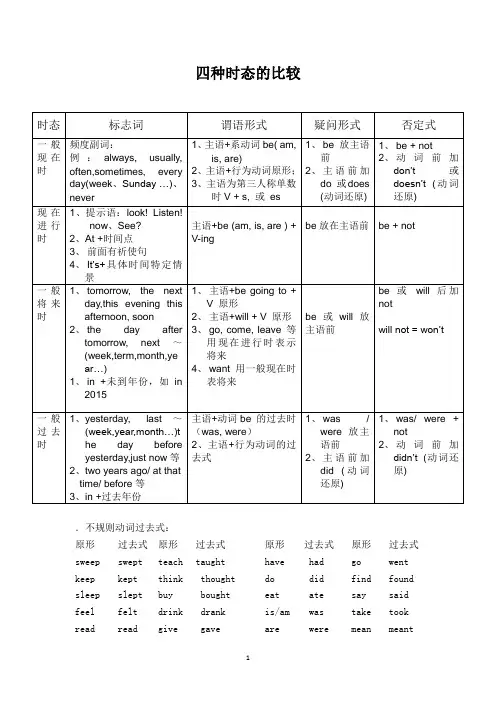
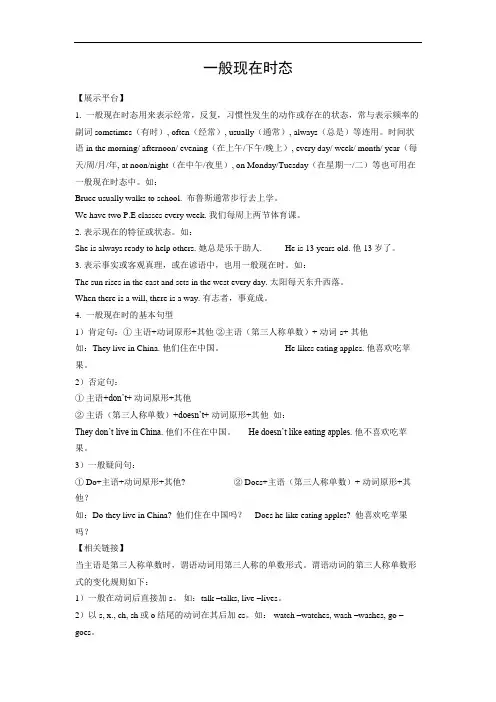
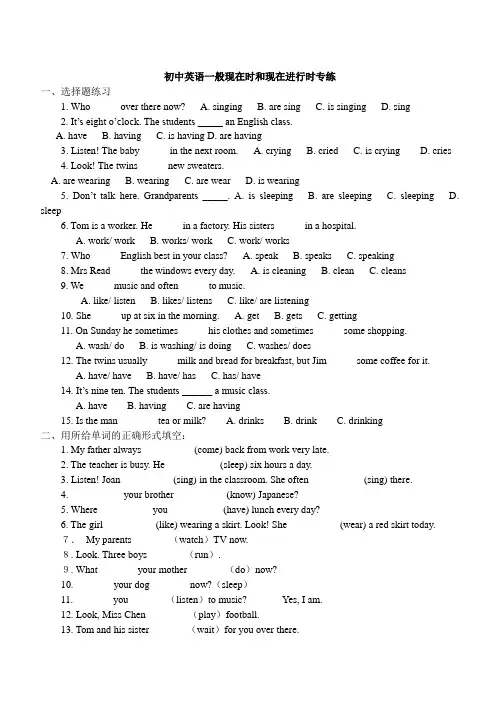
一般现在时、现在进行时、一般将来时、一般过去时四大时态讲解表格对比总结
- 格式:doc
- 大小:67.50 KB
- 文档页数:4
1 四大时态总结--------一般现在时、一般将来时、一般过去时、现在进行时
一、 一般现在时
一般现在时表示经常性或习惯性的动作,常与表示频度的时间状语连用,如often, usually, always,
sometimes, never, seldom, every week/day/year/month..., once a week, on Sundays等。动词用原形。当主语为第三人称单数时(he, she, it, 一个人名) ,动词变为三单形式。
肯定句 否定句
一般疑问句 特殊疑问句
Be动词 主语+am/is/are+其它
I am a boy.
主语+am/is/are
not+其它
I am not a boy. Am/is/are+主语+其它
Are you a boy?
Yes, I am.
No, I am not. 疑问词(where/what/
when/who/why/how)+am/is/are+主语+其它
Where are you?
行为动词 第一人称I、第二人称you、
复数 主语+动词原形(+其它)。We play
basketball after
school everyday. 主语+ don't+动词原形(+其它)。we don’t
play
basketball
after school
everyday. Do +主语+动词原形+其它?
Do you play
basketball after
school everyday?
Yes, we do. / No, we
don't. 疑问词+ do +主语+动词原形+其它?
What do you do after
school everyday?
第三人称单数 主语+动词三单式(+其它)。
He swims well.
主语+ doesn’t+动词原形(+其它)。
He doesn’t
swim well.
Does +主语+动词原形+其它。
Does he swim well ?
Yes, he does. / No,
he doesn't.
疑问词+ does +主语+动词原形+其它。
How does your father go to
work?
第三人称单数的动词变化规则:
(只有在第三人称(he, she, it, 一个人名)为主语的肯定句中,动词才用三单式)
(1)一般情况下,直接加s runs gets likes
(2)结尾是s, x, sh, ch, o,前为辅音字母,结尾加es watches, goes, washes, crosses, mixes, does
(3)动词末尾y,前为辅音,将y改为i加es study→studies fly→flies
但在y前如果为元音则直接加s buys says plays
(4)不规则变形 have—has
二、现在进行时
现在进行时表示此时此刻或现阶段正在进行的动作。常与now, at this time, these days, Listen! Look!
at this moment/time等词连用。
肯定句 否定句 一般疑问句 特殊疑问句
现在进行时 主语+be(am/is/are)+v-ing+其它
She is playing in
the garden. 主语+be(am/is/are)+not+ v-ing+其它
She is not playing in
the garden Be(is/am/are)+主语+v-ing+其它?
Is she playing in the
garden? 疑问词+ be(am/is/are)+v-ing+其它?
What is she doing in
the garden?
动词加ing规则
2 (1)直接在动词后加ing. going, starting, working.
(2)去掉词尾不发音的e,再加ing. leave--leaving, make---making.
注意:如果单词结尾的e发音,则不能去掉,也直接加ing. see –seeing agree - agreeing .
(3) 对于动词只有一个元音,而其后跟了一个辅音字母时,双写末尾辅音字母再加ing.
sitting, beginning run – running stop – stopping cut – cutting control –
controlling
(4)以ie结尾,把ie变y再加ing。如:lie – lying die – dying tie – tying picnic - picnicking.
三、一般将来时
一般将来时表示将来发生的事。常与tomorrow, next day/week/month/year..., soon, in a few
minutes, the day after tomorrow, in the future等时间状语连用。
Will/shall +动词原形;(shall用语第一人称) be(am/is/are) going to+ 动词原形
肯定句 否定句 一般疑问句 特殊疑问句
Will/shall+动词原形 主语+will/shall+动词原形+其它成份
she will write to
him next week. 主语 + will
/shall+ not + 动词原形 +其它成份
She will not
write to him
next week. will/shall+主语
+动词原形+其它成份
Will she write to
him next week? 疑问词+will/shall+主语 +动词原形+其它成份
what will she do next
week?
Be going to +动词原形 主语+
be(am ,is,are)
going to +动词原形+其它成份
My sister is going
to learn English
next year.
主语+be(am,is,are)not+going
to +动词原形+其它成份
My sister is not
going to learn
English next
year. Be (am / is / are)+主语+going to+动词原型+其它成份…?
Is your sister
going to learn
English next
year? 疑问词+ be (am / is /
are)+主语+going to+动词原型+其它成份…?
What is your sister
going to do next
year?
四、一般过去时
一般过去时表示过去某一时候或某一段时间所发生了的事情或存在的状态。常与过去时间yesterday,ago, this morning,just now,a moment ago,last night / year / week/month,once upon a time,the other day,before,the day before yesterday, in 1989, at the age of five, one day, then(那时), on that day, in the past连用。
肯定句 否定句 一般疑问句 特殊疑问句
Be动词 主语+was/were+其他
I\he\she\it+was
we\you\they + were
She was a baby ten years
ago. 主语+was/were+
not+其他
She was not a baby
ten years ago. Was/were + 主语+其它
Was she a baby ten
years ago? 疑问词+was/were
+主语+其它
Who was a baby
ten years ago?
行为动词 主语+动词过去式+其它
主语+ didn’t + 动词原形+其它 Did + 主语+动词原形+其它? 疑问词+did+主语+动词原形+其
3 He went to school
yesterday.
He didn’t go to
school yesterday.
Did he go to school
yesterday? 它?
What did he do
yesterday?
4
欢迎您的下载,
资料仅供参考!
致力为企业和个人提供合同协议,策划案计划书,学习资料等等
打造全网一站式需求