
最新跨文化交际(UNIT10)-修正版.pdf
- 格式:pdf
- 大小:3.13 MB
- 文档页数:17

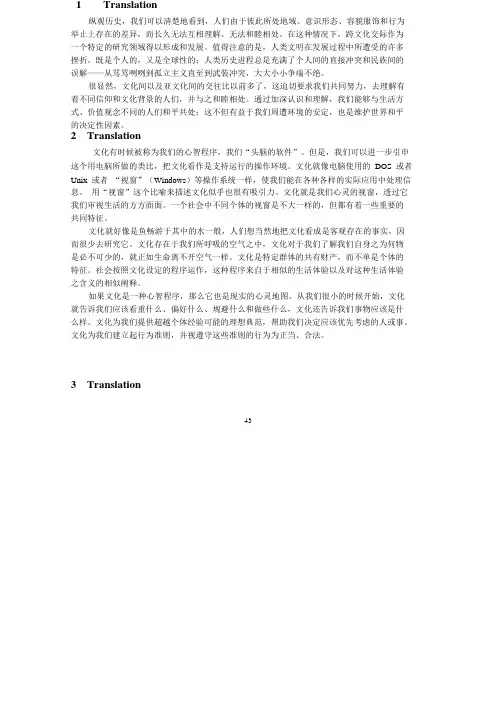
1 Translation纵观历史,我们可以清楚地看到,人们由于彼此所处地域、意识形态、容貌服饰和行为举止上存在的差异,而长久无法互相理解、无法和睦相处。
在这种情况下,跨文化交际作为一个特定的研究领域得以形成和发展。
值得注意的是,人类文明在发展过程中所遭受的许多挫折,既是个人的,又是全球性的;人类历史进程总是充满了个人间的直接冲突和民族间的误解——从骂骂咧咧到孤立主义直至到武装冲突,大大小小争端不绝。
很显然,文化间以及亚文化间的交往比以前多了,这迫切要求我们共同努力,去理解有着不同信仰和文化背景的人们,并与之和睦相处。
通过加深认识和理解,我们能够与生活方式、价值观念不同的人们和平共处;这不但有益于我们周遭环境的安定,也是维护世界和平的决定性因素。
2 Translation文化有时候被称为我们的心智程序,我们“头脑的软件”。
但是,我们可以进一步引申这个用电脑所做的类比,把文化看作是支持运行的操作环境。
文化就像电脑使用的DOS或者Unix或者“视窗”(Windows)等操作系统一样,使我们能在各种各样的实际应用中处理信息。
用“视窗”这个比喻来描述文化似乎也很有吸引力。
文化就是我们心灵的视窗,透过它我们审视生活的方方面面。
一个社会中不同个体的视窗是不大一样的,但都有着一些重要的共同特征。
文化就好像是鱼畅游于其中的水一般,人们想当然地把文化看成是客观存在的事实,因而很少去研究它。
文化存在于我们所呼吸的空气之中,文化对于我们了解我们自身之为何物是必不可少的,就正如生命离不开空气一样。
文化是特定群体的共有财产,而不单是个体的特征。
社会按照文化设定的程序运作,这种程序来自于相似的生活体验以及对这种生活体验之含义的相似阐释。
如果文化是一种心智程序,那么它也是现实的心灵地图。
从我们很小的时候开始,文化就告诉我们应该看重什么、偏好什么、规避什么和做些什么,文化还告诉我们事物应该是什么样。
文化为我们提供超越个体经验可能的理想典范,帮助我们决定应该优先考虑的人或事。
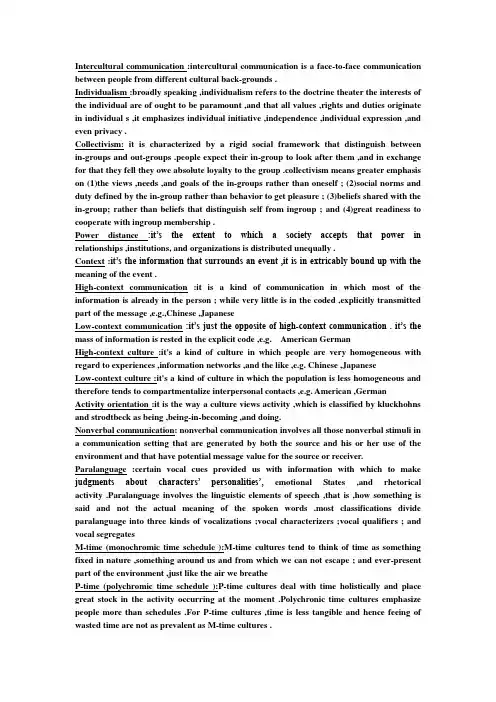
Intercultural communication :intercultural communication is a face-to-face communication between people from different cultural back-grounds .Individualism :broadly speaking ,individualism refers to the doctrine theater the interests of the individual are of ought to be paramount ,and that all values ,rights and duties originate in individual s ,it emphasizes individual initiative ,independence ,individual expression ,and even privacy .Collectivism: it is characterized by a rigid social framework that distinguish between in-groups and out-groups .people expect their in-group to look after them ,and in exchange for that they fell they owe absolute loyalty to the group .collectivism means greater emphasis on (1)the views ,needs ,and goals of the in-groups rather than oneself ; (2)social norms and duty defined by the in-group rather than behavior to get pleasure ; (3)beliefs shared with the in-group; rather than beliefs that distinguish self from ingroup ; and (4)great readiness to cooperate with ingroup membership .Power distance :it’s the extent to which a society accepts that power in relationships ,institutions, and organizations is distributed unequally .Context :it’s the information that surrounds an event ,it is in extricably bound up with the meaning of the event .High-context communication :it is a kind of communication in which most of the information is already in the person ; while very little is in the coded ,explicitly transmitted part of the message ,e.g.,Chinese ,JapaneseLow-context communication :it’s just the opposite of high-context communication . it’s the mass of information is rested in the explicit code ,e.g. American GermanHigh-context culture :it's a kind of culture in which people are very homogeneous with regard to experiences ,information networks ,and the like ,e.g. Chinese ,JapaneseLow-context culture :it's a kind of culture in which the population is less homogeneous and therefore tends to compartmentalize interpersonal contacts ,e.g. American ,GermanActivity orientation :it is the way a culture views activity ,which is classified by kluckhohns and strodtbeck as being ,being-in-becoming ,and doing.Nonverbal communication: nonverbal communication involves all those nonverbal stimuli in a communication setting that are generated by both the source and his or her use of the environment and that have potential message value for the source or receiver. Paralanguage :certain vocal cues provided us with information with which to make judgments about characters’ personalities’, emotional States ,and rhetorical activity .Paralanguage involves the linguistic elements of speech ,that is ,how something is said and not the actual meaning of the spoken words .most classifications divide paralanguage into three kinds of vocalizations ;vocal characterizers ;vocal qualifiers ; and vocal segregatesM-time (monochromic time schedule ):M-time cultures tend to think of time as something fixed in nature ,something around us and from which we can not escape ; and ever-present part of the environment ,just like the air we breatheP-time (polychromic time schedule ):P-time cultures deal with time holistically and place great stock in the activity occurring at the moment .Polychronic time cultures emphasize people more than schedules .For P-time cultures ,time is less tangible and hence feeing of wasted time are not as prevalent as M-time cultures .Ethnocentric(文化中心主义):the belief that your own cultural background is superior. Encoding编码Unfortunately (or perhaps fortunately), humans are not able to share thoughts directly. Your communication is in the form of a symbol representing the idea you desire to communicate. Encoding is the process of putting an idea into a symbol.Message编码信息The term message identifies the encoded thought. Encoding is the process, the verb; the message is the resulting object.Channel交际渠道The term channel is used technically to refer to the means by which the encoded message is transmitted. The channel or medium, then, may be print, electronic, or the light and sound waves of the face-to-face communication.Noise干扰The term noise technically refers to anything that distorts the message the source encodes. Receiver交际接受The receiver is the person who attends to the message.Decoding解码Decoding is the opposite process of encoding and just as much an active process. The receiver is actively involved in the communication process by assigning meaning to the symbols received.Feedback反馈Feedback refers to that portion of the receiver response of which the source has knowledge and to which the source attends and assigns meaning.Context场景The final component of communication is context. Generally, context can be defined as the environment in which the communication takes place and which helps define the communication.stereotypes:refers to negative or positive judgment made about individuals based on any observable or believed group membership.针对目标群体成员所特有的正面或方面的判断。

北师大版(2019)选择性必修第四册Unit 10 Connections Lesson 1 How Closely Connected Are We本节课的教材分析:本节课所使用的教材是北师大版(2019)选择性必修第四册Unit 10 Connections Lesson 1 How Closely Connected Are We? 教材内容主要讲述人们在当今信息爆炸时代中如何建立紧密联系,提供了一系列相关话题,例如社交网络、跨文化交流等。
教学目标:1. 知识目标:学生能够掌握关于连接和交流的基本词汇和短语,并进一步了解不同媒体对人际关系和跨文化交流的影响。
2. 能力目标:学生能够运用所学知识分析和讨论人际关系互动的现象,并在跨文化交流中正确运用适当的说法和表达。
3. 情感目标:通过本节课的学习,学生能够培养积极的交流态度,增进对他人的理解和尊重。
教学重点:1. 掌握关于连接和交流的基本词汇和短语;2. 学习如何分析和讨论人际关系互动的现象;3. 运用适当的语言表达和说法进行跨文化交流。
教学难点:1. 如何培养学生积极的交流态度;2. 如何帮助学生运用所学知识进行跨文化交流。
学情分析:学生为高二学生,对英语的基础知识已有一定掌握,但在语言运用和文化交流方面可能存在困难。
学生生活在信息时代,对社交网络等新媒体比较熟悉,但在人际交往技巧和跨文化交流方面可能较为薄弱。
教学策略:1. 激发学生学习的兴趣:引入课题前,通过提问或展示相关真实案例等方式激发学生对课题的兴趣,让学生主动参与学习。
2. 合作学习:通过小组活动、合作探究等方式,培养学生的合作意识和互动能力,促进彼此之间的交流和共同学习。
3. 情景模拟:通过以情境为基础的练习和角色扮演等方式,让学生在实际情景中运用所学知识,提高语言运用能力和跨文化交际能力。
教学方法:1. 问答法:通过提问学生基本问题,激活学生思维,开展思维导图或词汇网络等活动。
