
Teaching Plan
- 格式:xlsx
- 大小:11.78 KB
- 文档页数:1
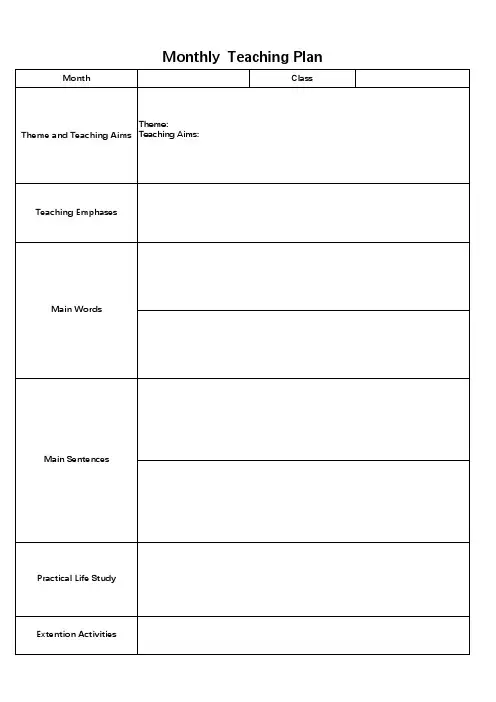

第五册Teaching Plan for Lesson一、教学目标1、知识与技能目标学生能够熟练掌握本单元的重点词汇和短语,如_____、_____、_____等。
学生能够正确运用本单元的重点句型,如_____、_____、_____等进行交流和表达。
学生能够听懂、读懂与本单元主题相关的简单对话和文章,并能够提取关键信息。
2、过程与方法目标通过多种教学方法,如情景教学、小组合作学习等,培养学生的自主学习能力和合作精神。
引导学生通过观察、分析、归纳等方式,总结语言规律,提高语言学习的效率。
3、情感态度与价值观目标激发学生学习英语的兴趣,培养学生积极主动的学习态度。
培养学生的跨文化意识,让学生了解不同国家的文化差异。
二、教学重难点1、教学重点重点词汇和短语的理解与运用。
重点句型的结构和用法。
2、教学难点如何让学生在实际情境中灵活运用所学的词汇和句型。
培养学生的阅读理解和写作能力。
三、教学方法1、情景教学法通过创设生动的情景,让学生在真实的语境中学习和运用语言。
2、任务驱动法给学生布置明确的任务,让学生在完成任务的过程中提高语言能力。
3、小组合作学习法组织学生进行小组合作学习,培养学生的合作精神和交流能力。
四、教学过程1、导入(Warmingup)通过播放一段与本单元主题相关的英语视频或歌曲,引起学生的兴趣,导入新课。
与学生进行简单的交流,如询问学生对相关主题的了解和看法,激活学生的已有知识。
2、词汇学习(Vocabulary)展示本单元的重点词汇,通过图片、实物、动作等方式帮助学生理解词汇的含义。
让学生跟读词汇,纠正发音,然后进行词汇拼写和记忆练习。
3、句型学习(Sentence Patterns)讲解本单元的重点句型,分析句型的结构和用法,举例说明。
组织学生进行句型操练,可以通过模仿、替换、造句等方式,让学生熟练掌握句型。
4、课文学习(Text)让学生听课文录音,理解课文大意,回答一些简单的问题。

Unit 11: Could you please tell me where therestrooms are?Part 1: Teaching Design第一部分:教学设计Period 1: Matching, Listening and Speaking (Page 86)(Could you tell me where I can buy some stamps?) Objectives●To learn to understand and use indirect questions●To listen and speak about how to ask for information politelyProcedures■Warming up by studying the title “Could you please tell me where the restrooms are?”Hello everyone. I am a strange here in this city. Could you tell me how to get to the supermarket? All right, I am telling a lie to you. I am not new here. I said so just to help you learn to use the indirect questions.Now turn to page 87 first and look at the three sentences in the Grammar Focus.Have you noticed the word “where” and “how” used in the sentences. The questions introduced by them are called the indirect questions.Now in pairs make similar sentences with “where” and “how”.1a Looking and matchingOn page 86 is a picture of a city. A visitor is asking someone questions about things to do at certain places. Now look at the picture and match each thing with a place.1b Listening and completingIt is difficult to get around in a new place. Now listen to the recording and complete the dialogue in the picture on page 86. Write your words here in the speech bubbles.Now go to page 134 to read the tapescript.While reading try to find all the sentences used to ask for information politely, cut/ the sentence into thought groups, study all the predicates, circle all the linking words and underlineall the expressions. That’s grammar study, indeed.Now try to make a conversation like the one you read just now.1c Pairing and speakingIn 1a there are many phrases describing activities. Now use them to make up conversations to talk about your own city. (The Indirect questions are darkened.)Period 2: Listening and Speaking (Page 87) (Can you tell me where I can buy some shampoo?) Objectives●To learn to understand and use indirect questions●To listen and speak about how to ask for information politelyProcedures■Warming up by studying the “Target Language”Hello, class. Go to page V first. Read after me the sentences in Target Language.—Excuse me. Do you know where I can exchange money?—Sure. There’s bank on the second floor. Take the escalator to the second floor and turn right. The bank is next to the bookstore.2a Listening and numberingDo you like shopping? If you do,come and listen to the directions for going shopping around a new city.While listening please number the directions in the order that you hear them.Now go to page 134 and read the tapescript. While reading try to find all the indirect questions, cut/ the sentence into thought groups, study all the predicates, circle all the linking words and underline all the expressions. That’s grammar study, too.2b Listening and drawingDo you like drawing?Now listen to the recording again to draw a line on the picture on page 87 to show how the boy walks to the drugstore.2c Pairing and speakingWhat else do you like to buy? Then make conversations in pairs using the other places in the picture on page 87.Period 3: Reading, Speaking and Writing (Page 88)(They’re all at the mall.)Objectives●To learn to understand and use indirect questions●To read, speak and write asking for information politelyProcedures■Warming up by learning to use “mall” to make sentencesHello, class. Do you know what a mall is?It is a business center, usually including restaurants and a convenient parking area. It is a modern version of the traditional marketplace.Now let’s make sentences with “mall”.3a Reading and listingOn page 88 is an article about going to a mall. Now read it to list the advantages and disadvantages of going to a mall. While reading try to cut/ the sentence into thought groups, study all the predicates, circle all the linking words and underline all the expressions. That’s grammar study, in deed.Copy all the expressions in your notebook.3b Grouping and speakingWhere do you usually hang out with friends? What are the advantages and disadvantages of hanging out at your house, at a mall or at your school? Now in groups talk about them.4. Thinking and writingNow we are going to challenge one another. Write directions from your school to three certain places. Read the directions to each other and guess the places.Unit 11 Could you please tell me where the restrooms ar e?Section BObjectives●T o describle some places with adjectives●tolearn to understand and use indirect questions●To write, listen and speak asking for information politelyProcedures■Warming up by looking at some pictures1a Reading and orderinginteresting fascinating inexpensive delicious uncrowdedbig beautiful safe clean convenientFirs t:Look at the words and make sentencesSecon d:Make new conversationsOn page 89 is a list of words and a box with places. Now go over them and put in words beside the place, the most important quality words first.1b Pairing and speakingYou are familiar with the words in 1a. Now use them to talk about your city.2a Listening and writingSome tourists are going around your city. They are asking about things. Now listen to them talking and write what they ask about.Do you know what the tourists are asking about?2b Listening and writingNow you are to listen to the conversations for the second time. Listen for where the man saysthe tourists should go.EXERCISE S:To look at the screen and do them SUMMAR Y:To learn to understand and use indirect question To speak asking for information politely HOMEWOR K:To make new conversations like 2c on page 89教学设计三河中学马云霞Period 5: Reading, Writing and Speaking (Page 90) (Eat, have fun and learn in Watertown!)3b Reading and completingOn page 90 is an unfinished tour guide to Sunville. Now turn back to 2a and 2b for information to finish it.3c Write a guide to your city or townMY HOMETOWN: TAIYUANTaiyuan, the capital city of Shanxi Province, lies in the north part of Middle Jin and crosses the River Fen. The city area has three parts, one smaller city and five counties. The history of the city can go back to over 2,400 years ago. It was set up in 497 BC, the end of the Spring and AutumnPeriod and was named Jinyang, the northern bank of the Jin River. In Chinese, the northern bank of waters is called yang. In 982, Song Taizong, Zhao Kuangyi, the second emperor of the Song Dynasty burned and flooded Jinyuan City. After that, he ordered one of the officials, Pan Mei to build Taiyuan City in Tangming Town, north of Jinyuan City. Thus, came the present Taiyuan City. Taiyuan, in Chinese, means the greatest plain. In fact, around it there are many high mountains and hilly areas. Only one-fifth of the whole area is plains. Taiyuan has coal and iron, so it has the name, "the home of coal and iron." Taiyuan is nice in climate. It is not dry and cold in winter, not hot and rainy in summer, not dusty and windy in spring. But it is cool and comfortable in autumn.4 Grouping and speakingOne of the group members is to role play the information booth worker, and the others are the tourists. The tourists are asking about your city.。

Teaching_Plan(英语说课稿)1000字IntroductionGood morning/afternoon everyone. My name is [Teacher’s Name] and today I am here to present my teaching plan foran English class. The subject I will be teaching is [Topic]. The target students for this class are [Age/Grade level].ObjectivesBy the end of this class, the students will be able to:1. Discuss [Topic] in English fluently;2. Use basic English vocabulary related to [Topic];3. Accurately construct sentences in English;4. Practice listening and speaking skills through conversation.MaterialsFor this class, we will be using the following materials:1. A whiteboard and markers;2. A worksheet related to the topic;3. A handout with basic vocabulary related to the topic;4. Listening materials.Classroom Set-upThe classroom should be set up with students seated in groups of four to facilitate group work and conversation. The teacher’s desk and whiteboard should be positioned in the front of the classroom. The classroom should also bewell-lit and quiet to minimize distractions.Procedure1. Warm-up Activity (10 minutes)The teacher will start the class with a warm-up activity to get the student’s minds focused and engaged. This activity will include asking the students to introduce themselves and talk about their hobby in English. Through this activity, students can introduce themselves to their peers, and start practicing their speaking skills. This activity will also help in establishing rapport within the class.2. Introduction of Vocabulary (20 minutes)The teacher will then move on to introducing basic vocabulary related to the topic of [Topic]. The vocabulary will be presented through a handout and the teacher will ask the students to match the words with their corresponding meanings. This activity will help familiarize the students with the terminology related to [Topic].3. Individual Work (20 minutes)After the introduction of vocabulary, students will be given a worksheet related to [Topic]. Students will be asked to answer questions related to [Topic] based on the information they have learned from the handout. Thisactivity will help students practice their reading and comprehension skills while also reinforcing their understanding of the vocabulary.4. Group Work (25 minutes)In this activity, students will be divided into groups of four. Each group will be given a set of pictures related to [Topic]. Students will then be asked to describe what they see in the picture in English. Through this activity, the students will be able to practice their speaking and listening skills while also practicing constructing sentences in English.5. Conclusion and Feedback (10 minutes)To end the lesson, the teacher will summarize the keypoints of the lesson and ask for feedback from the students regarding the class. The teacher will also address any questions or concerns from the students. This activity will help ensure the students have understood the lesson andgive them the opportunity to provide feedback about the class.ConclusionIn conclusion, this teaching plan is designed to help students practice their English language skills while also learning about [Topic]. Through this plan, students will engage in activities that develop their listening, speaking, reading and writing skills. It is hoped that by the end of the class, the students will leave with a deeper understanding of [Topic] and improved English language proficiency. Thank you for listening.。

二年级英语Time (teaching plan) 教学教案第一章:课程简介教学目标:1. 让学生掌握时间相关的词汇,如:morning, afternoon, evening, night, hour, minute等。
2. 培养学生用英语询问和表达时间的能力。
3. 引导学生通过观察和思考,发现时间的变化和规律。
教学内容:1. 时间词汇的学习和运用。
2. 时间表达句型的学习和实践。
3. 通过观察和实验,探索时间的规律。
教学方法:1. 采用直观教学法,利用图片、教具等辅助教学。
2. 采用情境教学法,创设生活情境,让学生在实际情境中学习和运用英语。
3. 采用分组讨论法,引导学生相互交流、合作学习。
第二章:教学重点与难点教学重点:1. 时间词汇的掌握。
2. 时间表达句型的运用。
教学难点:1. 时间的精确表达,如:几点几分。
2. 理解并运用时间相关的疑问词,如:What time is it? How old are you?第三章:教学步骤1. 热身活动:引导学生用中文谈论自己的一天,如:早上、下午、晚上等。
2. 引入新课:展示时间相关的图片,引导学生用中文表达,过渡到英文。
3. 学习时间词汇:教授morning, afternoon, evening, night, hour, minute 等词汇,让学生跟读、模仿。
4. 学习时间表达句型:教授What time is it? How old are you?等句型,让学生进行角色扮演,实际运用。
5. 实践环节:分组讨论,让学生用英语询问和表达时间,教师巡回指导。
第四章:作业布置1. 抄写时间词汇,加强记忆。
2. 运用时间词汇,编写小故事。
3. 观察生活中时间的变化,记录下来并与同学分享。
第五章:教学反思本节课通过图片、教具等直观教学手段,让学生掌握了时间词汇,并能够在实际情境中运用时间表达句型。
在实践环节,学生分组讨论,积极参与,提高了英语口语表达能力。