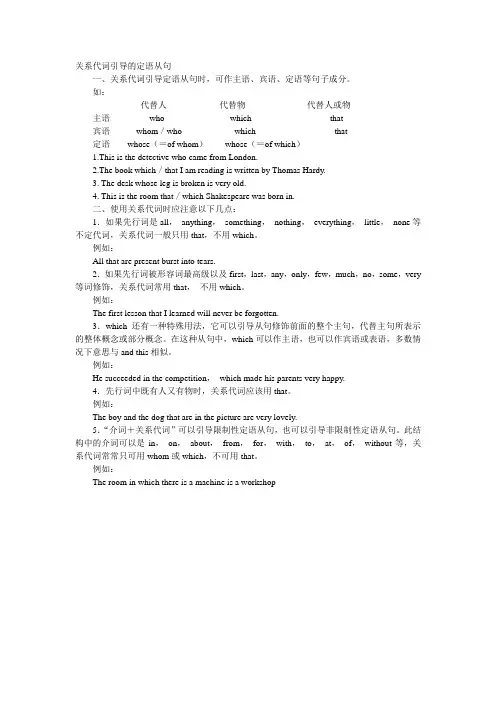
关系代词引导的定语从句
- 格式:docx
- 大小:18.71 KB
- 文档页数:2
关系代词引导的定语从句
制作人:常倩倩祝乃荣
参考文献:摘录《张道真英语语法大众珍藏版第二版》中“关系代词和定语从句”
的章节介绍。
知识点介绍
关系代词有下面这些:who, whom, whose, that, which都是用来引起定语从句的。
把它们称作关系代词是因为它们有关联作用,把引起的从句和所修饰的词联系起来,这种从句可称作关系从句(relative clauses),由于他修饰一个名词或代词,因此也称作定语从句(attributive clauses)。
定语从句有两类:限制性定语从句(defining attributive clauses)和非限制性定语从句(non-defining attributive clauses)。
知识点讲解
大多数定语从句都对所修饰的意思加以限制,表示“......的人(事物)”,这类从句称为限制性定语从句,也可称作限制性关系从句(defining relative clauses)。
一、代表人时多用who:
1)The man who stole your car has been arrested. 偷你汽车的人已经捕获。
2)Would anyone who saw the accident please get in touch with the police? 请目击这一事故的人与警方联系好吗?
有时可用that, 特别是在all, everyone, no one, nobody和those 后面:
3)Is he the man that sells dogs? 他就是卖狗的人吗?
4)Everyone that (who) knows him likes him. 认识他的人都喜欢他。
在从句中作宾语时用whom,也可用that代替:
5)The man whom (that) I saw told me to come here.我见到的人让我到这里来。
6)The man with whom I travelled (that I travelled with) couldn’t speak English. 和我一道旅行的人不会说英语。
二、代表物时多用which或that,可在从句中作主语(a),宾语(b)或介词宾语(c):
a.This is the film which (that) created a great sensation.这就是那部引起很大轰动的电影。
b.The book which they sent me is very good. 他们寄给我的书非常好。
c.This is the pan in whichI boiled the milk. 这是我煮牛奶的锅。
注:that 不能紧跟在介词后面,但若把介词放在句末,则可以用that(也可省略):
This is the pan that I boiled the milk in.
还有一种定语从句为非限制性的,称为非限制性定语从句(non-defining attributive clauses)。
这种从句,对所修饰的名词没有限制意义的作用,而只补充一点情况,与主句关系不紧密,把它们拿掉,主句照样成立。
它们和所修饰的名词之间常加一个逗号,译成汉语时另起一个句子,仿佛是并列句。
只有who(m), whose和which等关系代词能引起这类从句(that不能):1)I have invited Diana, who lives in the next flat. 我邀请了戴安娜,她住在我们隔壁。
2)Tom, whom everyone suspected, turned out to be innocent. 人人都怀疑汤姆,结果证明他是无辜的。
3)Mrs. Gray, whose children are in college, is trying to get a job. 格雷太太的孩子们都在上大学,她想找一份工作。
4)The 8:30 train, which is usually very punctual, was late today. 八点半的火车通常是很准时的,今天却晚点了。
which, whom等可以和of(a)或其他介词(b)一起用:
a.I picked up the peaches, some of whichwere badly bruised. 我捡起那些桃子,其中有些已经碰伤了。
I met the fruit-pickers, several of whom were university students. 我碰到那些摘水果的人,其中有好几个是大学生。
b.Ashdown forest, through which we’ll be driving, isn’t a forest any longer.我们将开车穿过阿希顿森林,可是现在它已不再是一座森林了。
George, with whom I played tennis on Sundays, was fitter than me. 我每星期天都和乔治一道打网球,他的身体比我好。
which有时不代表一个名词,而代表前面句子的全部或部分意思:
Peter drove too fast, which was dangerous. 彼得开车很快,这是很危险的。
He said that he had never seen her before, which was not true. 他说他从没见到过她,这是不真实的。
有时还可在从句中作定语:
He advised me to hide behind the door, which advice I took at once. 他劝我躲在门后,我立即照他的话做了。
例题讲解。