Hypotaxis vs.Parataxis 1
- 格式:doc
- 大小:61.50 KB
- 文档页数:4
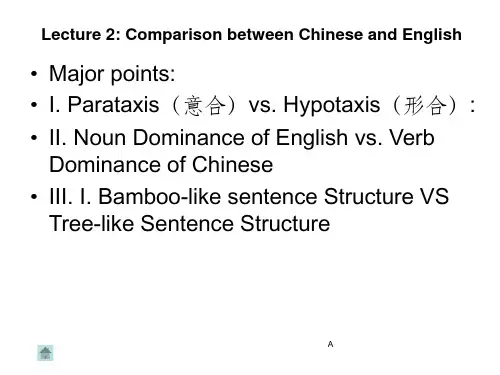
形合(hypotaxis) vs.意合(parataxis)所谓形合指的是句子中的词语或分句之间用语言形式手段(如关联词等)连接起来,表达一定的意义,The dependent or subordinate construction or relationship of clauses with connectives, for example, I shall despair if you don’t come. ---The American Heritage Dictionary意合指的是句子中词语或分句之间不用语言形式手段连接,句中的语法意义和逻辑关系通过词语或分句的含义表达。
The arranging of clauses one after the other without connectives showing the relations between them. Example: The rain fell; the river flooded; the house washed away. ---The World Book DictionaryWARM-UP:他不干,我干。
我买了6支钢笔,一共30元,拿回家一看,都是用过的了。
Before them lay miles and miles of beautiful plain with lots of wild animals among the grass. 但愿人长久,千里共婵娟。
We wish each other a long life so as to share the beauty of this graceful moonlight, even though miles apart.奈达在其《译意》(Translating Meaning) 一书中指出“英汉在语言学上最重要的一个区别就是形合和意合的不同。
”“so far as English and Chinese are concerned, the most important difference linguistically is the contrast between hypotaxis and parataxis.”枯藤老树昏鸦,小桥流水人家,古道西风瘦马,夕阳西下,断肠人在天涯。
英语造句多用各种形式手段连接,注重显性接应(overt cohesion),重形式,重结构。
相对汉语而言其连接手段和形式不仅数量大,种类多,而且使用频率极高。
汉语造句少用甚至不用形式连接手段,注重隐形连贯(covert coherence), 重逻辑事理顺序,重功能,重意义,以神统形。
英语的形合手段1、关系词和连接词关系词(关系代词、关系副词、连接代词和连接副词)如who, whom, whose, that, which, what, when, where, why, how 等用来连接主句和定语从句、主语从句等。
连接词(并列连词和从属连词)如and, or, but, yet, so, however, as well as, when, while, as , since, until, unless, lest 用来连接词、词组、分句或状语从句。
All was cleared up some time later when news came from a distant place that an earthquake was felt the very day the little copper ball fell.2、介词简单介词with, to, in, about, through, between , 合成介词inside, onto, upon, within, without, throughout 和成语介词according to, along with, in front of , on behalf of, with regard to )据统计英语各类介词共约286个。
介词是英语里最活跃的词类之一,是连接词语和从句重要手段。
Change of information, if any, concerning the contents of this section will be found in the appendix at the end of this book.3、其他连接手段如形态变化形式,包括词缀变化(前、后缀),动词、形容词、代词、副词的形态变化(如性、数、格、时态、语态、比较级等N+s/es, v+ing/ed, n‟s ,adj+er/est)及保持前后一致的关系,广泛使用代词以保持前呼后应的关系,以及使用it ,there作替补词起连接作用。
英语常常综合运用上述的关系词、连接词、介词以及其它连接手段,把各种成分连接起来,构成长短句子,表达一定的语法关系和逻辑关系。
There is nothing more disappointing to a hostess who has gone to a lot of trouble or expense than to have her guest so interested in talking politics or business with her husband that he fails to notice the flavor of the coffee, the lightness of the cake, or the attractiveness of the house, which may be her chief interest and pride.汉语的意合手段1、语序。
汉语的许多主从复句,虽然不用关联词,形式类似并列复句,但分句含义却有主有次。
人不犯我,我不犯人。
(因为)他不老实,我不能信任他。
抓住了主要矛盾,一切问题就可以迎刃而解。
2、反复、排比、对偶等,这些词句整齐,匀称往往不用关联词。
吃苦在前,享受在后。
聪明一世,糊涂一时。
3、紧缩句。
这类意合句式是由复句紧缩而成的。
有饭大家吃。
狼披羊皮还是狼。
上梁不正下梁歪。
4、四字格。
不进则退物极必反Translation strategies:Chinese: Meaning-focused with emphasis on implicit coherence (隐性连贯)Paratactic:语义型语言(以意统形)English: Form-focused with emphasis on explicit cohesion(显性联接)Hypotactic:形态型语言(以形驭意)英译汉时,往往要先分析句子的结构,形式,才能确定句子的功能、意义;要考虑汉语意合的特点,英语中的关联词及某些语境可以暗示的信息要省略,以符合汉语“形散”的特点。
汉译英时,往往要先分析句子的功能、意义,才能确定句子的结构、形式;必须特别注意汉语句子中隐含的逻辑关系,这种逻辑关系在注重意合的英语中一般要采用增加关联词的方法表达出来。
Practice:The isolation of the rural world, because of distance and the lack of transport facilities, is compounded by the paucity of the information media.Chilly gusts of wind with a taste of rain in them had well nigh dispeopled the street.The ignorant old woman who ruled for the entire last half of the nineteenth century did more than any other single person to hold back China‟s progress.(Lin Yutang:Moment in Peking)跑得了和尚,跑不了庙。
知己知彼,百战不殆;不知彼而知己,一胜一负;不知彼不知己,每战必殆。
①我常见许多青年的朋友,②聪明用功,③成绩优异,④而语文程度不足以达意,⑤甚至写一封信亦难得通顺,⑥问其故则曰其兴趣不在语文方面。
(梁实秋《学问与趣味》)①I have come across a great many young friends, ②bright and diligent, ③do exceedingly well in studies, ④but they are rather weak in Chinese, ⑤even can't write a smooth Chinese letter. ⑥when asked why, they…ll say they are not interested in Chinese.人穷志短/ 人穷志不短彼此之间,情趣相投、脾气对味则合、则交,反之,则离、则绝。
(2010 TEM-8)生了儿子,吃啥有啥;生了女儿,有啥吃啥。
四川人不怕辣,江西人辣不怕,湖南人怕不辣。
Note: 辩证地看待两种语言中的意合与形合I came, I saw, I conquered. Grasp all, lose all. The older, the wiser.关于英汉句型结构的比喻1、“葡萄藤型”结构(grapevine structure),意为在短短的主干上派生出长长的枝蔓和丰硕的果实;汉语句子因为很少叠床架屋,节外生枝,而是一个短句接一个短句地往下延伸,因此被称为“竹竿型”结构(bamboo structure)。
---王寅. 《英汉语言宏观结构区别特征》2、“波浪形”结构:汉语的句子关系往往是并列、并行的,因此是以时序或逻辑顺序排列的。
子句与子句之间的关系须透过上下文才能决定,所以句子是意合的;而且连词的使用也不像英语中普遍,结构也较为简练明快。
汉语的句式称之为“流水句”,整个句子像由一个一个独立的子句,按时间顺序或逻辑顺序层层推进。
因此,有人把汉语句子结构比作“波浪形”结构,每个子句犹如波浪,前浪推后浪,宛如“万顷碧波,层层推进”。
“枝杈形结构”:英语采用主从关系的形合法(use of hypotaxis)。
英语可以通过连词(如状语从句)、关系词(如定语从句)和分词、动名词及不定式等构成句子,因此构成方式是形合的;英语利用关系代词引出包孕句(embedded clause),语法结构采用层次结构,关系紧凑严密。