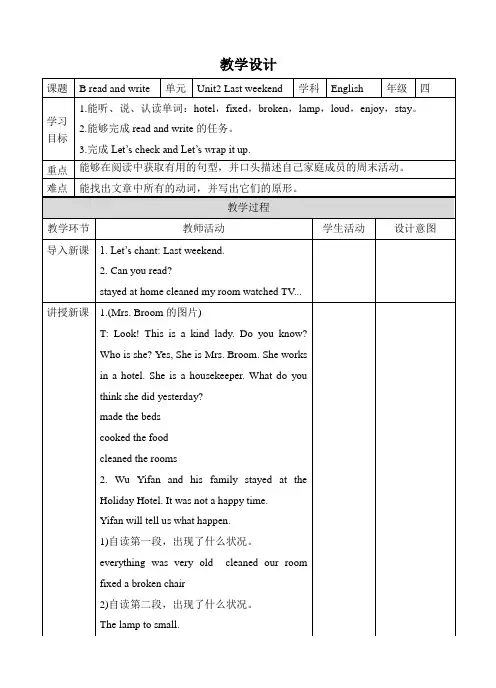
英语人教版六年级下册六年级下册 Unit 3 Read and write 教案
- 格式:doc
- 大小:18.50 KB
- 文档页数:4
六年级下册Unit 3 Where did you go?
Read and write 教学设计
惠州市青塘小学 刘文静
教学内容: Read and write Let’s check ﹠ Let’s wrap it up
课 型 :阅读教学
教学目标:
1、能朗读、理解Read and write 的短文并完成相关练习.
2、能独立完成Let’s check 和Let’s wrap it up 中的练习。
3、培养学生的阅读能力和听说能力。
4、教育学生要养成一个良好的学习习惯。
教学重点:
1、能朗读、理解Read and write 的短文并完成相关练习. 教学难点
2、理解短文中出现的新单词、短语及句子。
教学准备:课件、图片
教学过程:
Step 1: Warm-up
1. 师生采用问答的方式来复习动词原形和动词过去式。
如:T: bought gifts
S1: buy gifts
T: rode a horse
S2: ride a horse
T: ate fresh food
S3: eat fresh food
T: went swimming
S4: go swimming
T: went camping
S5: go camping
2. 教师利用前面课时所学的重点短语和句型与学生展开以下对话。
T: What did you do on your summer holiday ?
S1: I bought gifts.
T: How did you go to Sanya?
S2: I went to Sanya by plane.
Step 2: Presentation Read and write
1.阅读前
(1)看一看,说一说。教师要求学生按教材要求与同桌讨论:How did Wu Yifan
meet Max ? What will happen next ? 完成后可在全班交流,教师把学生们的想法用简单的句子写在黑板上。
(2)教师让学生分类,哪些是好的事情?哪些是不好的事情?从而引出主题:
Life is full of good news and bad news.
2.阅读中 (1)第一次阅读:教师要求学生尝试快速阅读文本,捕捉 关键信息,给图片排序。
(2)第二次阅读:要求学生再次阅读文本,概括并写出这 一天发生在Wu Yifan家的三件好事和两件坏事。
教师示范如何找读信息:Which sentences show Wu Yifan’s family’s good
new ? Let’s read and underline. What should we write here ? We can write
like this…… What about the other two pieces of good news ? Please read
and write . 学生完成后,师生核对答案。
(3)第三次阅读:理解更多细节。教师可设计问题,检查学生对文章细节的理解。
如: What was the date ?
Where did Max sit ?
How was the weather ?
Why did they stay in the hotel in the afternoon ?
How was that day?
Who did Max like ? What did they do in the morning ?
What did Max do to Robin?
教师展示Read and write 板块的文字内容,教师放课文的录音,要求学生跟读,模仿正确的停顿、语音和语调。
(4)教师自制的课件,呈现几名学生讲述自己同时经历好事情和坏事情的不寻常的经历。
(5)教师引导学生结合自己的实际情况,写出发生在自己身上的一件好事、一件坏事情和自己的对策,并在四人小组或班上交流,在此过程中渗透以下观念:事情都有两面,好事坏事没有绝对,可以相互转换,因此要保持乐观的心态,通过努力把干事变好事。
3.阅读后
(1)教师补充中国传统故事“塞翁失马,焉知非福 ”,要求学生阅读并完成相应的读后活动。教师可自制worksheet。
示例如下: Read and fill in the form, then retell the story.
A Good Thing or a Bad Thing
In the old times, there was an old man. His name was Saiwent. He always
thought differently from the other people. One day, his horse came out
and didn’t come back. His neightbours felt sorry for him. However, he
said, “Losing a horse is a bad thing, but maybe it will become a good
thing,” Several months later, his horse came back with another fine horse.
His neighbours felt happy for him, but he said, “Maybe it will become
a bad thing.”Just as he worried, one day, his son rode the fine horse.
He fell off and hurt his leg. His son become a disabled man. His neighbours
were sorry for him again, but he didn’t think so: “Maybe it will become
a good thing again.”One year later, there was a war. Many young men became
soldiers and died. His son did not have to serve in the army because of
his leg. His leg injury saved his life.
Good Things Bad Things
(2)学生完成《同步精练》相关练习。
4.教师播放Read and write 录音,学生一边跟读录音,一边用手指出相应的句子。
Step 3:Practice Let’s check
1. Listen and write T(true ) or F( false ).
(1)教师请学生看图,尝试推测它们 表达的意思和听力要求。
(2)教师放本部分录音,学生完成听 力判断练习。
(3)教师和学生一起核对答案,学生改正。
2.Listen again and answer the questions.
(1)教师要求学生听前先读题,尝试猜测问题的答案,如第二题的答案可以从第二幅图中
得到线索,第四题的答案可以从第四幅图中得到线索。
(2)教师放录音,学生完成练习,教师也可让学生把答案写在问句旁。
(3)教师核对答案。可采取小组互评的方式,还可用小组竞赛的形式。
Let’s wrap it up
1.教师呈现一些不规则动词的原形和过去式,让学生 进行匹配。
2.师生校对答案,朗读,如有必要让学生进行补充。
3.小组内用这些动词的过去式造句。
4.教师呈现恐龙的图片,与学生谈论恐龙的生活习性。
5.教师请学生打开课本,完成课文练习,并核对答案。
6.恐龙生活习性介绍。教师课前可让学生收集恐龙生活习性的图片和信息,课上可以让学生先在四人小组里讨论,然后在班上分享。
Step 4 : Condolidation and extension
1.学生朗读B.Read and write ,并读给家长听。
2.做相关练习。
板书设计:
Unit 3 Where did you go ?
Friday , April 23 rd .
Today was….In the morning, we…. Max sat….That was fun. We took…We
bought… In the afternoon. Mum ate…. So we stayed…. Dad and I….We
dressed… Robin played…. He was… Max liked…. He jumped….Of course ,
Bobin didn’t ….We laughted …. It was a bad day but also a good day.
教学反思:
1、本课时以口头问答的形式来导入新课,一方面让学生复习前面 所学的知识,另一方面为新知识的学习做了铺垫。
2、在教学中,教师以看图说话的形式,给予学生充分的想象空间,并鼓励学生大胆说出自己的想法,有利于学生更好地融入课堂,做课堂的主人。在短文教学中,教师采用分段讨论教学的方式,鼓励学生用表格来梳理短文内容,一方面降低了学生的阅读难度,另一方面有利于学生逻辑思维能力的培养。