
NJM4559中文资料
- 格式:pdf
- 大小:56.83 KB
- 文档页数:2

1981Instruction ManualAVTM56-9J Rev. AFor theUltrasonic Coronaand Leak DetectorCatalog Number 569001and AccessoriesThe industry leader since 1895, AVO Biddle Instruments offers a comprehensive line of electrical test and measurement products, from portable instruments for use in the field to fully-integrated systems for high voltage systems testing. AVO Biddle Instruments fulfills a range of requirements found in electric utility, large industrial, electrical apparatus manufacturing, military and governmental applications worldwide.Portable Field Test EquipmentAVO Biddle’s extensive product line includes its well known portable field test equipment, including the MEGGER® family of Insulation Resistance testers, which indicate the deterioration of electrical insulation; Ground Resistance Testers for installing and maintaining grounding systems; and equipment for locating faults in both power and communications cable.Precision Test & Measurement EquipmentAVO Biddle operates a calibration lab traceable to the NIST to insure the quality of its precision products, which includes the DRLO® line of digital low resistance ohmmeters.High Voltage Systems Test EquipmentAVO Biddle is a leading supplier of equipment and systems for High Voltage Systems testing applications, from rigorous QC testing of manufactured power cable to demanding R&D requirements in the Aerospace industry. This range of products includes fully-integrated systems for detecting minute levels of partial discharge to HV power supplies and DC dielectric, transformer turn ratio and capacitance/dissipation factor test sets for use in the field testing of large power apparatus.No matter whether it’s a hand-held MEGGER® Insulation Tester or a 750kV Partial Discharge Detection Systems, AVO Biddle Instruments backs it up with a full range of support services:Application AssistanceOur Application Engineers can demonstrate how AVO International can fulfill your testing requirements.Customer ServiceContact one of AVO’s Customer Service Representatives for quick answers to your questions regarding where to buy, order entry, delivery or warranty and repair information. They can also assist you in ordering replacement parts, accessories, operating/service manuals and product/application literature.Worldwide Network of Authorized Stocking DistributorsMany of our products are readily available through an Authorized Stocking Distributor near you.And More…AVO Biddle also supports you with expert calibration services traceable to the NIST, full one-year warranty, convenient leasing and much more. Because when you buy AVO Biddle, you’re getting more than a quality product.To speak to an AVO International Customer Service Representative or for information about any of Biddle’s products and services, contact us at:P.O. Box 9007Valley Forge, PA 19485-10071-800-723-2861 ext. 8578610-676-8578Shipping Address:Valley Forge Corporate Center2621 Van Buren AvenueNorristown, PA 19403Instruction Manual 56-9Jfor the use of ULTRASONIC CORONAand LEAK DETECTORCatalog Number 569001AVO InternationalP.O. Box 9007 Valley Forge, PA 19485-1007TABLE OF CONTENTSFIG. 1: ULTRASONIC CORONA AND LEAK DETECTOR CAT. NO. 569001..a1 FIG. 2: ACCESSORY ITEMS............................................................................a2 INTRODUCTION...............................................................................................A1 SAFETY PRECAUTIONS..................................................................................B1 RECEIVING INSTRUCTIONS...........................................................................C1 DESCRIPTION AND SPECIFICATIONS...........................................................D1 OPERATION......................................................................................................E1 APPLICATION....................................................................................................F1 MAINTENANCE.................................................................................................G1 WARRANTY AND REPAIRS.............................................................................H1a1FIGURE 1: ULTRASONIC CORONA AND LEAK DETECTOR CATALOG NO. 569001Contact Probe, Catalog No. 569001-8 UltrasonicTone Generator,Catalog No.569001-7FIGURE 2: ACCESSORY ITEMS.a2INTRODUCTIONElectrical discharges from a high voltage terminal to the air (corona) or along an insulated surface generate acoustical signals. Over a wide range of circumstances a significant portion of the generated signal energy will have frequencies above the range of the human ear. This is the ultrasonic frequency range and may be used to detect the presence of corona or surface discharge with the advantage that audible background noise is excluded.Corona and surface discharge are localized to small areas relative to the total size of the equipment. The Biddle Cat. No. 569001 Ultrasonic Corona and Leak Detector is equipped with a highly directional horn to permit the user to localize the source of the electrical discharge while remaining at a safe distance from the electrical terminals. This directional property also increases the sensitivity of the detector and tends to exclude any ultrasonic signals not related to the test in progress. The Cat. No. 569001 is effective in locating corona on insulators, bushings, and potheads in energized circuits such as utility poles, non-enclosed switchgear, bus bars or transformers and aids in isolating multiple sources located on the equipment under test. It is also useful in checking insulation test setups for either ac or dc to determine if corona is present on the test terminals. Pinpointing such corona and demonstrating its reduction will usually result in considerable saving of testing time and assist in obtaining reliable results.The Detector is designed for easy use. It is supplied in a compact light-weight carrying case; it operates on a single transistor battery and is quickly ready for service in the field or on the test floor.In addition to detecting corona sources, the Detector is an excellent tool for locating gas leaks and other sources of ultrasound.A1INTRODUCTION (Cont’d.)When ultrasound is generated in parts of a container or assembly, the surfaces of the container usually transmit the ultrasonic sound but may not radiate effectively. For such cases the Cat. No. 569001-8 Contact Probe accessory is available. This probe makes direct contact with the surface to detect the ultrasound, similar to the action of a stethoscope. The contact probe is used to identify such problems as defective bearings or gears, or leaking steam traps. Ultrasonics can also be used to detect leaks in a sealed container before it is filled. (This can be a significant cost saving.) The container can be considered, in the general sense, as any enclosure where a leak may be damaging. For such applications, the Cat. No. 569001-7 Ultrasonic Transmitter is available. In effect, the transmitter is sealed in the enclosure or container while it is transmitting. Since ultrasonic sound will escape through remarkably small openings, the detector is used to scan the outside to locate the leak.A2Section BSAFETY PRECAUTIONSSAFETY IS THE RESPONSIBILITY OF THE USERLA SEGURIDAD ES LA RESPONSABILIDAD DEL OPERADOR Although this test set does not contain any high voltages, it is usually operated in the vicinity of high voltage apparatus. The Test Set must be used only by persons fully aware of the proper safety procedure in such locations.Further precautions are necessary because the person wearing headphones may not hear vehicular traffic or audible alarms. When such hazards exist BIDDLE Instruments recommends that the loudspeaker or meter of the Cat. No. 569001 be used in preference to the headphones.The sound produced by the headphones of the Cat. No. 569001 can reach levels approaching those that risk hearing damage, therefore, the operator must set the volume control at a sufficiently low level to prevent discomfort.BIDDLE Instruments considers it advisable for the user to become familiar with the Cat. No. 569001 prior to using it in the field.Section CRECEIVING INSTRUCTIONSWhen your BIDDLE instrument arrives, check the equipment received against the packing list to ensure that all items are present. Notify AVO International Valley Forge, PA 19485 of any shortage. Make sure all the components shown in Figure 1 are included.Examine the instrument for damage received in transit. If any damage is discovered, file a claim with the carrier at once and notify BIDDLE Instruments or its nearest authorized sales representative, giving detailed description of the damage observed.This instrument has been thoroughly tested and inspected to meet rigid inspection specifications before being shipped. It is ready for use when set up as indicated in Section E.DESCRIPTION and SPECIFICATIONSGENERALThe Biddle Cat. No. 569001 Detector consists of several interconnecting components supplied in a cushioned carrying case as shown in Figure 1. The microphone probe and the receiver make up a basic complete system. The receiver converts and amplifies the ultrasonic signals from the microphone probe to an audible loudspeaker or headphone output and also to a meter deflection. It has a single control for on-off and volume.Although the microphone probe has directional properties, a great improvement is provided by assembling it into the directional “horn” which is the key part of the system. The horn focuses sharply enough to enable the user to locate corona sources while remaining at a safe distance from the high-voltage energized apparatus. A pistol-grip holder and a peepsight provide for aiming.A rubber “sound concentrator” tube can also be attached to the microphone; this aids in locating very small ultrasound emitters of mechanical nature such as pinhole gas leaks.Two accessories are available for use with the basic detector, (see Fig. a2). One is a contact probe that replaces the microphone. When this is used, the detector acts similar to a stethoscope to detect ultrasound transmitted in solid bodies. The second accessory is an ultrasound Tone Generator; an independent unit that can be placed in an enclosure. The ultrasound generated will penetrate small openings and can be detected using the microphone pickup with the detector. CIRCUIT DESCRIPTIONThe solid state circuit operates on the hetrodyne (heat frequency) principle. The detecting microphone probe is crystal responsive to frequencies from about 35 to 45 kilohertz.The receiving circuitry amplifies the transducer probe signal and mixes it with a signal from a fixed-frequency local oscillator to produce a beat note of about 1000 Hz when the microphone is responding to a signal of 40 kilohertz. The amplified beat frequency is used to drive the internal speaker and also rectified to operate the output meter. Plugging the headphones into the circuit diverts the signal from the speaker to the headphones.DESCRIPTION AND SPECIFICATIONS (Cont’d.)The circuit is powered from a 9-volt transistor type battery. The power requirements are small enough so that the battery life is on the order of 75 hours if used intermittently.The circuit has sufficient gain available so that the sensitivity is limited only by the noise of the input stage.SPECIFICATIONS:Operating frequency .......................range35 to 45 kHz Directivity.........................................Distinguishes point sources6 inches apart at 5 feet and1 foot apart at 10 feet. Output..............................................Headphones, speaker and meter. Sensitivity.........................................Can detect corona sources inair with as little as 5 micro-coulombsat 5 feet.Power Supply...................................9-volt transistor battery,NEDA #1604, Burgess #2V6,Eveready #216 or equivalent.Components included:Padded carrying case, receiver with meter and speaker, muff-type headphones with 12 ft. retractile cord, microphone probe with 5½ ft. retractile cord, directional horn with peep-sight and pistol-grip holder, rubber sound concentrator. PHYSICAL Dimensions......................................17 x 12 x 5 inches,(432 x 305 x 127 mm) Weight..............................................5½ lbs. (2.5Kg.)DESCRIPTION AND SPECIFICATIONS (Cont’d.)ENVI RONMENTALTemperature range..........................32ºF to 110ºF (0º to 43ºC)The instrument must be protected from direct exposure to water. It can withstand the shock and vibration normally encountered in field use.Catalog No. 569001-8 Contact Probe: Responds at 40kHz to minutedisplacements in solid bodies. Overall Length.................................10 inches (25.4 cm). Diameter..........................................1 3/4 inches (4.4 cm).Probe Stem Length..........................6 inches (15.2 cm).Probe Diameter ...............................1/8 inch (.32 cm).Catalog No. 569001-7 Ultrasonic Tone Generator (Self-Contained)Overall Size.....................................3½ x 2½ x 1 3/4 inches(8.9 x 5.7x 4.4 cm). Controls...........................................On-Off Toggle Switch.Power Supply...................................9-Volt transistor battery;NEDA 1604. Burgess 2V6, Eveready216.or equivalent.Operating Frequency.......................Centered on 40kHz.OPERATIONPRELIIMINARYSelect any accessories to be used with the basic system (microphone probe and receiver). Fit the microphone with either the sound concentrator or the directional horn by sliding it into the mating opening. In the case of the horn, the microphone must be fully inserted into the socket and the two thumb screws tightened with the fingers to prevent the microphone from dropping out if the horn is pointed overhead. Now clip the receiver to a convenient article of clothing or hold it in your hand. Connect the microphone probe cord to the fitting marked “PROBE’ making sure to tighten the lock ring.If the headphones are to be used they are simply plugged into the jack marked “PHONE”. Turn on the set by pushing the control thumb wheel to the left. Increase the volume setting until the background noise is heard. Hold your hand about an inch or two from the horn mouth (probe mouth) and lightly rub your fingers together. This will produce a distinct output to insure that everything is operating. Now turn the receiver off.LOCATING CORONA SOURCESMake a careful survey of the apparatus to be tested and take all precautions to avoid electrical shock. Identify the high voltage terminals and suspected regions to be examined. Choose a safe location that gives a clear direct air path to the suspected area.WARNING!DO NOT APPROACH ENERGIZED APPARATUS WITH THEHORN IN HAND: IT IS AN EXCELLENT ELECTRICALCONDUCTOR!Turn on the receiver and scan the suspected area with the microphone probe by simply pointing it at the suspected regions.Corona, surface discharge or arcing will be readily identified over the background noise. If the circuit is ac the corona will be identified as a very rough sounding tone with the power frequency identifiable. The sound is similar to that produced by passing a coarse file over the edge of a 3 x 5 paper card.OPERATION (Cont’d.)If the apparatus is operating with dc, you will hear a series of popping sounds when there is an intermittent discharge. For extensive discharges the sound approaches a tone.CONTACT PROBETo use the Contact Probe, connect it to the receiver in place of the microphone. Test the system just as for the microphone except lightly rub your finger on the probe stem.WARNING!THE CONTACT PROBE IS NOT INTENDED TO PROVIDEHIGH VOLTAGE INSULATION. IT SHOULD ONLY BE USEDWHERE NO DANGER OF ELECTRIC SHOCK EXISTS.TONE GENERATORTo use the Tone Generator, move the toggle switch to the “On” position. To insure that the Tone Generator is operating, place it at least 5 feet away and listen for a tone, using the receiver with the microphone. Be sure to keep the gain setting low to avoid discomfort.Section FAPPLICATIONThe Corona and Leak Detector can be adapted to many different situations.In the case of large apparatus such as a small open air substation or a portion of a larger substation, use the microphone probe without the directional horn when making a fast general survey. To localize a source such as a particular bushing, insulator or cable pothead, use the directional horn and scan the area by aiming directly at the suspected object using the peep sight for accuracy.To investigate the interior of metal-clad switchgear, use the rubber sound concentrator and listen at openings in the structure such as door seams or ventilating openings.The Detector is useful for many other purposes beside the location of electrical discharges. The most common of such uses are:Locating leaks in pressurized communication cable.Locating leaks in air systems.Detecting the flow of water in pipes.Locating leaks in steam lines or steam traps.Detecting poor bearings on rotating machinery.Detecting defective gears.The operation of the Detector is the same as for corona detection; however, since there is no high-voltage hazard, the directional horn may be required to pinpoint the source of ultrasound if the source is not easily accessible. The rubber sound concentrator is useful to pinpoint small leaks. Slide it along the suspect surface to find the maximum signal point.Section GMAINTENANCEThe BIDDLE Cat. No. 569001 Detector requires no routine maintenance except to periodically replace the battery and examine the leads from the microphone probe and headphones. It is recommended that the receiver case, headphones and microphone occasionally be wiped clean with a dry cloth.Turn the receiver off when replacing the battery (located beneath the snap-flap on the leather case).TROUBLESHOOTING and REPAIRIn the event the Detector does not work, first try replacing the battery. If this does not solve the problem, localize the trouble by disconnecting the microphone probe and headphones and turn the receiver on. Set the volume control up to almost full; if the receiver is operating a characteristic background noise will be heard on the speaker and the meter will read. To check the headphones use an ohmmeter at the plug, checking between the metal closest to the shell and (a) the insulated ring, and (b), the tip. Each should measure about 10 ohms.To check the microphone probe, connect it to a test set that is known to be operating. Do not make an ohmmeter measurement of the microphone as this may damage it.Before returning a set for repair make certain that the battery is not at fault. Headphones and microphone probe can be replaced without returning the test set.PARTS LISTThe following parts are available from AVO International for use on the Corona and Leak Detector:NUMBERITEM PARTReceiver 569001-1Carrying Case 569001-5-3Headphones 569001Microphone Probe 569001-2Directional Horn 569001-6Sound Concentrator 569001-4Instruction Manual 56-9JThe Accessory Items 569001-7 and 569001-8 must be replaced as a unit if defective.Section HWARRANTY AND REPAIRSWARRANTYAll products supplied by AVO BIDDLE Instruments are warranted against all defects in material and workmanship for a period of one year following shipment. Our liability is specifically limited to replacing or repairing, at our option, defective equipment. Equipment returned to the factory for repair will be shipped Prepaid and Insured. The warranty does not include batteries, lamps, or tubes, where the original manufacturer’s warranty shall apply. WE MAKE NO OTHER WARRANTY.The warranty is void in the event of abuse or failure by the customer to perform specified maintenance as indicated in the manual.REPAIRSAVO BIDDLE Instruments maintains a complete instrument repair service. Should this instrument ever require repairs we recommend that it be returned to the factory for repair by our instrument specialists. When returning instruments for repairs, either in or out of warranty, they should be shipped Prepaid and Insured, and marked for the attention of the Instrument Service Manager.Printed in the U.S.A.。

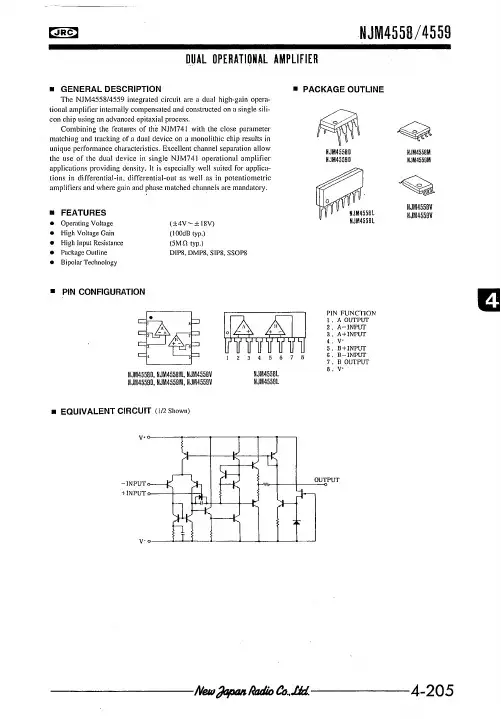
NJM4558 替换型号X4558双极型线性集成电路
摘自:第一价值网(IC网络超市)
双运算放大器
简介
★X4558/E/L 内部包括有两个独立的、高增益、内部频率补
偿
的双运算放大器,适合于电源电压范围很宽的单电源使用,
也适用于双电源工作模式,在推荐的工作条件下,电源电
流与电源电压无关。
它的使用范围包括传感放大器、直流
增益模块和其他所有可用单电源供电的使用运算放大器的
场合。
★X4558/E/L 的封装形式为塑封8引线双列直插式或扁平贴
片封装。
特点
★内部频率补偿
★直流电压增益高(约100dB)
★单位增益频带宽(约1MHz)
★低输入偏流
★低输入失调电压和失调电流
★共模输入电压范围宽,包括接地
★差模输入电压范围宽,等于电源电压范围
★输出电压摆幅大(0至VCC-1.5V)
产品规格分类
产品封装
X4558 DIP-8-300-2.54
X4558E SOP-8-225-1.27
X4558L SIP-8-2.54
内部电路图和框图
极限参数:
电参数(除非特别说明,Vcc=15.0V,VEE=-15.0,TA=25℃)
封装形式:。


lm2904中文资料LM2439 视频信号输出集成电路LM2453 视频信号输出集成电路LM2577 稳压集成电路LM2595 直流变换集成电路LM270H 自动增益及静噪控制集成电路LM2808N 伴音中频放大、鉴频及功率放大集成电路LM2904 双运算放大集成电路LM3065N 伴音中频放大、鉴频及前置放大集成电路LM3089 调频中频放大集成电路LM311N 电压比较运放集成电路LM317T 三端电源稳压1.5A集成电路LM324 四运算放大集成电路LM324M 四运算放大集成电路LM3361 解调集成电路LM33T 三端电源稳压-26V集成电路LM358 双运算放大集成电路LM358PS-T1 双运算放大集成电路LM3656 伴音中频放大、鉴频及前置放大集成电路LM377 双声道音频功率放大集成电路LM378 双声道音频功率放大集成电路LM380 场扫描输出集成电路LM381 运算放大集成电路LM382 宽带放大集成电路LM384 音频功率放大集成电路LM386 音频功率放大集成电路LM387 宽带放大集成电路LM3875T 音频功率放大集成电路LM3886 音频功率放大集成电路LM3915 发光二极管十位显示驱动集成电路LM399 基准稳压集成电路LM4500A 调频立体声解码集成电路LM4610 音调、音量、平衡调节集成电路LM4765 双声道音频功率放大30W×2集成电路LM741CN 运算放大集成电路LM79052 三端电源稳压-5.2V/1A集成电路LM8915N 显示驱动集成电路LN5241RA89 显示驱动集成电路LP62S512AX-70LLT 存储集成电路LPUVCP-96 端口功能扩展集成电路LR37632 伺服集成电路LR381641 主轴、字符控制集成电路LS0072 变音集成电路LSC4350 屏幕显示控制集成电路LSC4584P2 屏幕显示控制集成电路LT1074 开关电源稳压集成电路LT1109 升压稳压集成电路LTC1147 直流变换集成电路LTC1148 直流变换集成电路LTV1817 光电耦合集成电路LUKS-5140-M2 微处理集成电路LV1011 人工智能处理集成电路LV1100 音频信号处理集成电路LVA501 视频信号处理集成电路LVA521 制式切换集成电路M11B416256A 存储集成电路M1418VVW 微处理集成电路M2063SP 制式转换集成电路M208 系统控制集成电路M24C08 存储集成电路M24C128-WMN6 存储集成电路M27V201-200N6 中文字库集成电路M28F101AVPAD 存储集成电路M3004LAB1 红外遥控信号发射集成电路M32L1632512A 存储集成电路M34300-012SP 微处理集成电路M34300-628SP 微处理集成电路M34300M4-012SP 微处理集成电路M34300N4-011SP 微处理集成电路M34300N4-012SP 微处理集成电路M34300N4-555SP 微处理集成电路M34300N4-567SP 微处理集成电路M34300N4-584SP 微处理集成电路M34300N4-587SP 微处理集成电路M34300N4-628SP 微处理集成电路M34300N4-629SP 微处理集成电路M34300N4-657SP 微处理集成电路M34302M8-612SP 微处理集成电路M37100M8-616SP 微处理集成电路M37102M8-503SP 微处理集成电路M37103M4-750SP 微处理集成电路M37201M6 微处理集成电路M37204M8-852SP 微处理集成电路M37210M2-609SP 微处理集成电路M37210M3-010SP 微处理集成电路M37210M3-550SP 微处理集成电路M37210M3-603SP 微处理集成电路M37210M3-800SP 微处理集成电路M37210M3-901SP 微处理集成电路M37210M3-902SP 微处理集成电路M37210M4-650SP 微处理集成电路M37210M4-688微处理集成电路M37210M4-705SP 微处理集成电路M37210M4-786SP 微处理集成电路M37211M2-604SP 微处理集成电路M37211M2-609SP 微处理集成电路。