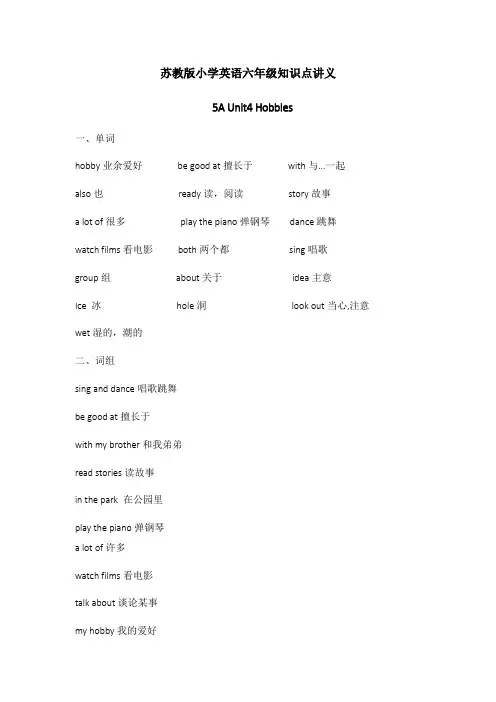
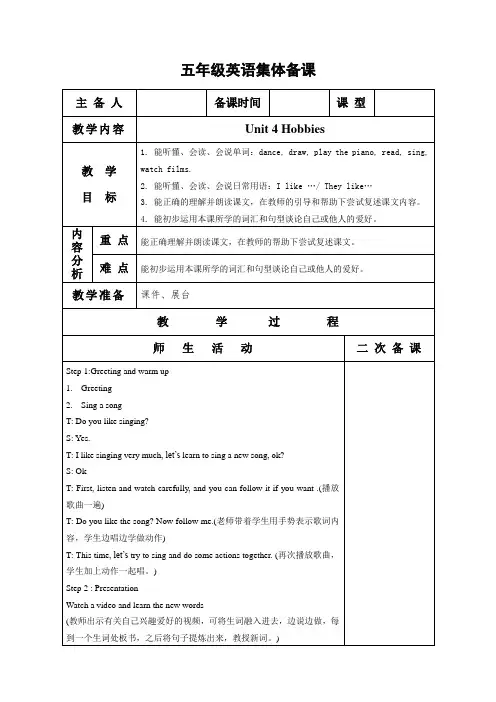
苏教版英语五年级上册unit4知识点归纳
- 格式:pdf
- 大小:489.80 KB
- 文档页数:4
1 Unit 4 Hobbies
结合四年级上册unit4的话题,结合学生喜爱的颜色(三上U6)、科目(四下U1)、动物(四上U1)、季节(四下U5)、食物(四上U2)、玩具(四上U8)等词汇。 教学目标 1. 能听懂、会说、会读单词 hobby, with, also, play the piano, watch the films, both, group, about, idea, ice, hole, wet.
2. 能听懂、会说、会读、会写单词 be good at, read, story, a lot of, dance, sing. 3. 能听懂、会说、会读、会写句型I/We like doing... She/He likes doing... Look out! 4. 能知道字母y在单词中的读音/j/。 5. 能唱歌曲《We all like climbing》 教学重点: 1. 句型:I/We like doing... She/He likes doing... 2. 词汇:be good at, read, story, a lot of, dance, sing. 3. 语音:字母y在单词中的读音。 教学难点: 1. 句型:be good at, read, story, a lot of, dance, sing. 2. 词汇:be good at, read, story, a lot of, dance, sing等词的读音和拼写。 3. 语音:字母y在单词中的读音。 单元知识详解
1、有关兴趣爱好的单词 going swimming
(去游泳) going shopping
(去购物) reading books
(看书) Playing computer games
(玩电脑游戏) playing
football(踢
足球) Watching TV
(看电视) growing flowers
(浇花) eatting food
(吃食物) Playing basketball
打篮球 traveling
旅游 traveling
旅游 reading
阅读 writing
写作 surfing the internet
上网 chatting
聊天
going hiking
去远足 go skating
去溜冰 making crafts
花工艺品 collecting stamps
集邮
2、like的用法 like的反义词dislike
to do… 表示一次性的,未发生的动作。 like +人/物
doing… 表示习惯性的经常性的喜欢做某事。★
☞知识扩展:动词+ing(动名词的变化规律) ▲一般情况下在动词后面加 ing. 如 going, reading, drawing, playing… ▲ 以不发音的字母e结尾的动词,去e再加ing. 如 skate → skating make → making dance → dancing write → writing have → having ride → riding come → coming
▲ 以“元音+辅音”结尾的重读闭音节单词,先双写辅音字母再加ing. 如 put →putting run-running swim → swimming jog → jogging sit → sitting 2 (1)like doing sth句式变化:
①肯定句:主语 + like(s) + doing +… 当主语是第三人称单数时,like后面要加s,如: I like singing. They like dancing. He likes playing basketball. She likes skating.
②否定句:主语 + don’t/ doesn’t + like + doing + ….,如: I don’t like singing. They don’t like dancing. He doesn’t like playing basketball. She doesn’t like skating.
③一般疑问句:Do/ Does + 主语 + like + doing + …? 如: Do you like sing? Do they like dancing? Does he like playing basketball? Does she like skating?
④特殊疑问句: 疑问词 + do/ does + 主语 + like + doing + …? 如: What do you like? What do they like doing? What does he/she like (doing)?
句型练习: My name is Si Qian. I have a lot of hobbies. I like _________(draw) and ________(play) the piano. I like _________(fish) and __________(shop), too. But I don’t like _________(listen) to
music or _________(dance). I have a good friend. Her name is Petch(佩奇) . She ________ (like) ________ (play) basketball and _________(have) a picnic. She __________(not like) __________(paint) or ___________(run).
例句:【2018无锡市统考五年级下】He likes playing football. 词句考点:①人称代词 ②动词的三单形式 ③like的用法 【2018无锡市统考五年级下】The girl on the shoes,but it fit her. A tries;isn’t B try;isn’t C tries;doesn’t
3、be good at (擅长,在……方面做得好)的用法 +名词 Iam not good at football. be good at +代词 He is good at it. +动名词(ing) Iam not good at playing football.
☞知识拓展 ①be good for +动词原形。 对……有用(益) 例句:Practice is good for health ②be good to +人/名词。 对……好(和善、慈爱) 例句:My mother is good to me. 4、too, also和either的区别 A. He likes playing football too. 他也喜欢踢足球。 B. She also like playing the piano. 她也喜欢弹钢琴。 C. Don’t be sad, Bobby. I can’t fly either. 别伤心。我也不会飞。(4A Unit4)
以上三个句子中too, also, either三个单词都有“也”意思,但在句子中的用法有所不同。 ①too 是个常用词,多用于口语,语气较随便。一般用在肯定句中,放在句末,或作为插入语放在句中。如: I'm a student, too.我也是个学生。 She,too,is a singer.她也是一位歌唱家。
② also 是比较正式的用语,语气较庄重。它经常放在句中,位于行为动词之前;位于系动3 词, 助动词或情态动词之后。如: Mrs Green can also sing the song in Chinese.格林夫人也能用汉语唱这首歌。 They also have fish shops in that small town.那个小镇上也有鱼店。
③ either 表示“也”时一般只用于否定句,且只置于句末。(unit 3已学习either与or连用也可用于肯定句)如: I don't know him.Tom doesn't know him,either.我不认识他,汤姆也不认识他。 He doesn’t have apples. She doesn’t, either. 他没有苹果,她也没有。
5、课本例句 :A: I like playing basketball. B:She also likes playing the piano.
A句中,play后面不跟the, B句中,play后面跟the。
(1)作及物动词的play play 用作及物动词时的含义较多,用法也不尽相同。
① 表示“玩”,后接“牌、游戏、棋类”等名词。此时这些名词前不用冠词。如: Many people like playing cards. 很多人喜欢打牌。 Don’t play chess in the classroom. 不要在教室里下象棋。
②表示“打(踢)球”、“参加(体育活动、比赛)”等。此时表示球类名词前不加冠词。如: Can you play football? 你会踢足球吗? Let's go and play table tennis. 让我们一起去打乒乓吧。
③表示“吹、拉、弹、演奏”,此时乐器名词前要加定冠词。如: He can play the piano. 他会弹钢琴。 She likes playing the violin after school. 她喜欢在放学后拉小提琴。
(2)作不及物动词的play play用作不及物动词,常和介词with相连,表示“玩”、“玩耍”。如果说play的“玩”是
进行比较正规的文体活动,那么play with的“玩耍”就是表示进行非正规的游戏,尤指小孩利用玩具或其他东西来娱乐。如: The little boy can play with a yo-yo. 这个小男孩能玩溜溜球。 Don't play with fire. It's very dangerous. 别玩火,那很危险。
6、She likes reading stories.
▲注意动词的三单形式和名词的复数形式之间的区别。 7、both 、all、each、either、neither之间的区别(不定代词)
(1)both、all、each的区别 ①both表示“两者都”,是对两者的肯定。both…and… 不但…而且…。其反义词是neither。 ②all指两者以上的人或事。 ③each指“每一个”,着重于个别情况。 【2017年梁溪区小学五年级期末】My parents and I like playing cards. A all B both C also
(2)either、neither、both的区别 both是对两者的肯定;either是对两者之一的肯定;neither表示对两者的否定。 8、on the ice和in the ice的区别(on+面; in+体) A. Sam and Billy skate on the ice. B. There is a hole in the ice.