
earthquakes
- 格式:ppt
- 大小:8.10 MB
- 文档页数:44

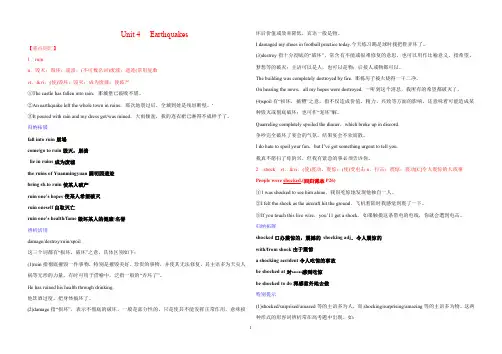

unit4 Earthquake(知识点)Unit 4: EarthquakesIntroduction:Earthquakes are natural disasters that occur when there is a sudden release of energy in the Earth's crust, causing the ground to shake. They can cause widespread destruction and lead to loss of life. In this unit, we will explore various aspects of earthquakes, including their causes, effects, and ways to mitigate their impact.I. What Causes Earthquakes?Earthquakes can be triggered by several factors, but the majority of them occur due to the movement of tectonic plates. As the Earth's crust consists of several large plates that float on the semi-fluid asthenosphere, their constant motion can create stress and tension. When the stress becomes too high, it is released in the form of seismic waves, causing an earthquake.II. Types of Earthquakes:1. Tectonic Earthquakes:- These are the most common type of earthquakes and occur at plate boundaries.- There are three main types of plate boundaries: divergent, convergent, and transform.- Divergent boundaries occur where plates move apart, while convergent boundaries occur where plates collide. Transform boundaries occur where plates slide past each other horizontally.- The intensity and magnitude of tectonic earthquakes vary depending on factors such as the type of boundary and the amount of accumulated stress.2. Volcanic Earthquakes:- Volcanic activity can also lead to earthquakes.- When magma rises to the surface, it can cause the surrounding rocks to crack, resulting in volcanic earthquakes.- These earthquakes are usually localized around the volcano and are associated with volcanic eruptions.3. Induced Earthquakes:- Human activities can sometimes trigger earthquakes.- Activities such as mining, reservoir-induced seismicity (due to filling of large reservoirs), and hydraulic fracturing (fracking) can induce seismic events.- Induced earthquakes may occur in areas where the Earth's crust is already under stress.III. Earthquake Effects:1. Surface Effects:- Shaking of the ground during an earthquake can cause various surface effects.- Buildings and infrastructure may collapse or suffer severe damage, leading to injuries and loss of life.- Landslides, ground cracks, and changes in the landscape can also occur.2. Secondary Effects:- Earthquakes can trigger secondary effects such as tsunamis, which are large ocean waves generated by the displacement of water.- Fires may break out due to damaged electrical systems or ruptured gas pipelines.- The movement of the ground can also lead to liquefaction, where saturated soil temporarily loses its strength and behaves like a liquid.IV. Mitigating Earthquake Impact:1. Preparedness:- Education and public awareness are crucial for earthquake preparedness.- Communities should have disaster response plans, evacuation routes, and emergency supplies in place.- Conducting regular drills and training sessions can help people understand the appropriate actions to take during an earthquake.2. Building Design:- Constructing buildings and infrastructure that can withstand seismic forces is essential.- Engineers use various techniques, such as base isolation and dampers, to reduce the impact of earthquakes on structures.- Building codes and regulations should be followed to ensure safety standards are met.3. Early Warning Systems:- Advances in technology have made it possible to develop early warning systems for earthquakes.- These systems can detect initial seismic waves and provide a few seconds to minutes of warning before the more destructive waves arrive.- Early warning can help prompt evacuations and give people time to take cover.Conclusion:Earthquakes are powerful natural phenomena that can have devastating consequences. By understanding their causes, effects, and implementing effective mitigation strategies, we can work towards minimizing the impact of earthquakes and protecting lives and infrastructure. Increased public awareness and preparedness are vital in ensuring resilience against these unpredictable yet recurring events.。

人教版高中英语必修第一册 《Unit 4:Earthquakes》教案一、教学目标1.知识目标o学生能够掌握与地震相关的重点词汇和短语,如 “earthquake, ruin, destroy, rescue, shock” 等。
o学生能够理解并运用描述地震现象、危害和救援的句型和表达方式。
2.技能目标o学生能够听懂有关地震的简单对话和新闻报道,获取关键信息。
o学生能够阅读并理解关于地震的文章,分析文章结构和主旨。
o学生能够用英语简单讲述地震的相关知识和个人应对地震的措施。
o学生能够写一篇关于地震预防或救援的短文,表达自己的观点和建议。
3.情感目标o培养学生对自然灾害的认识和防范意识。
o激发学生的同情心和社会责任感,关注地震受灾地区和人群。
二、教学重难点1.教学重点o重点词汇和短语的记忆与运用。
o对课文中地震相关内容的理解和语言表达的学习。
o培养学生用英语描述地震和表达应对措施的能力。
2.教学难点o如何帮助学生理解地震的复杂科学原理和巨大危害,并能用英语进行准确描述。
o引导学生在写作中清晰、有条理地阐述地震预防或救援的观点和建议。
三、教学方法1.直观演示法:通过图片、视频等展示地震的场景和数据。
2.问题引导法:以问题为导向,引导学生思考和探究。
3.讨论交流法:组织学生讨论地震相关话题,促进学生之间的思想交流。
四、教学过程(一)导入(5 分钟)1.播放一段地震的视频片段,展示地震的破坏力。
2.提问学生:What do you see in the video? How do you feel about earthquakes?(二)词汇学习(10 分钟)1.呈现本单元的重点词汇和短语,结合地震的情景进行讲解。
2.通过词汇练习,如填空、选择等,巩固学生对词汇的理解和掌握。
(三)阅读前准备(5 分钟)1.让学生观察课文标题和图片,预测文章的主要内容。
2.提出一些引导性问题,如:What might the article talk about earthquakes?(四)课文阅读(15 分钟)1.学生快速阅读课文,概括文章的主旨。