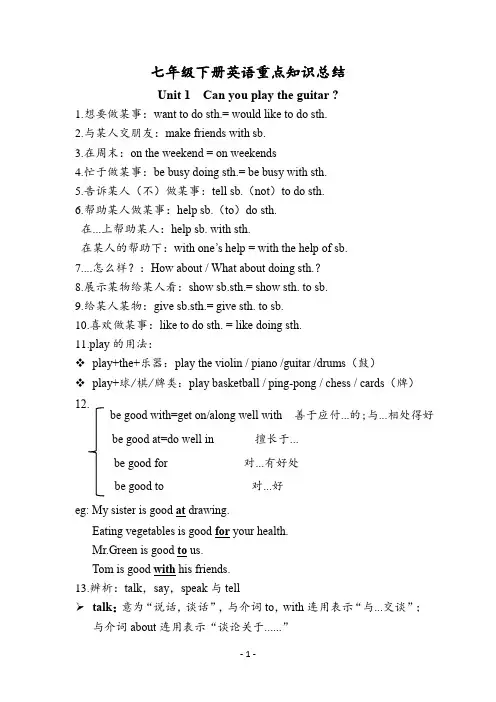
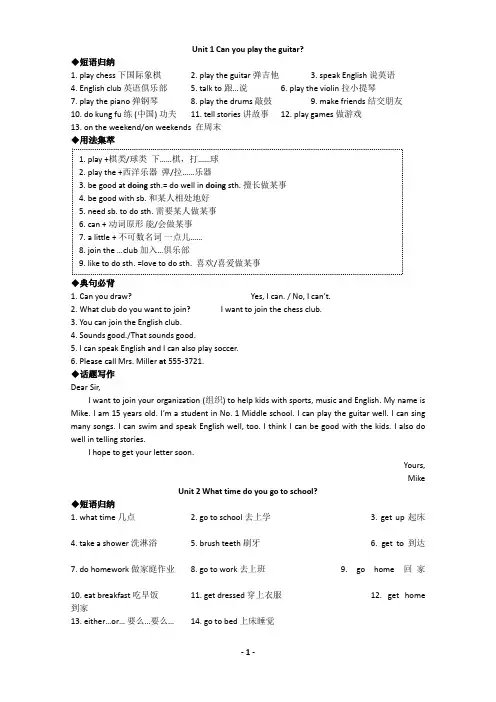
初一至初三全程英语知识点总结及练习
- 格式:doc
- 大小:509.00 KB
- 文档页数:46
I.
1. Sit down
2. on duty 3. in English
4. have a seat 5. at home
6. look like 7. look at
8. have a look
9. come on 10. at work 11. at school 12. put on
13. look after 14. get up
15. go shopping
II.
1. help sb. do sth.
2. What about ?
3. Let ’ s do sth.
4. It ’ s time to do sth.
5. It ’ s time for
6. What ’ s ? It is / It ’ s
7. Where is? It ’ s .
8. How old are you? I ’ m .
9. What class are you in?
I ’ m in .
10. Welcome to .
11. What ’ s plus ? It ’ s .
12. I think
13. Who’ s this? This is .
14. What can you see I can see .
15. There is (are) .
16. What colour is it (are they)? It ’ s (They ’ re)
17. Whose is this? It ’ s .
18. What time is it? It ’ s .
III.
1. Good morning, Miss/Mr .
2. Hello! Hi!
3. Nice to meet you. Nice to meet you, too.
4. How are you? I ’ m fine, thank you/thanks. And you? 5. See you. See you later.
6. Thank you! You ’ re welcome.
7. Goodbye! Bye!
8. What ’ s your name? My name is .
9. Here you are. This way, please.
10. Who ’ s on duty today? 11. Let ’ s do.
12. Let me see.
IV. 重要语法
1. 动词 be 的用法;
2. 人称代词和物主代词的用法;
3. 名词的单复数和所有格的用法;
4. 冠词的基本用法;
5. There be 句型的用法。
【名师解说】
1.in/on
在表示空间地点时, in 表示在某个空间的范围以内, on 表示在某一个物体的表面之上。
比如: There is a bird in the tree. 树上有只鸟。 There is a picture on the wall. 墙上有张图。
2. this/that/these/those
(1)this
常常用来指在时间、地址上更靠近发言人的人和事,
these
是
this
的复数形式。
that
常常用来指在时间、地址上离发言人更远一点的人和事,
those 时
that
的复数形式。比如:
You look in this box and I ’ll look in that one over there. 你看看这个盒子, 我去看那处的那个盒子。
I want this car, not that car. 我想要这辆小汽车,不是那一辆。
Take these books to his room, please. 请把这些书拿到他房间去。
This is mine; that ’ s yours. 这个是我的,那个是你的。
These are apples; those are oranges. 这些是苹果,那些是橘子。
(2) 在打电话的用语中, this 常常指的是我, that 常常指的是对方。比如:
This is Mary speaking. Who ’ s that? 我是玛丽。你是谁?
3. There be/ have
There be " 有 " ,其切实含意为 " 某处或某时存在某人或某物。 " 其构造是: There be + 某人或
某物 + 表示地址或时间的状语。 There be 后边的名词其实是主语, be 动词的形式要和主
语在数上保持一致, be 动词后边的名词是单数或不行数名词时用 is,名词是复数时用 are。
比如: (1) There is a big bottle of coke on the table. 桌上有一大瓶子可乐。
(2) There is a doll in the box. 那个盒子里有个娃娃。
(3) There are many apples on the tree. 那树上有很多苹果。
总之, There be 构造重申的是一种客观存在的 " 有 " 。 have 表示 "拥有,据有,拥有
人有某物 (sb. have / has sth.)。主语一般是名词或代词,与主语是所属关系。比如:
" ,即:某
(4) I have two brothers and one sister. 我有两个兄弟,一个姐姐。 (5) That house has four rooms.那所房屋有四个房间。
4. look/ see/ watch
(1)look 表示“看、瞧” ,侧重指仔细看,重申看的动作,表示存心识地注意看,但不必定看到,以提示对方注意。 ,如:
Look! The children are playing computer games. 瞧!孩子们在玩电脑游戏。
Look! What ’ s that over there? 看!那处那个是什么?
独自使用是不及物动词,如重申看某人 /物,此后接介词 at,才能带宾语,如:
He’ s looking at me 。他正在看着我。
(2)see 重申“看” 的结果, 侧重的是 look 这个动作的结果, 意思是 “看到”,see是及物动词,
后边能直接跟宾语。如:
What can you see in the picture? 你能在图上看到什么?
Look at the blackboard. What did you see on it? 看黑板!你看到了什么?
(3)watch “观看,凝视” ,重视于场面,表示聚精会神地观看、察看或凝视某事务的活动,重申过程,常用于“看电视、看足球、看演出”等。如:
Yesterday we watched a football match on TV. 昨天我们从电视上看了一场足球竞赛。
4. put on/ / in
put on
意为“穿上,戴上” 。主要指“穿上”这一动作
, 后边接表示服饰、鞋帽的名词。
in 是介词,表示“衣着”重申状态。在句中能够做定语、口号和状语。如:
It ’ s cold outside, put on your coat. 外面冷,穿上你的外套。
He puts on his hat and goes out. 他戴上帽子,走了出去。
The woman in a white blouse is John ’ s mother.穿白色衬衣的那个妇女是
5. house/ home/family
John 的妈妈。
house :“房屋”,指居住的建筑物 ; Home: “ 家”,指一个人同家人共同常常居住的地方 ; Family:
“家庭 “,“家庭成员” 。比如: Please come to my house this afternoon. 今日下午请到我家来。 He is not at home. 他不在家。 My family all get up early. 我们全家都起得很早。
6. fine, nice, good, well
四者都可用作形容词表示 "好 "之意,但前三者既可作表语又可作定语,尔后者仅用作表语。
主要差别在于:
(1) fine 指物时表示的是质量上的 " 精美 " ,形容人时表示的是 "身体健康 " ,也 能够用来指 " 天气明朗
"。比如: Your parents are very fine. 你父亲母亲身体很健康。
That's a fine machine.那是一台很好的机器
It's a fine
day for a walk
today.今日是漫步的好时
候。
(2)nice 主要重视于人或物的表面,有 "美好 ", " 美丽 "的意思,也可用于问候或赞誉他人。
比如: Lucy looks nice. 露西看上去很美丽。 These coats are very nice. 那些裙子很美丽。
Nice to meet you. 见到你很快乐。 It's very nice of you. 你真好。
(3)good 形容人时指 "道德好 ",形容物时指 " 质量好 " ,是表示人或物各方面都好的一般用语。
比如: Her son is a good student. 她儿子是一个勤学生。
The red car is very good. 那辆红色小汽车很好。
(4)well 只可用来形容人的 " 身体好 ",但不可以作定语, 它也能用作副词作状语, 多放在所修饰的动词以后。比如: I'm very well, thanks. 我身体很好,感谢。
My friends sing well. 我的朋友们歌唱得好。
【考点扫描】
中考考点在本单元主要集中在: