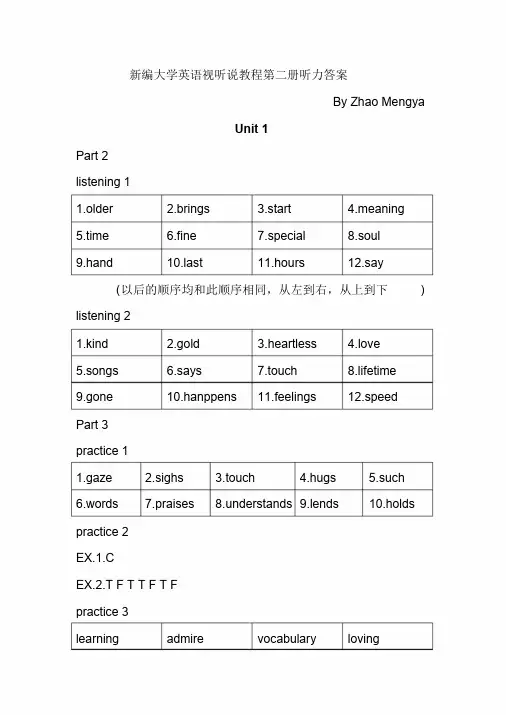
新编大学英语视听说教程第二册听力答案By Zhao MengyaUnit 1Part 2listening 11.older2.brings3.start4.meaning5.time6.fine7.special8.soul9.hand st 11.hours 12.say(以后的顺序均和此顺序相同,从左到右,从上到下) listening 21.kind2.gold3.heartless4.love5.songs6.says7.touch8.lifetime9.gone 10.hanppens 11.feelings 12.speed Part 3practice 11.gaze2.sighs3.touch4.hugs5.such6.words7.praises8.understands9.lends 10.holds practice 2EX.1.CEX.2.T F T T F T Fpractice 3learning admire vocabulary lovingrelationships connections expriences remembering proud try body expressions willingness fears pace bestjokes foundness laugh withpractice 4EX.1.DEX.2.unsuccessful failed dreamed ofrelationshipswords action men naturalPart 4Section 1 1 2 3 5 7 8 9 11Section 2 C B A B A C C BSection 3perfect half full ashamed failure apologized house side flower watered pickneedsUnit 2Part 2Listening 1EX.1.F T F F TEX.2.skin local hospital eat skin trouble waiting for a big done all her shopping her shopping basket listListening 2EX.1.British American Englishsound words and expressions grammarconfusing different understandable eachEX.2.BE: 1 4 6 8 9 11 13 16AE:2 3 5 7 10 12 14 15Listening 3EX.1.F T T F TEX.2.Problem:left outExamples:MEN HIS MEN-madeConsequences:mental image female females malesPart 3Practice 1EX.1.F T F F TEX.2.refused hire a dog pointed outa letter writing a program running itperfectlyPractice 2EX.1.Mandarin Zhang Smith Oxford English DictionaryEX.2.B A B B C D A C A DPractice 3EX.1. T F T T T TEX.2an American fluent English misseseducationnice little things walking the dog weather snowy sunshineboots umbrella a big smile Practice 4EX.1 T F F F F Tsmall pie pine big smallpint half German warm Englishbrownpacket of in the fried crispsevening potatoesPart 4Section 1difficult frustrating rawardingpeople places ideasculture live similarities differences beliefs attitudesSection 2 F F T F F F F TSection 3At an Little boys use conversation Little girls` early age to establish status with their conversation is less sisters. definite andexpresses moredoubts.In publicconversations,men Intalk more and interrupt otheradulthoodspeakers more.Men consider private talking Women consideras a way to explore the power private talking as astrusture of a relationship. way to establish andtest intimacy.When a man teaches a When a womanwoman,he wants to show that teaches anotherhe has more knowledge,and woman,she is morehence more power in likely to take aconversation. sharing approachand to encourageher student to joinin.Unit 3Part 2Listening 1EX.1. 22 died 4 9 12 12 last 3Listening 2go on song true love see believesky fly away open door silence achieveListening 3To come in and have something to eat.Because the men of the house wasn`t at home. Wealth,Success and Love.Wealth.Success.To invite Love to come in.Love.Love,Success and Wealth.Part 3Practice 1 EX.1 C B A B DPractice 2EX.1.authority behaviour timid twenty-six-year assistant most recent studies EX.2.T F F F FPractice 3EX.1. 3 5 6 7 EX.2. A B D C D Practice 4EX.1. 1782 1795 1802EX.2. 1 3 5 6 8 9 10Part 4Section 1 D C B A C BSection 2 T F T T F T F FSection 3seventh encouraged performed amused natural musical form DespiteUnit 4Part 2Listening 1EX.1. F T T F F FEX.2.prison do the planting ten daysthe money the plant the potatoesgunListening 2EX.1. 5EX.2.the lift service engineers Adding more lifts faster ones too expensive psychologist Placing lots large simple inexpensivemirrorPart 3Practice 1EX.1.T T F F TEX.2.office discussion Immediately long describing wrongs over shoulders minutes satPractice 2EX.1. B FEX.2.Cultural preference Economic factorsPsychological space needsChoice of number of How closely the family bedrooms gathers together EX.3.T F F T TPractice 3EX.1. color brain message red exciting signal meaningEX.2.Color Effect FunctionBlue Peaceful Calming nervesCreating focused Orange Joyousactivity Aiding in Yellow Cheerfuldisicion-making White Reflective Enhancing brain power Violet Creative Increasing intuitiveness Enlivening tired green Relaxedmuscles Practice 4EX.1.Noise how nice Two BooksPassers-by student OnevolunteerEX.2Setting 1 Noise Level Normal LoudA person would Normal 20% of the 10% helped. see a manexperimenter passers-bycarrying two stopped toboxes filled with help.books.As theExperimenter 80% helped. 15% helped. person came wearing acloser,the bookcast on hiscarrier dropped armseveral books.Setting 2 Noise Level Normal LoudA student Results 75% of the 37.5% volunteer waited students helped.in a room before helped.being called forExplanation Noise is distraciing,so the the experiment he 1 students didn`t notice and expected. The respond as quickly to the experiment book-dropping.waited in theExplanation The book-dropping further same2 annoyed the students already room,holdingirritated by the noise,making some books. Hethem less likely to help out. dropped some ofthem.Part 4Section 1identify achievement parties personalitiescenter crowd unitygetting along with friendly caring plannedstructured a few friends A big groupSection 2Part 1American history $64,000 the best guest missed aquestionsecond easier play it safePart 2 F T F T FSection 3Part 1 T T F F FPart 2In support stress level heartrate blood pressure close relationshipsUnit 5Part 2Listening 1EX.1. B A C D B CEX.2.at rest slows down slowlittle inactive rises increasesstill inactive active active move rapidlyListening 2EX.1. 1 3 5 6 7 8EX.2. A C D BEX.3.strange strange force very steepat the bottom watching be punishedin the darkness scared avoidexam interpreting dreams disappointing making mistakes symbolPart 3Practice 1EX.1. D C B D EX.2. T F T F F TPractice 2parting wrong dream night none seem shore sand fingers grasp save wave Practice 3EX.1. N Y Y N N Y EX.2 A C B C A CPractice 4EX.1. 1-C 2-A 3-I 4-H 5-F 6-D 7-J 8-GEX.2. 1.Because dreams are closely related to waking lives.2.more women have careers3.The possible reason is that they are making important decisions about carreer.4. solve problems5.Biological conditioning and soucial conditioning,life stages and attitudes.Part 4Section APARTA E G D A F C H BPARTB C A B D B D CSection BPARTA T F F T F TPARTBpushing awayfriend`s house burned to deaththe dead In front ofkids` minds making moneySection CPART A A C D B CPART B Y Y N Y N N Y YUnit 6Part 2Listening 1EX.1B D A C BEX.2226 7:30orange grapefruitbacon,eggs,tomato solf-boiled eggstoast,butter lemon teaListening 2EX.1.1. take out ,cardboard,plastic,plastic tight-fitting2.board,menu,order,microphone,20 yards3.knives,forks,everything ,trayEX.2.F T F F TPart 3Practice 1EX.1.T F T F T T EX.2.B C C A CPractice 2EX.1. F T T F TEX.2.900 1493 corn,sweetpotato,pineapple realize,full exercise,perform,better,burnsPractice 3EX.1C A B DEX.2.T F T F TPractice 4EX.1.B C E FEX.2 1.Television.2.A sailer.3.Meat and potatoes.4.Biscuits,cake and chips.5.To make them look good.6.Excellent7.One can remain healthy without meat.8.Opposed but tolerant.Part 4Section aPARTA T F F T TPARTB D C C B BSection bPARTA 1 2 4 6 7 9 10 11 12PARTB 1 2 7 11Section cPARTA T F T F T TPARTBforeign aware, very good time,effort owners,foreign foodslower,a hurry shopping,sightseeingUnit 7Part 2Listening 1Ex.1. f f t t t f f fEx.2 1.cold open outing 2.overpowering friendly6.long time for lifecent country loud behaviour l anguage8.closer distanceListening 2Ex.1.C D A B CEX.2. 1.lost 2.India 3.stay pare 5.water 9.spoil 7.sugar 8.stayPart 3Practice 1Ex.1. B A D C AEX.2. F F T F FPractice 2Ex.1. 4 7 6 1 3 8 2 5Ex.2 F F T F FPractice 3Ex.1. E B G A D F CEX.2 1.European 2. 1:00 p.m. 4:30 p.m. 3.brown 10.party 5.standPractice 4Ex.1.1 2 5Ex,2, A C D A B DPart 4Section amatter leave share meetoffer Promptness invited delay especially normal surprised manners Section bPart a 1 3 5 7Part b T F F F T F T TSection cPart a C C B D D APart b T F F T F TUnit 8Part 2Listening 1Ex.1. A C D CEx.2. cashier punches account losing cashListening 2Ex.1. F T F T T TEx.2. no getting thought fun happiest punniless money peacePart 3Practice oneEx.1. 1.His allowance.2.Every Saturday.3.The father isn`t sure if he`s got enough money.4.A money jar.Ex.2.F F T T FPractice 2Ex.1. island boring asleep working rob police Ex.2 1.Working in a big office with a computer.6.Because he stole money from the company he was working for .11.He was in the newspaper that a man was wanted by the police because of stealing money from the company.Practice 3Ex.1. D C B DEx.2. shivering desire check price invitation performPractice 4Ex.1. C B A D AEx.2 1.Two blocks away. 2.$30.7.Because he has a sick wife and four hungry children.8.Yes.About $25.Part 4Section aPart a T T F F T TPart b Week Million sick alarm awaySection bPart a F T F T F FPart b 5 35 excellent countingSection cPart a 50 85 175,000 3,000 200,000Part b C B A CUnit 9Part 2Listening 1Ex.1.B C D C BEx.2 leather 1,450 tight cheaer 2.3 wholemeal 57 seedsListening 2Ex.1 At Your Service give advice (01)2468041 Jack Mlills Consumer Aid AssociationEx.2. T F T T F F F T F TPart 3Practice 1Ex.1 red twelve Pennsylvania Indiana something September Visa JK4096239Ex.2. 1.By telephoning W orldwide Flowers.2.Long-tern red roses and quite nice.9.10.Before 6 in the evening11.All my love,JimPractice 2Ex.1 T F T T FEx.2 milk white bread three or four Ready Quick Soupeggs soap peanut butter ice cream frozen corn Practice 3Ex.1. C C B C AEx.2.on sale $89.99 too expensive stereo heavy The sound headphonds carry it anywhere at home my kids $59.50 size stereo on sale $74.99 stereo PerfectPractice 4Ex.1 B B A A CEx.2 1.opposite,electrical goods,discount prices,9 till 6,the difference plus 5 pounds2.menswear and ladies` fashions,bargains,on August 8 at 9 o`clock3.energy-saving,feeling soft, looking snowing vhite,1pound note,washing powers,to savePart 4Section aPART A F T F T F FPART B 2 4 5 8 10 11 14Section bPART A F T F T FPART B repainted 6 blue 60,000 two airconditioning 6408Section cPART A T F F FPART B D C A E H G F BUnit10Part 2Listening 1Ex.2 ill sore throat headache wedding examination took examined chestprescribed four tenlistening 2ex.1.A C D Aex.2. F F F F F Tpart 3practice 1ex.1 beauty protect just five minutes an average of 10 points wind on your cheeksreduce stress favourite scene beach blue sky less anxiousex.2 fallen strolled missing health benefits reached outdoors disappeared or eventhinking so much being outdoors absorb stronger practice 2ex.1 D B C A B ex.2 3 4 7 8practice 3ex.1 ill spirits accomplishing ambitious mental ex.2 T N T F N T F N T Npractice 4ex.1 B A D B Cex.2 T T T T Fpart 4section awork friendship sincerity organize taking action faith happiness excellence difficulties tolerance praise lovesection bPART A B C C A D PART B F F T T FSection cPART A B C C D A PART B T F F T F T。