
牛津译林版高中英语Module 10 Unit 1 Word power教学课件
- 格式:ppt
- 大小:3.05 MB
- 文档页数:28
1 牛津译林版高中英语必修四
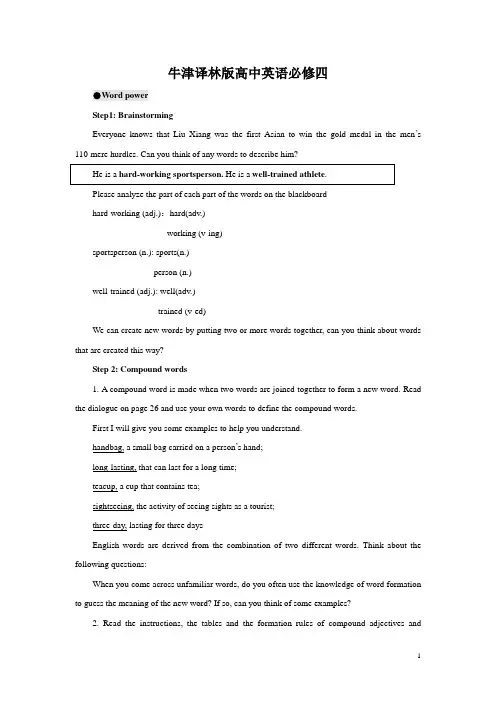
●Word power
Step1: Brainstorming
Everyone knows that Liu Xiang was the first Asian to win the gold medal in the men’s
110-mere hurdles. Can you think of any words to describe him?
He is a hard-working sportsperson. He is a well-trained athlete.
Please analyze the part of each part of the words on the blackboard
hard-working (adj.):hard(adv.)
working (v-ing)
sportsperson (n.): sports(n.)
person (n.)
well-trained (adj.): well(adv.)
trained (v-ed)
We can create new words by putting two or more words together, can you think about words
that are created this way?
Step 2: Compound words
1. A compound word is made when two words are joined together to form a new word. Read
the dialogue on page 26 and use your own words to define the compound words.
First I will give you some examples to help you understand.

探索尚未知道的东西
M8U4 Films and film events
Word power学案
第一部分:重点讲解
1. Not all films are made in ‘real’ places. When they are, they are shot on location, which
means that real streets, trees and buildings are used. (P54)
shoot (shot, shot)
v. [I or T] to use a camera to record a film or take a photograph:
We shot four reels of film in Egypt.
The film was shot on location in Southern India.
location
n. [C or U] a place away from a studio where all or part of a film or a television show is recorded:
The documentary was made on location in the Gobi desert.
not all 表部分否定,“不是所有的”
Not all the students are interested in the lecture about American culture.
=All the students are not interested in the lecture about American culture.
与not构成部分否定的词有: all everyone, everywhere, entirely, both, everybody, always, wholly,
M3U2 Language
Period 3 Word Power
一【设计思想】
通过区分正式和非正式英语及了解国家和它们的语言来以扩大学生的相关词汇量。
二【教学目标】
1. Know the names of some countries and their official languages.
2. Learn the differences between formal and informal English.
三【教学重难点】
1. Grasp some countries and their languages.
2. Recognize the flags of different countries and their languages.
四【教学环节】
【课堂导入】
Step1 Lead-in
【预习检查】
小组展示预习结果(预习过程中所划出的短语及句型)
【课堂教与学】
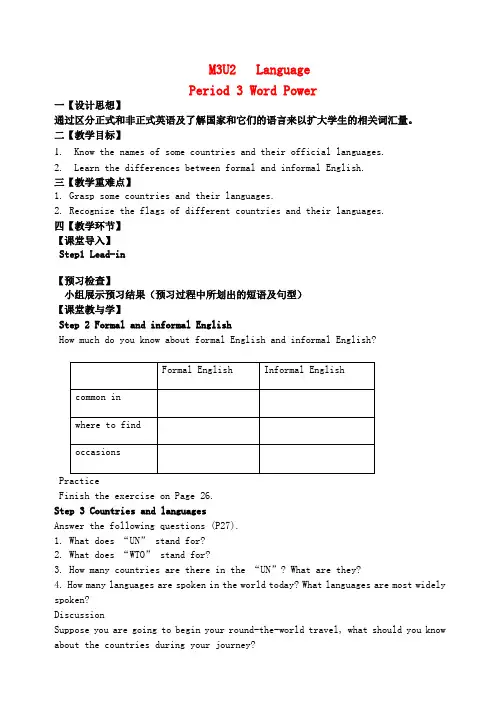
Step 2 Formal and informal English
How much do you know about formal English and informal English?
Formal English Informal English
common in
where to find
occasions
Practice
Finish the exercise on Page 26.
Step 3 Countries and languages
Answer the following questions (P27).
1. What does “UN” stand for?
2. What does “WTO” stand for?
3. How many countries are there in the “UN”? What are they?

1 单元教学设计
课题 AWE M10 U1 主备人 戚
敏
项 目 目 标 要 求
话 题 Building the future
语言知识 语音 Natural and fluent pronunciation and intonation
词汇 Short-term, long-term, rainfall, gravity, headline, politician, statesman,
wrestle, dilemma, agency, pregnant, beyond, loaf, permanent, irrigation,
framework, enterprise, housewife, problem-solving, conventional, ox,
tractor, dam, expense, weaken, squeeze, basement, creativity, catering,
adjustment, housing, grandchild, deposit, oilfield, solar, flour, tentative,
hopefully, systematic
Make the headlines, put pressure on, beyond doubt, at a crossroads,
work of art, catch up on, alarm bell, put sth. into practice, on top of,
push for, solar energy
语法 1. Linking words
功能 1. Describing social issues
2. Describing ways of reducing poverty