
七年级英语上册 Unit 6 Do you like bananas(第3课时)习题课件 (新版)人教新目标版
- 格式:ppt
- 大小:1.32 MB
- 文档页数:13
新目标英语七年级上册Unit6 Do you like bananas?课标解析
许晏菱初2014级
教材分析
本单元的主题是教会学生在日常生活中养成健康饮食的习惯。
整个单元以食物名词为主题,以一般现在时的like进行对话为途径,从听说读写等方面开展学习任务。
语法的重点是行为动词的一般现在时。
由于课文以对话展现,学生很容易地把生活中的情景和书上的对话以及文段比较自然地联合起来。
本单元的中心话题是Food,主要语言功能项目是Talk about likes and dislikes.当主语是第三人称单数时句型的变化以及回答是本单元的语法重点。
在第五单元学生已经对do and does 有了一定的认识。
本单元主要句型:Do you like…? 及其回答Yes, I do. / No, I don’t.学生就容易理解。
综上所述,本单元以食物为主线,围绕着谈论喜欢与不喜欢以及一日三餐等语言功能项目展开了一系列任务活动。
要求学生能够用英语写一篇介绍自己家人喜欢和不喜欢的食物,养成健康饮食的习惯。
单元教学安排
本单元分为5个课时,分别是sectionA两课时,sectionB两课时,一课时阅读课。
单元目标
课时目标
思想情感目标:
1)通过学习文章,学会养成健康饮食的习惯。
2)学习养成节约粮食,爱惜食物的品质。
能力发展目标:
1)能掌握书面表达的基本写法。
2)能正确使用可数名词和不可数名词。
3)能掌握一般现在时的结构、意义和用法。
Unit 6 Do you like bananas? 讲义一、【重点单词】banana /bə'nɑ:nə/香蕉hamburger /'hæmbɜ:(r)ɡə(r)/汉堡包tomato /tə'mɑ:təʊ/西红柿ice-cream /,aɪs'kri:m/冰激凌salad /'sæləd/沙拉strawberry /'strɔ:berɪ/草莓pear /peə(r)/梨milk /mɪlk/牛奶bread /bred/面包birthday /'bɜ:(r)θdeɪ/生日dinner /'dɪnə(r)/(中午或晚上吃的)正餐week /wi:k/周;星期food /fu:d/食物sure /ʃʊə(r)/当然;肯定;一定burger /'bɜ:(r)ɡə(r)/汉堡包= hamburgervegetable /'veʤtəbəl/蔬菜fruit /fru:t/水果right /raɪt/正确的;适当的apple /'æpl/苹果then /ðen/那么egg /eɡ/蛋;鸡蛋carrot /'kærət/胡萝卜rice /raɪs/大米;米饭chicken /'ʧɪkɪn/ji鸡肉so /səʊ/ (引出评论或问题)那么breakfast /'brekfəst/早餐;早饭lunch /lʌnʧ/午餐star /stɑ:(r)/明星;星星eat /i:t/吃well /wel/好;令人满意的habit /'hæbɪt/习惯healthy /'helθi/健康的really /'ri:əli/真正地question /'kwesʧən/问题want /wɒnt/需要;想要be /bi:/变成fat /fæt/肥的;肥胖的二、【重点短语】1. John ’s birthday dinner 约翰的生日宴会2. vegetable salad 蔬菜沙拉3. two tomatoes 两个西红柿4. eat well 吃得营养5. think about 考虑6. eat/have breakfast/lunch/dinner 吃早/午/晚饭7. sports stars 体育明星8. the volleyball star 排球明星9. ask sb. about sth. 问某人某事10. like hamburgers/ice-cream 喜欢汉堡包/冰淇淋11. like eating eggs 喜欢吃鸡蛋12. her eating habits 她的饮食习惯13. be (not) healthy (不)健康14. one last question 最后一个问题15. healthy food 健康食物16. after breakfast/lunch/dinner 早/午/晚饭后17.one last question 最后一个问题18.some fruit 一些水果19.for dinner 作为晚餐20.how about 怎么样三、【重点句型】1.—Do you like salad? 你喜欢沙拉吗?一Yes,I do. /No, I don’t. 是的,我喜欢。
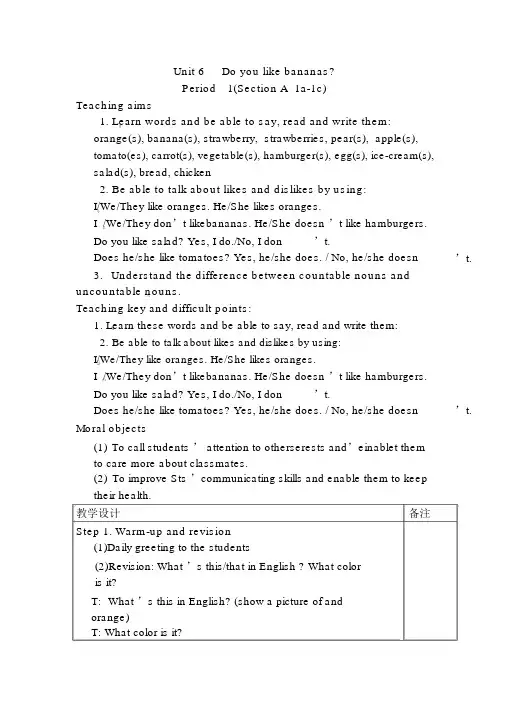
Unit 6Do you like bananas?Period 1(Section A 1a-1c)Teaching aims1. Learn words and be able to say, read and write them:orange(s), banana(s), strawberry, strawberries, pear(s), apple(s),tomato(es), carrot(s), vegetable(s), hamburger(s), egg(s), ice-cream(s),salad(s), bread, chicken2. Be able to talk about likes and dislikes by using:I/We/They like oranges. He/She likes oranges.I /We/They don’t likebananas. He/She doesn’t like hamburgers.Do you like salad? Yes, I do./No, I don’t.Does he/she like tomatoes? Yes, he/she does. / No, he/she doesn’t.3.Understand the difference between countable nouns and uncountable nouns.Teaching key and difficult points:1.Learn these words and be able to say, read and write them:2.Be able to talk about likes and dislikes by using:I/We/They like oranges. He/She likes oranges.I /We/They don’t likebananas. He/She doesn’t like hamburgers.Do you like salad? Yes, I do./No, I don’t.Does he/she like tomatoes? Yes, he/she does. / No, he/she doesn’t. Moral objects(1)To call students ’ attention to otherserests and’ei n ablet themto care more about classmates.(2)To improve Sts ’communicating skills and enable them to keeptheir health.教学设计备注Step 1. Warm-up and revision(1)Daily greeting to the students(2)Revision: What ’s this/that in English ? What coloris it?T:What ’s this in English? (show a picture of andorange)T:What color is it?Step 2. Presentation –New words.(1)Go on asking: What ’s this/that in English ? Whatcolor is it?T:What ’s this in English? (show a picture of anapple and if the student don’t know it, show thephonetic symbol of the word.)T: Spell it, please.S: A-P-P-L-E.T: What color is it?S: It ’s red.(Present the other three words as above: pear,strawberry, banana )T:We can call all of these things fruit . (Teach the newword “fruit ”.)Show pictures and ask the Ss “What arethese/those? ”and ask the SS to spell the pluralforms of these words: oranges, apples, pears,strawberries, bananas.(2)Repeat step (1) to present: carrot, carrots,tomato, tomatoes and vegetable, vegetables.(3)Present some more words by showing pictures. Get theSs to make an effort to pro nounce and spell the new words.Bread, hamburger ,hamburgers, milk, ice-cream,ice-creams, salad, chicken ,an egg, eggsWe can call all of these things food:食物3.Memory Challenge: Who has the best eyes?(1)Show the pictures, and say the plural forms of the nouns andsome uncountable noun.(2)Summarize. 可数名词有复数形式 , 不可数名词一般没有复数形式Step 3Presentation Target language 11. Show the pictures and say:I like tomatoes, but I don’ t like bread.2.Let students say:I like, but I don’t like ....3. Show the pictures and say:She likes bread, but she doesn’t like milk.He likes chicken, but he doesn’t like eggs.4.Let students say: He/She likes , but he/she doesn’tlike ....According Ss’answers and say:5. Sing a chant:Bananas, bananas, I like bananas! Salad, salad, I like salad!Strawberries, strawberries,I don ’t like strawberries!Pears, pears, he likes pears!Milk , milk, he likes milk!Tomatoes, tomatoes,He doesn ’t like tomatoes! Step 4 Work 1a .1. Read the words.2.T: Look at the pictures and fill in the chart .Fruit Food Vegetable3.Match the words with the things in the picture.4.Check the answers .Step 5 Present the new language 1 .1. T: Oh, we have lots of delicious fruits . I like apples best.Do you like apples ?S1 :Yes , I do. I like apples.S2: No, I don't . I like salad.T: Do you like salad ? S3: Yes , I do. I like salad./ No, I don't . I don’tlike salad.Step 6 Pairwork .1. T: Work in pairs .Ask and answer with your partners .(Before class the students have draw some pictures of the food )2. Get the Ss to ask and answer in pairs, using the sentences:’t.A: Do you like ?B: Yes, I do./ No, I don 3. When you ask andanswer, please fill in the chart. Name Like DislikeStep 7 Present the new language 2 .1.Show pictures and ask and answer questionsDoes she/he like ?Yes, she/he does. She/He likes/ No, she/he doesn ’t. She/He doesn ’tlike .Step 8 Pairwork .1. T: Work in pairs .Ask and answer with your partners .2.Get the Ss to ask and answer in pairs, using the sentences:Does she/he like ?Yes, she/he does. She/He likes/ No, she/he doesn ’t. She/He doesn ’tlike .3.According Ss’answers and ask “Do they like ? Yes, they do./ No, they don’t.”Step 9 Work on 1b.1.T: 1b. List en and number the conversations.2.Listen.3.Check the answers.4.Read after the tape.Step 10 work on 1c.1.First, practice the conversations in 1b.Then, make a survey and fill in the chart below.2. Report: I like milk and tomatoes, but I don’t like ice-cream. Mary likes oranges, but she doesn’liket milk orice-cream. Tom likes tomatoes and strawberries, but hedoesn ’ t like bread.Step 11 . HomeworkWrite down the report.Blackboard design:New Words Unit 6 Do you like bananas?Do you like?Yes , I do. I likeNo ,I don ’t. I don ’tlikeDoes she/he like ?Yes, she/he does. She/He likes/No, she/he doesn ’t. She/He doesn ’tlike.Period 2(Section A 2a-2d)Teaching aims:1. Words & expressionsBirthday, dinner, week, think about, food, sure, how/whatabout ? Burger, vegetable, fruit, apple, then2. Target languageI like strawberries, they’re delicious. Let’s have them.--Yes, I like them ,too./ No, I don’tlike them.I like salad, it ’s delicious. Do you like it?-- Yes, I do./No, I don’t but I likeice cream.Let ’ s have Let ’s think about the food.Ability goalsEnable students to talk about likes and dislikes.Learning ability goalsHelp students learn how to talk about likes and dislikes.2. Listening and speaking skills.Moral object:Learn to keep healthy.Teaching important / difficult pointsHow to talk about likes and dislikes with the target language.教学设计备注Step1 Warm up and revision.1.Everyday greeting.2.Review.Show the pictures and say the singularforms and the plural forms of the countable nouns.3.Show some pictures of the uncountable nouns.4.Summarize.(1).当可数名词复数再次出现时,用“They( 主语)或 them(宾语)”替代。