
3.后元音
- 格式:ppt
- 大小:4.65 MB
- 文档页数:46


第三节 后元音
/ɑ:/近音汉字 啊(à)
1. 发音要诀
(1) 发此音时,嘴巴尽量张大,舌后略为抬高,舌身放平向后缩,舌尖离开下齿,双唇自然张开.口腔肌肉绷紧,发长音。
(2) 这个音就像我们去看口腔科时医生让我们发的“啊”音一样。
(3) 在美式英语中,此音有时带儿化音(当音节中有字母r时),有时又被发成[ae]。
2. 常用见发音字母或组合
a _ last,glass ar _ tar,smart
al _ calf,behalf er _ clerk
au _ aunt ear _ heart
3.单词精读练习
(1)after ['ɑːftə] 之后 ask [ɑːsk] 问
(2)march [mɑːtʃ] 前进 class [klɑːs] 班级
(3)father ['fɑːðə]父亲 bark [bɑːk] 吠声
(4)fast [fɑːst]快速的 card [kɑːd]卡片
(5)hard [hɑːd] 硬的 pass [pɑːs] 通过
(6)banana [bə'nɑːnə] 香蕉 car [kɑː]汽车
(7)parcel ['pɑːs(ə)l]包裹 large [lɑːdʒ]大的
(8)mark [mɑːk] 标识 farm [fɑːm]农场
(9)last [lɑːst]最后 cast [kɑːst]演员表
(10)arm [ɑːm] 胳膊 bar [bɑː]酒吧
4.短语速读练习
(1)a large farm………………………大农场

单元音音标:后元音
主讲:黄冈优秀英语教师
周雪梅
一、Revision
1.复习三个中元音音标的发音:
2.朗读下列短语:
much money
hurry up
trust us
love each other
early bird thirsty girl turn over
a useful person
a cup of water a book about china brothers and sisters
a moral person
3.朗读下列句子:
She loves nothing but money.
You must come to have supper with us and join the fun.
Don’t trouble trouble until trouble troubles you.
I’m learning to put first things first.
The girl gave her a purse.
The teachers will get together tomorrow.
二、单元音音标:后元音
1.后元音
(1)发时,舌头置于口腔底部,舌后部略微抬高,口腔完全张开,但不呈圆形,口腔肌肉绷紧,发长音,这是音标中所需口型最大的音标,发音时停顿稍长,声带振动。
① 发音的字母与字母组合: a:ask last glass grass
ar:car far smart
al:calf behalf half
au:laugh
② 读短语和句子:
start the
bargain 开始议价
do harm to the heart 对心脏有害
He laughs best who laughs last.
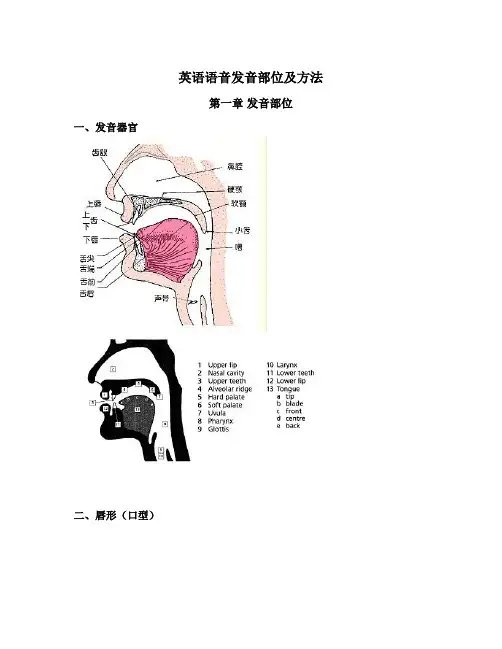
英语语音发音部位及方法
第一章 发音部位
一、发音器官
二、唇形(口型)
(1)双唇紧闭
(2)自然开口
(3)扁唇:微笑
(4)大圆唇:尽量张大口
(5)小圆唇:口型渐渐变小
第二章 元音(Vowel)发音方法
一、单元音 (Monophthong)
1. 前元音(4 Front Vowels)
1)/i:/——舌尖抵下齿龈,但不要抵得太紧。略略扁唇,像微笑的口型。发音时间略长。(Open your mouth just a little for the sound. Spread your lips into a smile. Push
your tongue forward in your mouth. It’s a long sound. Move your tongue up a little as
you say it.)
2) /I/(/i/)——先发/i:/,在此基础上,嘴角稍微收小一点,开口略大一点,舌尖靠近,但不要紧贴下齿龈,发音时间相对较短。(Open your mouth just a little more
for this sound. Don’t spread your lips into a smile. The sound is shorter, more relaxed
than /i:/.) 3)/e/(ε)——舌尖抵下齿龈, 不要抵得太紧。口略开,约可放入一个指尖。不扁唇,口型自然放松,发音时间相对较短。(Practice the sound /I/, then open your
mouth a little more for this sound. It is a short and relaxed sound.)
4)/æ/——舌尖抵下齿龈, 双唇尽量向两边张开,嘴角肌肉感到紧张。开口程度大,约可放入食指和中指交叠。不扁唇。(Practice the sound / e /, then open your

音标认读:
一、元音
前元音:[ i: ] [ i ] [ e ] [ æ ]
[ i: ]
音标特征: 前元音 舌位高 不圆唇 长元音
发音要诀: 舌前部抬得最高,牙齿近乎全合。舌尖抵下齿。
舌前部向硬颚尽量抬起,但比汉语普通话 “i”音稍低, 没有摩擦。
嘴唇向两旁伸开,成扁平行. 做微笑状,发[ i: ]长音。
注意:“:”是长音符号,长元音往往比它相应的短元音长两倍以上。
发音组合: e ee ea ie ei
代表单词: me he we even
bee feel breeze deep free
seat beat lead tea eat reason
grief believe achieve
receive conceive
[ i ]
音标特征: 前元音 半高音 扁平唇 短元音
发音要诀: 舌前部比[i:]稍低,比[e]高,舌尖抵下齿,嘴唇扁平分开。 牙床也开得稍大一些比[ i:]稍宽,比[ e ]窄。
上下齿之间的距离大约可以容纳一个小指尖。
使下颚稍稍下垂,舌前部也随之稍稍下降,即可发出短促[ i ]音。
发音组合: i
代表单词: sit bit kick pick wish
音标对比: [ i: ] [ i ]
seat sit
beat bit
sheep ship
[ e ]
音标特征: 前元音 半高音 不圆唇 短元音
发音要诀: 舌尖抵下齿, 舌前部稍抬起, 舌后接近硬颚, 比[ i:] 低。
牙床也开得半开半合,比[ i:] 宽,整体做微笑状。