
《there_be句型》
- 格式:ppt
- 大小:893.00 KB
- 文档页数:14

therebe句型主语there be 的基本句型为:there be +人或物+地点。
其中,there 是一个引导词,没有具体实际词义,be是谓语动词,人或物才是这个句型的主语,地点在句中作状语。
在这个句型中,there be的意思是“有”,表示一种存在。
例如:There is a snake on the floor. 地板上有一条蛇。
一、there be 句型中,除了可以使用be动词外,还可以使用表示状态的动词在这个句型中,be动词只能使用is、are、was、were,除此之外,其实there后还可以使用一些表示状态的动词,如live、stand、appear、exist等,举例如下:There is an apple on the English book. 英语书上有一个苹果。
There are many pears in the basket. 篮子里面有很多梨。
There lived an old woman in the forest. 森林里住着一个老妇人。
二、there be 句型中的就近原则there be句型中的be动词需要和与其后的主语保持一致,主语是不可数名词或单数名词的时候,需要使用is或was,如果主语是复数时,需要使用are或were。
那么如果主语是一个并列主语呢?这个时候be动词要与它距离最近的主语在数上保持一致了,这就是所谓的就近原则。
举例如下:There is a monkey on the big stone. 这个大石头上有一只猴子。
There is a boy and five girls on the street. 大街上有一个男孩和五个女孩。
There are five girls and a boy on the street. 大街上有五个女孩和一个男孩。

there be句型及用法“There be”句型是一种常用的英语语法结构,主要用来表示存在关系。
其基本结构为“There be + 名词 + 地点状语”,可以表示某地有某人或某物。
以下是其用法及注意要点:1. “There be”句型中,“be”可以是“is”、“am”、“are”、“was”、“were”,这取决于主语和时态。
例如,“There is a book on the table.”(桌子上有一本书。
)2. “There be”句型中,主语不能是“there”。
例如,“There is a book on the table.”(那里有一本书在桌子上。
)这句话中的“there”是副词,不能作为主语。
3. “There be”句型中,谓语动词“be”的数要与主语保持一致。
例如,“There is a book on the table.”(桌子上有一本书。
)这句话中的谓语动词“is”与主语“a book”保持了一致。
4. “There be”句型中,可以加入修饰语来修饰整个句子。
例如,“There is a very important book on the table.”(桌子上有一本非常重要的书。
)这句话中,“very important”是修饰整个句子的。
5. “There be”句型中,地点状语可以省略。
例如,“There is a book.”(有一本书。
)这句话中省略了地点状语“on the table”。
6. “There be”句型中,有时也可以用否定形式,例如“There is not a book on the table.”(桌子上没有书。
)7. “There be”句型还可以与其他情态动词结合使用,例如“There might be a book on the table.”(桌子上可能有一本书。
)总之,“There be”句型是一种常用的英语语法结构,可以用来表示存在关系,其用法需要注意主谓一致、修饰语的使用、地点状语的省略等方面。

“There be”句型
There be句型在英语表达中为特殊句型,一般句型为There be+名词(n.)+地点状语/时间状语,意思为某地/某时有某物。
There be句型有时也属于主谓一致中的一种。
There be句型结构:
1.肯定句结构:there be(is/are)+名词(n.)+地点状语/时间状语
2.否定句结构:there be(is/are)+not +名词(n.)+地点状语/时间状语
3.疑问句结构:be(is/are)there +名词(n.)+地点状语/时间状语
注意:There be句型属于一般疑问句,其回答方式为:肯定回答:Yes,there is/are.
否定回答:No,there is/are not。
There be句型时态:
There be句型时态与普通动词的时态一致,不展开说明。
There be句型与have/has的区别
There be句型的主语为事或物,而have/has主语为人。
特别注意:There be句型如果为单个名词做主语,那be
动词要根据名词的单复数决定be动词用is还是are;如果为多个名词,就采用就近原则来决定be动词用is 还是are。
Tips:就近原则:离谓语动词更近的主语来决定。
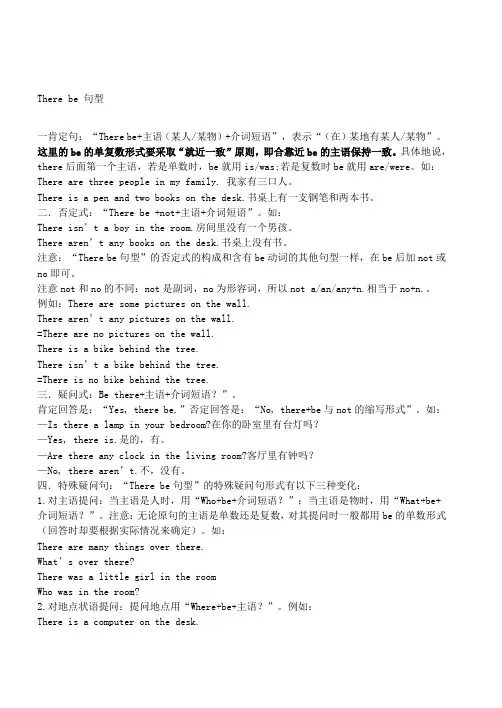
There be 句型一肯定句:“There be+主语(某人/某物)+介词短语”,表示“(在)某地有某人/某物”。
这里的be的单复数形式要采取“就近一致”原则,即合靠近be的主语保持一致。
具体地说,there后面第一个主语,若是单数时,be就用is/was;若是复数时be就用are/were。
如:There are three people in my family. 我家有三口人。
There is a pen and two books on the desk.书桌上有一支钢笔和两本书。
二.否定式:“There be +not+主语+介词短语”。
如:There isn’t a boy in the room.房间里没有一个男孩。
There aren’t any books on the desk.书桌上没有书。
注意:“There be句型”的否定式的构成和含有be动词的其他句型一样,在be后加not或no即可。
注意not和no的不同:not是副词,no为形容词,所以not a/an/any+n.相当于no+n.。
例如:There are some pictures on the wall.There aren’t any pictures on the wall.=There are no pictures on the wall.There is a bike behind the tree.There isn’t a bike behind the tree.=There is no bike behind the tree.三.疑问式:Be there+主语+介词短语?”。
肯定回答是:“Yes, there be.”否定回答是:“No, there+be与not的缩写形式”。
如:—Is there a lamp in your bedroom?在你的卧室里有台灯吗?—Yes, there is.是的,有。