There be句型
- 格式:docx
- 大小:16.91 KB
- 文档页数:4
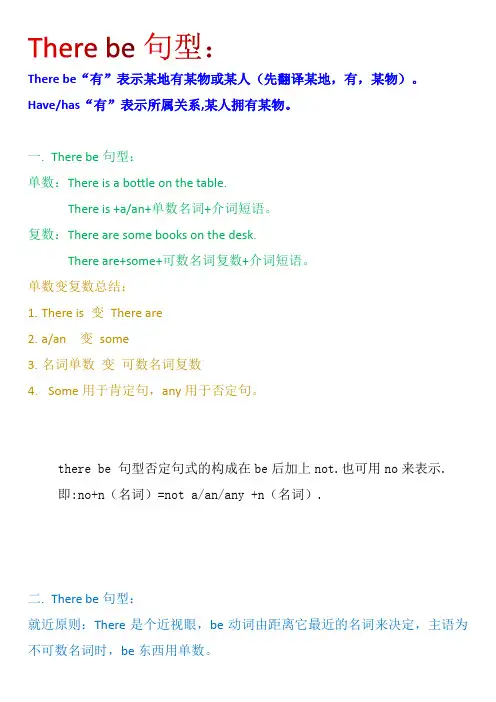
1.There be句型表示“在某地有某物(或人)”。
2.在There be句型中,主语是单数,be动词用is;主语是复数,be动词用are; 如有几件物品,be动词根据最靠近be动词的那个名词决定。
简称:就近原则
例如
(1)There is a pen on the desk.书桌上有一支钢笔。
(2)There are two books on the desk.书桌上有两本书。
(3)There is a pen and two books on the desk.书桌上有一支钢笔和两本书。
(4)There are two books and a pen on the desk.书桌上有两本书和一支钢笔。
3.there be句型要变成否定句时,在be动词后加not; 一般疑问句则把be动词调到句首。
例如
(1)否定句There is not a box on the table. 饭桌上没有一个盒子。
疑问句Is there a car in the room? 房间里有一只猫吗?
(2)否定句There are not any oranges in the box. 盒子里没有任何橘子。
疑问句Are there any organs in the box? 盒子里有一些橘子吗?
4.some和any在there be句型中的运:some用于肯定句any用于否定句或疑问句。
例如
(1 ) There are some rulers in thepencil-box. (肯定句)
(2) There are not any rulers in thepencil-box. (否定句)
(3) Are there any rulers in the pencil-box?(疑问句)
5.and和or在there be句型中的运用:and用于肯定句,or用于否定句或疑问句。
例如
(1) There is a boy and a girl in the room. (肯定句)
(2) There aren't any books or pencils on the desk. (否定句)
(3) Are there any chairs g stools in the house? (疑问句)
6.针对数量提问的特殊疑问句的基本结构是How many+名词复数+are there+ 介
词短语?
例如:
How many books are there in your bag?
二、There be(有)与have/has(有)的区别
1. there be表示在某地有(存在)某物(或人)have (has)表示某人拥有某物。
例如:
(1)There is a dog in the box. 箱子里有条狗。
(某地有某物)
(2)I have a pencil,我有一支铅笔。
(某人拥有某物)
2. 在there be句型中,主语是单数,be动词用is;主语是复数,be动词用are;如有多件物品,be动词根据最靠近be动词的那个名词决定(如上面的例子)。
在句子中含有have/has(有)的句型中,究竟是选用have还是has、则由作为主语的人称词来决定。
例如:
(1) I have dog and a cat,我有一条狗和一只猫。
(2) She has two rabbits,她有两只兔子。
一. 根据所给汉语完成句子。
1. 桌子上有一本书和两支钢笔。
There _______ a book and two pens on the desk.
2. 钱包里有些钱。
There _______ some money in the picture.
3. 在吉姆的书包里有一些卡片。
_______ _______ some cards in Jim’s bag.
4. 里面还有其他的东西吗?
_______ _______ anything else in it?
5. 我们学校有许多教室。
There _______ many _______ in our school.
6. 树上没有鸟。
There _____ ______ birds in the tree.
7. 树上有很多苹果。
______ ______ _______apples ______the tree.
二. 选择填空:
1. Are there any maps on the wall? _______
A. There are some.
B. Yes, there is.
C. Yes, there is one.
D. No,there are.
2. How many_______ are there in the picture?
A. woman
B. women
C. boy
D. milk
3. There aren’t _______ trees near the house. There is only one.
A. any
B. some
C. many
D. much
4. There _______ two bowls of rice on the table.
A. is
B. have
C. has
D. are
5. Are there _______ houses near the river?
Yes, there are_______ .
A. some, some
B. any, some
C. any, any
D. some, any
三.句型转换:
1. There is a woman near the house.(变复数)
__________________________
2. There are some buses near the hill.(变单数)
__________________________
3. There are some apples in the tree(变一般问句)
__________________________
4. There are some oranges in the glass.(变否定句)
__________________________
5. Is there a baby in the room?(变复数)
__________________________
四.there be与have区别专练。
1. This desk _____ four legs.
2. ______ some books on the desk.
3. Everyone ______ a dictionary in my class.
4. _______ no knives in the room.
5. I _____ a new sweater.
6. ______ some flowers and a desk in the room.
五.根据短文的首字母填空
A:
There is a big clothing s______nea r myhome. The n______ of the shop is “lucky sky”. It sells all k______of clothes .The clothes are very b______ .I often
b______clothes from the shop. The people are very f______ to me .I know one of them. Her name is Rose. We are good f_______now.We often play together in our s_______ time.
B:
Mr Green is from London o_____England. He t_______Englishin a middle school in China. The school is very big. T______ are aboutfifty-five classes in his class. Mr Green w_______ five days a week. He d______work on Saturdays or Sundays. He goes to Chinese classes e_______Saturday evening. Now he can s_______Chinese well . He likes l_______in China. He s_______ the Chinese people are very
f_______.He l______ eating Chinese food very much.。